
Qatar LNG expansion: readiness, financing and the production test
The expansion has several clocks
A large liquefied natural gas project moves through several timetables at once. Construction must produce a functioning facility. Commissioning must demonstrate that the connected systems can operate safely and reliably. Commercial production must then support deliveries that customers can receive. Finance follows another timetable, with expenditure often occurring before revenue arrives. The North Field East discussion in Qatar is most informative when those clocks are kept separate instead of being compressed into one start date.
Euronews reported on 9 October that Reuters sources expected November startup readiness and first-quarter 2027 LNG production. It contrasted this with chief executive Saad Sherida Al-Kaabi's earlier first-half 2027 guidance. QatarEnergy had not answered its request for comment.
The reported dates concern different milestones and have different evidential status. An expectation attributed to people familiar with plans is useful information, but it is not an official announcement that commercial output has begun. The analytical task is to understand what must connect readiness with dependable delivery. It is not to select the earliest date and present it as an accomplished operational fact.
Readiness is different from sustained operation
A readiness milestone indicates that a project is approaching a stage where startup activities can proceed. It does not necessarily mean every element required for continuous commercial service has been demonstrated. A complex plant combines equipment, control systems, utilities, trained personnel and supporting infrastructure. Testing their interaction matters as much as the completion of individual pieces. A commissioning programme is therefore a process rather than an announcement that instantly converts construction into normal operations.
This distinction helps explain why several dates can appear in responsible reporting without being directly contradictory. The first introduction of feedstock, first product, first cargo and sustained production describe different points in an operational sequence. The specific meaning depends on the project's own definitions and disclosure. An analyst should identify the named milestone before using it in an estimate of supply or cash flow.
For a buyer, reliable deliveries matter more than a ceremonial first. The commercial question is whether contracted quantities can arrive within agreed windows and meet the required specification. For the producer, reliability affects revenue, operating costs and customer confidence. Both interests require evidence from the operating sequence, not merely the existence of a planned start month.
Design capacity is a different kind of number
The 9 February 2021 contract announcement by Technip Energies described an award to its joint venture with Chiyoda for North Field East's onshore facilities. It covered four LNG trains, each designed for 8 million tonnes annually, plus associated utilities. That is project design capacity.
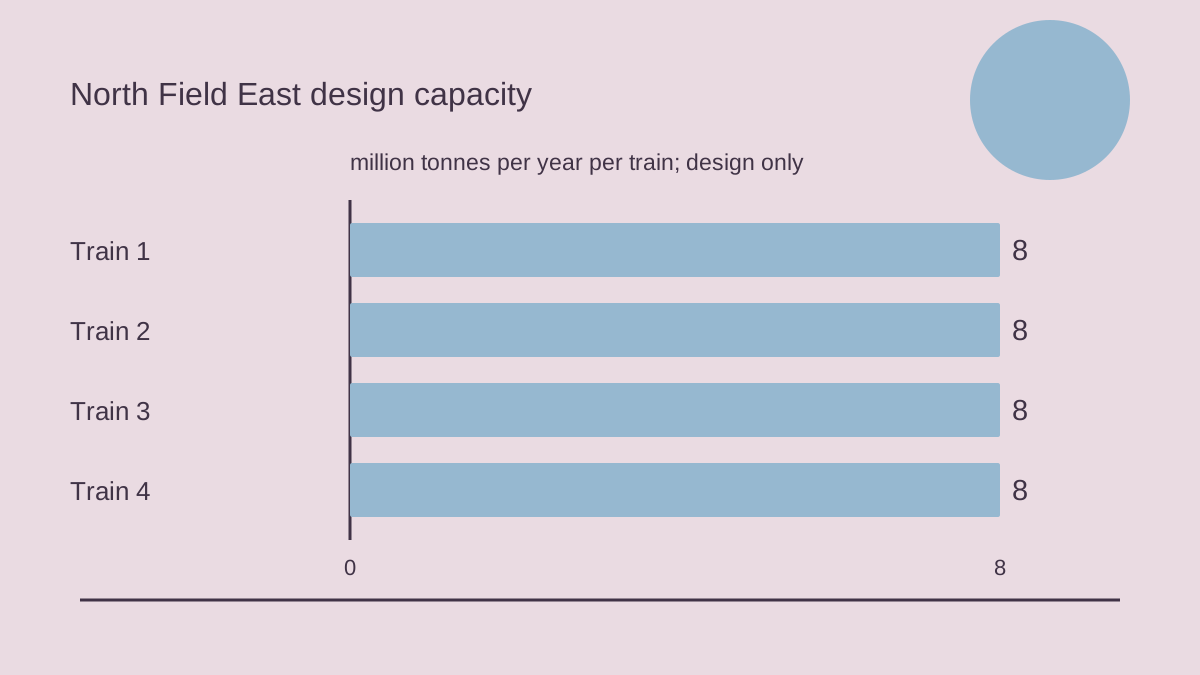
Adding the four identical train ratings gives 32 million tonnes a year of design capacity. This is arithmetic from the contractor's disclosed configuration, not a prediction of output in the first year of operation. The diagram accompanying this article illustrates that composition. It should not be read as evidence that every train is already producing at its rating or that all capacity becomes available at the same time.
Annual capacity also differs from a single cargo or a monthly production figure. A plant may run below its rating during an early operating period, scheduled maintenance or an external disruption. Those possibilities are reasons to distinguish capacity from output, not claims about an unreported utilisation rate. A supply assessment needs actual production and delivery data with an identified period.
Separate project phases before adding them
TotalEnergies' 24 September 2022 partnership announcement identified North Field East as a 32-million-tonne annual project and North Field South as a separate 16-million-tonne project. It reported participating interests of 6.25% in East and 9.375% in South, with QatarEnergy holding 75% of South.
These historical project descriptions clarify structure. They do not establish the current operating status of either phase. A large development programme can contain facilities with different schedules, owners and commercial arrangements. Combining planned capacity across phases may describe the overall ambition, but it can conceal when particular output becomes available and which party has rights to it.
Ownership percentages are also different from the facility's total production. An interest can determine an investor's participation in a project without implying ownership of the same share of every national export. The relevant commercial documents govern entitlements and obligations. A reader should avoid turning a project interest into a claim about the entire country's supply or treating a historical expansion target as current production.
The reported loan addresses liquidity
The same article relayed Bloomberg's account of a $3 billion, five-year working-capital loan, priced 50 basis points above SOFR. Named lenders from China were Bank of China, ICBC, Agricultural Bank of China and China Construction Bank (Asia). These are reported terms, not company-confirmed financing.
Working capital concerns the timing of receipts and payments in the course of business. A facility may help bridge cash needs while operations, deliveries or customer payments follow their own schedules. Its existence would not establish the total construction cost of a project or prove that the borrowed funds are earmarked for a particular train. The reported purpose should remain attached to the reported amount.
That distinction avoids an attractive but unsupported narrative in which a new loan automatically completes an expansion. Funding and engineering interact, but they solve different problems. A borrower can have sufficient liquidity and still face an operational delay. A project can achieve a technical milestone and still require cash to manage routine obligations. Assessing one does not eliminate the need to assess the other.
Understand the reference rate before the spread
The Federal Reserve Bank of New York describes SOFR as a measure of overnight cash-borrowing costs collateralised by Treasury securities in the United States. It is a reference rate; the reported loan spread is an additional component of pricing.
Fifty basis points equal half a percentage point. They are not a complete annual borrowing rate. The all-in cost of a floating-rate facility depends on the applicable reference-rate convention, the spread, fees and other contractual terms. A headline stating only the spread therefore cannot support a precise calculation of the borrower's total financing cost. The underlying contract would be needed for that calculation.
A floating benchmark also introduces sensitivity to future rate movements. If the relevant benchmark changes, borrowing costs may change under the agreed terms. This is a general explanation of the instrument, not a claim about hedging arrangements or a forecast of interest rates. Reporting should avoid inventing protections, covenants or repayment structures that the available account has not disclosed.
Funding diversification does not remove operating risk
A group of lenders can provide a borrower with access to a broader financing relationship. That relationship may have strategic value over time, but the identity of lenders does not prove that they control production decisions or receive particular cargo rights. Such conclusions would require evidence of the relevant agreements. A financing announcement should not be converted into a detailed geopolitical arrangement through inference alone.
Diversification is most meaningful when examined across actual dependencies. A company can have several banks but remain dependent on one shipping route. It can have several buyers but rely on a narrow equipment supply chain. A broader lending base addresses one form of concentration while leaving others intact. The useful analysis identifies which dependency has changed and which remains a concern.
The same principle applies to liquidity reserves. Additional cash flexibility can help absorb a delay, but it does not make the physical system immune to that delay. A resilient operating plan connects financial resources with practical contingencies, such as the ability to adjust schedules, maintain equipment and communicate with customers. Public reporting should distinguish that possibility from proof that specific contingencies are in place.
Shipping is part of the production chain
The commercial chain does not end at a liquefaction plant. Product must be stored, loaded, transported and received. A disruption anywhere in that sequence can change the relationship between a plant's capability and delivered supply. This is why a national capacity figure is insufficient on its own for judging what international buyers can obtain in a particular month.
A vessel's availability and a navigable route are separate requirements. A ship waiting nearby may indicate readiness to load, a scheduling delay or other operational circumstances. Its location alone does not establish a future departure date or a confirmed delivery. A useful assessment would connect loading windows, port availability, route conditions and receiving-terminal requirements rather than infer normal operations from one visible element.
Transport conditions can also affect equipment deliveries to a project that is still being completed. The resulting effect on expansion differs from the effect on shipments of finished LNG. Both may involve the same geography, but they occur at different points in the chain. Keeping them separate helps explain how an external disruption can influence present exports and future capacity through different mechanisms.
Recovery and expansion are separate contributions
Restoring interrupted facilities and bringing a new facility into service both support supply, but they should not be counted as the same change. Recovery reinstates capability that previously existed. Expansion adds capability that did not previously operate. A combined headline may describe improving prospects while obscuring which part of the improvement is restoration and which part is additional production.
For planning, the distinction affects the reference scenario. A buyer comparing future supply with an uninterrupted historical period asks a different question from a buyer comparing it with a disrupted recent month. A percentage increase from a depressed period may look large without surpassing earlier normal supply. Absolute delivered quantities and clear dates help prevent that confusion.
The evidence available for each contribution may also differ. Repair schedules, commissioning milestones and shipment data answer different questions. A responsible forecast should make those inputs visible and state which assumptions connect them. Without that discipline, the same expected recovery can be counted once as restored output and again as apparent growth attributed to the expansion programme.
Customers need a delivery profile
A purchaser's needs usually concern timing as well as total quantity. Energy demand can vary during the year, while storage and receiving infrastructure impose practical constraints. An annual capacity addition therefore becomes commercially meaningful through a delivery profile. The profile connects production to cargo dates, destination options and the customer's ability to receive and use the fuel.
Contractual flexibility can affect how disruptions are managed, but the actual provisions matter. A public report of production plans does not disclose every buyer's nomination rights, alternatives or remedies. An analytical article should explain the importance of those issues without inventing contract terms. The question is what evidence a buyer would need to assess its own exposure.
A robust purchasing review can separate confirmed deliveries, conditional expectations and contingency options. That categorisation supports clearer communication within the business. A budget based on an expected cargo should not silently become a production commitment based on a guaranteed cargo. Preserving uncertainty at each step makes it easier to revise a plan when better information arrives.
More LNG is not automatically lower-cost energy
Additional supply can influence market conditions, but the delivered cost to a customer includes more than production volume. Shipping, handling, contractual pricing and receiving arrangements matter. An expansion announcement cannot establish what a particular consumer will pay. The timing of availability also matters: supply that arrives after a period of strong demand may have a different effect from supply available during it.
The environmental assessment likewise requires more than a larger plant or a supplier's description of a low-emissions design. Emissions can arise at different points in the chain, and a comparison depends on the system boundary and the alternative being considered. This article does not claim a measured environmental result for the new operation. Such a result would require evidence from the relevant production and transport activities.
The practical implication is to preserve the distinction between a project characteristic and a customer outcome. Capacity, financing and technical design are important inputs. Reliable, affordable and measurable performance is established through operation. An account that labels those stages clearly is more useful than one that attaches every hoped-for benefit to a single planned milestone.
A monitoring file for the next stage
The following questions provide a practical framework for following the project. They identify missing evidence rather than assert that particular contractual conditions already exist:
- Which milestone does each announced date describe: readiness, first product, first cargo or sustained operation?
- What output and delivered quantities are reported, over what period and for which project phase?
- Which financing terms are officially confirmed, and which remain attributed media reporting?
- How do shipping and equipment-delivery conditions affect separate parts of the operating sequence?
- What assumptions connect the expansion timetable to a buyer's actual delivery plan?
A dated record of answers allows new information to improve the analysis without rewriting the status of earlier claims. When a milestone is completed, the record should identify the evidence and the remaining steps. When a plan changes, the record should preserve the previous assumption and explain the revision. This makes a complex development easier to follow without pretending that uncertainty has disappeared.
The commercial test is dependable delivery
North Field East's disclosed design provides substantial context for the reported timetable. The reported working-capital facility adds a separate financing dimension. Neither should be interpreted as proof that the full expansion is operating or that the commercial chain has become immune to disruption. The important connection is how engineering progress, financial flexibility and transport conditions combine to support deliveries.
As of 9 October, the most useful conclusion is therefore conditional. The programme offers a path towards additional supply, while its realised contribution depends on identifiable operational milestones. Future reporting should show those milestones and their relationship to production and exports. The ultimate test is not the earliest headline date or the size of a reported loan, but whether customers receive dependable output on terms they can plan around.
Documents consulted: the dated Euronews report, the contractor's North Field East announcement, and the New York Fed's SOFR explanation.
Latest Reports
Qatar LNG expansion: readiness, financing and the production test
Tianwan 7: first electricity and commissioning

RZD changes return fees for tickets purchased from December

Genentech breaks ground on its Hillsboro expansion

Why available capital does not close every defence supply gap

Leave a comment