
Why available capital does not close every defence supply gap

A supplier can have a sound product, a capable engineering team and a list of interested customers, yet still struggle to finance the capacity those customers want. That is the business problem behind a new discussion of private investment in the defence supply chain. Money being available somewhere in the financial system does not establish that a particular factory project has a dependable customer, an acceptable repayment timetable or a workable route from a prototype to recurring production. These are separate questions, and each can become decisive before a new machine is ordered.
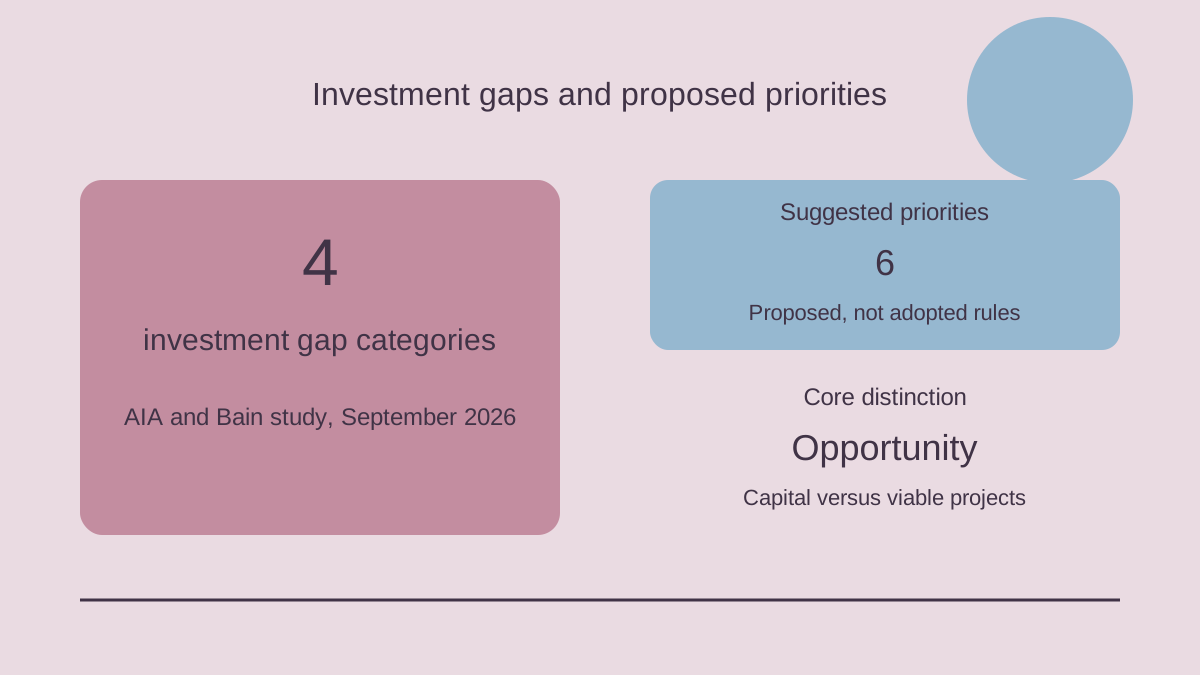
Manufacturing Dive reported on 30 September 2026 on a study by the Aerospace Industries Association, or AIA, and Bain & Company concerning private investment in the defence sector of the United States. The study identifies four investment gaps and six priorities for improving the conditions under which investment can proceed. Its central distinction is between a general shortage of capital and a shortage of opportunities whose expected returns justify their risks. The discussion below uses that distinction to examine industrial project decisions; it does not describe completed funding awards or provide instructions for producing military equipment.
Four gaps describe different business problems
The report groups the most critical gaps into production of essential inputs, the transition from prototypes to production, expansion and resilience among lower-tier manufacturers, and research, development and capital investment at large companies. These categories should not be treated as four identical requests for a larger financing budget. A materials supplier, an emerging technology business and an established manufacturer can need different evidence before committing resources. They may also face different customers, acceptance processes and opportunities to recover their expenditure over time.
For an input producer, the central problem may be whether an expansion will have enough sustained orders. For a prototype business, it may be whether technical acceptance will become a production contract. A lower-tier manufacturer may need a reliable forecast from customers further up the supply chain. A large company's development programme may have to compete with other uses of capital inside the same organisation. The four categories identify locations of difficulty; they do not by themselves establish the amount of funding needed at any particular company.
Demand needs a shape that a project can use
Broad statements about strong demand can explain why a sector attracts attention, but they do not specify the schedule a factory must meet. An industrial investment needs a description of what is expected, when it is expected and which commitments support that expectation. A supplier considering a capacity expansion can distinguish enquiries, forecasts, framework arrangements and actual orders. All can be commercially useful, but they offer different levels of support for an investment decision. Treating every expression of interest as a firm purchase would remove an important distinction.
The useful question is therefore not merely whether demand exists. It is whether the available demand information corresponds to the assets being proposed. A machine designed for a narrow family of components may require more stable demand than flexible equipment that can serve several product groups. A facility with a long installation period may need a different planning horizon from an expansion using existing floor space. These are general project considerations, rather than claims about the contracts of the companies mentioned in the study.
A prototype is a beginning rather than a production system
A working prototype can demonstrate an engineering concept without demonstrating that it can be manufactured repeatedly, inspected consistently and delivered to a customer on schedule. Moving to production brings another set of costs and decisions: tooling, documentation, training, purchasing arrangements and the organisation of inspection. Some of these activities begin before dependable sales revenue appears. The transition gap identified in the report concerns this difference between showing that an idea can work and building a business capable of supplying it regularly.
That gap also explains why a financing plan should identify what each stage is meant to establish. A prototype milestone may concern performance, while a later industrial milestone may concern repeatability or the ability to deliver an accepted batch. Combining them into one broad label such as “development complete” can obscure the remaining work. A clearer account names the outstanding uncertainty, the activity intended to resolve it and the decision that follows. This does not guarantee commercial success, but it makes the project easier to assess.
Lower tiers need visibility beyond their immediate order book
A manufacturer supplying a larger contractor does not necessarily receive the same information as the organisation dealing directly with the final customer. Orders can move through several commercial relationships before reaching the company that must purchase equipment or recruit employees. The lower-tier supplier still carries its own costs, even when the wider programme attracts considerable public attention. Its ability to expand depends partly on how the broader requirement becomes a usable schedule at its own level.
Resilience can also mean different things to different participants. A customer may want an alternative source, while a supplier needs a reason to maintain spare capability. Keeping equipment available, qualifying an additional material source or holding a trained team all require resources. A discussion of resilience becomes more concrete when it identifies which capability is being maintained and which commercial arrangement supports it. Otherwise, the same word can cover a customer's preference and a supplier's unfunded obligation without distinguishing between them.
Risk and reward need to be considered together
The study argues that traditional contracting structures can limit margins and expected returns while projects still face material risks. This is the report's assessment of investment conditions, rather than a finding about every contract in the sector. The commercial point is that the return available from an investment cannot be evaluated separately from the uncertainty attached to it. A project with demanding obligations and limited room to recover unexpected costs presents a different proposition from one with clearer responsibilities and a more dependable revenue path.
For a practical project review, risk can be described in categories instead of one undifferentiated rating. Demand uncertainty, installation uncertainty, qualification requirements and the possibility of changes in customer needs are different issues. Their remedies also differ. More borrowing cannot necessarily resolve a missing purchase commitment, and a longer order book cannot alone solve an unresolved technical requirement. Matching the proposed response to the actual uncertainty makes the investment discussion more useful than treating capital as a universal cure.
Six priorities address the conditions around capital
The report's priorities include backing clear requirements with funding, aligning incentives with risk and reward, reducing purchasing friction, expanding market opportunities through international and dual-use business, developing flexible sources of capital, and improving suppliers' operational performance. These are recommendations, not a list of measures already implemented. They concern the environment in which projects are considered as well as the projects themselves. Their effect would depend on how customers, suppliers and investors translate them into actual arrangements.
- Clarify which requirements have dependable financial support.
- Identify how each participant carries uncertainty and receives a return.
- Reduce avoidable delays in buying and selling processes.
- Assess additional markets without assuming every product transfers easily.
- Match financing arrangements to the project's timetable.
- Improve delivery, quality and manufacturing readiness.
The list offers a useful way to separate policy ambitions from company-level actions. A supplier cannot unilaterally change every procurement rule, but it can improve the clarity of its proposal and the evidence supporting its production plan. A customer cannot remove all investment risk, but it can explain requirements and decision processes more clearly. A financier can ask whether the proposed structure fits the period before revenue appears. Each contribution addresses a different part of the same investment environment.
Purchasing friction has a cost even without a quoted price
Long or unclear commercial processes can consume staff time and postpone a decision about capacity. A supplier may have to keep a proposal open while the expected start date changes. The resulting uncertainty can influence hiring, equipment reservations and other customer commitments. It is therefore useful to distinguish necessary verification from avoidable ambiguity. The report's call to reduce buying and selling friction should be understood in that context, rather than as a general instruction to bypass acceptance, quality or contractual responsibilities.
A well-defined process states who decides, what information is required and how changes will be communicated. It also distinguishes an early discussion from an authorised commitment. These basic features can help a company allocate its own resources without guessing at the status of a customer request. They do not require inventing a universal procurement timetable. Different products and organisations may have different requirements, while still benefiting from a clear account of the steps that remain before an order can proceed.
Additional markets require a separate commercial test
The report includes international sales and dual-use products among the ways to expand market volumes. Wider potential demand can improve the prospects of some investments, but a possible additional market is not automatically accessible revenue. A company must consider whether its product, documentation, production arrangements and commercial permissions suit that market. Where relevant, applicable export and other requirements remain part of the decision. The study's recommendation should therefore be read as an opportunity to evaluate additional demand, rather than proof that it can be captured.
Dual-use activity also raises an ordinary industrial question: how much of the planned capacity can genuinely serve more than one customer group? Shared machinery may be useful, while other operations or acceptance processes remain specific. A financing proposal becomes clearer when it identifies what is transferable and what is dedicated. That distinction avoids counting the same capacity twice in separate business cases. It also helps explain how a company would schedule work if several customer groups wanted delivery at the same time.
The financing timetable must fit the production timetable
Money can arrive at a different pace from the expenditure it is intended to support. A project might need payments for equipment before installation, followed by spending on training and preparation before regular deliveries begin. A financing structure that ignores this sequence can create pressure even when the long-term commercial proposition appears plausible. The report's discussion of flexible sources of capital points toward matching arrangements to the characteristics of defence-sector projects, rather than assuming that one standard product serves every stage.
Project records should therefore describe the period between an initial commitment and recurring operations. That description can identify planned expenditure, the evidence required for subsequent stages and the expected source of operating receipts. It should also show which dates are agreed and which remain estimates. This is a general way of organising information, not a claim that a particular financing structure is preferable for all businesses. The appropriate arrangement depends on the actual obligations, uncertainties and participants in the project.
Manufacturability connects engineering with customer confidence
The study recommends attention to manufacturability and to operational performance, including schedules, quality and cost. Those factors matter because a customer buys dependable supply, not only an attractive technical concept. A company can demonstrate readiness by showing that responsibilities, records and acceptance arrangements are sufficiently developed for the proposed stage. That does not mean every early business must already operate at full scale. It means the evidence should match what the company is asking customers and financiers to believe.
Operational improvements can also be evaluated independently from capacity expansion. Buying more equipment may be justified, but it is useful to know whether existing constraints concern machinery, scheduling, supplier reliability or the handling of rejected work. Otherwise, an investment can add assets without addressing the reason delivery is difficult. Separating these questions makes it possible to describe what the new capacity is intended to change and what other work must accompany it before the company can deliver a reliable result.
Investment interest becomes meaningful through specific commitments
A sector can attract strong interest while individual projects remain undecided. The AIA and Bain study draws attention to that difference and to the conditions needed to move beyond it. For readers assessing an industrial announcement, the most useful evidence is often the connection between a stated requirement, a defined production capability and a credible sequence of commitments. A large headline about capital available in the market cannot substitute for that connection at a supplier.
The report does not provide a single company-level financing solution. Instead, it identifies places where demand, contracting, operational readiness and the allocation of risk can keep investment from proceeding. Understanding those relationships allows the four gaps and six priorities to be read as a framework for examining business decisions. The result is a more precise discussion of industrial capacity: what a project would supply, what remains uncertain, who must act next and which evidence would demonstrate progress from interest toward sustained production.
Future announcements about implementing the recommendations should retain that precision. A financing programme, a signed agreement, an equipment purchase and recurring deliveries represent different changes. They may follow one another, but they are not interchangeable evidence. A statement of broad ambition leaves the actual project stage open. A disclosed sequence of decisions makes it easier to compare later announcements and understand which part of the initial investment gap has received a practical response and which part remains under discussion.
Latest Reports

Ancient Fortresses and Museums of Western Uzbekistan

Qatar LNG expansion: readiness, financing and the production test

Tianwan 7: first electricity and commissioning

Genentech breaks ground on its Hillsboro expansion

RZD changes return fees for tickets purchased from December
Why available capital does not close every defence supply gap
Partner reports
 Ageas agrees Esure acquisition to widen UK insurance distribution
 Uzbekistan’s Western Rail Corridor and the Journey to Khiva
 Imam al-Bukhari’s Heritage and Samarkand’s Pilgrimage Landscape
 Nilu and Sangardak: Village Tourism in Surkhandarya
 One Day in Kasri Orifon: Bukhara’s Pilgrimage Village
 Bukhara’s Biennale: Contemporary Art in Historic Spaces
 Khiva’s Walled City: Architecture, Palaces and Living Traditions
 Parkent’s Chashma Village: Folk Traditions Near Tashkent
 Uzbek Food and Cultural Traditions: From London’s Festival to Regional Tables
 Tashkent’s Museums, Mahallas and New Cultural Spaces
 Uzbekistan's Tourism Expansion: Heritage Cities, Living Crafts and Regional Routes
 Ancient Fortresses and Museums of Western Uzbekistan
 LH Marthinusen opens R32 million Germiston fan factory
 Rishtan’s Craft Neighbourhood and the Fergana Valley
Leave a comment