
Tatneft Starts Serial Tyre Production at Its New Plant in Saran, Kazakhstan
Russian oil group Tatneft has moved its new tyre plant in Saran, in the Karaganda region of Kazakhstan, into full serial production: tyres carrying the Attar brand now roll off the line on a regular schedule, the head of the company's tyre division, Andrei Pantyukhov, said at a press conference on August 12, 2024.
The Saran site belongs to KamaTyresKZ, a joint venture between Tatneft and the Kazakh automotive group Allur. The plant first went into production in December 2022, and investment in its construction reached roughly $400 million, according to earlier statements carried via the press service of Rustam Minnikhanov, the head of Tatarstan who chairs Tatneft's board of directors.
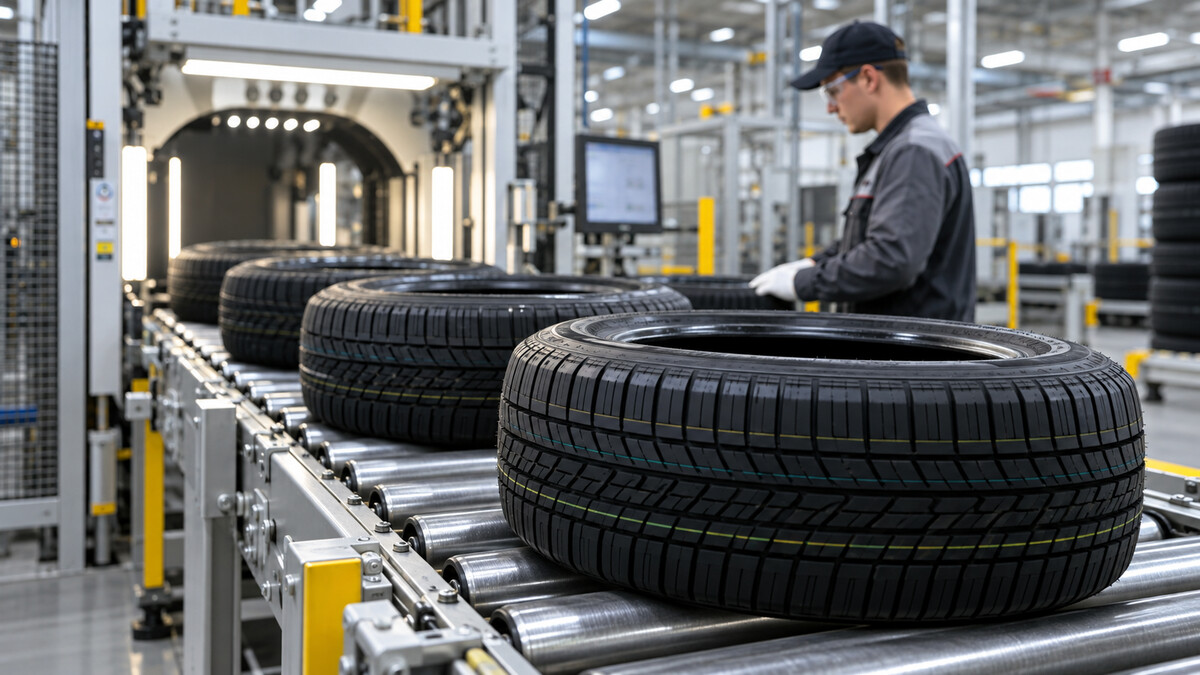
From the first batch to the retail shelf
Pantyukhov described the production ramp-up as a sequence of short, deliberate steps. Serial output of summer tyres for passenger cars began in June 2024; by the middle of July the first batches of Attar tyres had been dispatched to dealer centres in Kazakhstan and to tyre centres in Russia. The tyres are already showing up in retail networks in both countries, he noted.
- June 2024 — serial production of summer passenger-car tyres starts at the Saran plant;
- mid-July 2024 — first Attar shipments reach dealer centres in Kazakhstan and tyre centres in Russia;
- during 2024 — the plant plans to start serial production of all-steel cord tyres for trucks.
Capacity, range and the next product line
The design capacity of the enterprise is 3.5 million tyres a year. The split between product groups is straightforward:
- 3 million tyres a year for passenger cars;
- 500,000 tyres a year for truck and commercial equipment.
The current portfolio covers winter and summer tyres for passenger cars, SUVs, minivans and light trucks in rim diameters from 14 to 18 inches. The planned addition of all-steel cord truck tyres within 2024 would extend the plant into the commercial segment, where replacement demand holds up more steadily across the economic cycle.

Why Saran matters for the regional economy
The project ties together two industrial agendas at once. For Tatarstan-based Tatneft, the Saran plant is a manufacturing foothold inside the Eurasian Economic Union beyond the Russian border, converting upstream resources into a finished consumer product sold under its own brand. For the Karaganda region, a territory historically tied to coal and machine building, the venture adds a greenfield employer with an installed capacity of 3.5 million units a year — a scale that anchors local suppliers and service businesses around the plant.
The ownership structure also matters: the venture pairs a Russian petrochemical group with Allur, one of Kazakhstan's largest automotive assemblers, so distribution competence on the Kazakh side was in place before the first tyre left the line. That is visible in the shipping pattern Pantyukhov described — dealer centres in Kazakhstan and tyre centres in Russia were served from the same July dispatch.
What to watch next
The immediate test is the truck line: all-steel cord tyres carry different certification, load and mileage requirements, and their launch will show whether the Saran site can hold two product families at once. The second test is retail depth — how quickly Attar moves from first shipments to a stable shelf presence in two national markets. The company's own account of the first half of 2024, as reported by Interfax, suggests the ramp-up is running on schedule; the full-year numbers will tell whether the $400 million build-out is being loaded to its design capacity.
Latest Reports
Ancient Fortresses and Museums of Western Uzbekistan

Qatar LNG expansion: readiness, financing and the production test

Tianwan 7: first electricity and commissioning

Genentech breaks ground on its Hillsboro expansion
RZD changes return fees for tickets purchased from December
Why available capital does not close every defence supply gap
Partner reports
 Ageas agrees Esure acquisition to widen UK insurance distribution
 Uzbekistan’s Western Rail Corridor and the Journey to Khiva
 Imam al-Bukhari’s Heritage and Samarkand’s Pilgrimage Landscape
 Nilu and Sangardak: Village Tourism in Surkhandarya
 One Day in Kasri Orifon: Bukhara’s Pilgrimage Village
 Bukhara’s Biennale: Contemporary Art in Historic Spaces
 Khiva’s Walled City: Architecture, Palaces and Living Traditions
 Parkent’s Chashma Village: Folk Traditions Near Tashkent
 Uzbek Food and Cultural Traditions: From London’s Festival to Regional Tables
 Tashkent’s Museums, Mahallas and New Cultural Spaces
 Uzbekistan's Tourism Expansion: Heritage Cities, Living Crafts and Regional Routes
 Ancient Fortresses and Museums of Western Uzbekistan
 LH Marthinusen opens R32 million Germiston fan factory
 Rishtan’s Craft Neighbourhood and the Fergana Valley
Leave a comment