
China's 53% Problem: How Russia's Heavy-Truck Market Halved in 2025 and Handed the Wheel Back to KAMAZ
The heavy-truck market in Russia has spent 2025 doing something few industrial segments ever survive unscathed: halving in a single year. According to data compiled by the analytics agency Avtostat for the business daily Kommersant, sales of new trucks with a gross vehicle weight above 16 tonnes fell 56% year on year over January–November, to 41,840 units. The contraction was so deep that it redrew the competitive map of the entire segment — and handed something back to domestic manufacturers that they had not seen since the early 2020s: a rising share, a strengthening position against Chinese rivals, and a policy tailwind that now runs squarely in their favour.
The most striking movement belongs to the brands from China. After a spectacular expansion that took them from single-digit presence in 2021 to roughly seven out of every ten new heavy trucks sold in 2024, Chinese manufacturers watched their share collapse by about 17 percentage points in eleven months — from 70% to 53%. Their absolute volumes fell even harder: deliveries of Chinese brands dropped 66.5%, to 22,320 trucks. Russian producers, by contrast, lost far less ground in absolute terms (a 21% decline, to 15,050 units) and lifted their share from 20% to 36%. Truck makers from Belarus — chiefly the Minsk-based MAZ school of heavy vehicles — improved their slice from 5% to 7%, even though their unit sales also contracted, by 37% to roughly 3,000 vehicles.
This is a story about more than one product category. Heavy trucks are the workhorses of construction, long-haul freight, mining haulage, municipal services and distribution — which makes the segment one of the most sensitive barometers of business-to-business demand anywhere in the economy. When fleets stop buying 16-tonne-plus trucks, it is usually because cargo volumes are soft, credit is expensive, or both. In 2025, the Russian market delivered a textbook case of the second factor compounding the first, on top of a third element that analysts had flagged for months: a record-level inventory overhang sitting in dealer yards and on the balance sheets of leasing companies.
A five-year swing: how the market's geography turned inside out
To appreciate how violent the 2025 reversal was, it helps to look at the full arc of the past five years. Avtostat's breakdown of the new heavy commercial vehicle (HCV) market by country of origin shows a segment that changed its centre of gravity twice in half a decade — first away from Europe and toward China, then, in 2025, partially back toward domestic production.
| Country of origin | 2021 | 2022 | 2023 | 2024 | 2025 |
|---|---|---|---|---|---|
| Russia | 48.4 | 48.1 | 23.5 | 20.8 | 36 |
| China | 9 | 35.1 | 66.3 | 68.8 | 53.3 |
| Belarus | 6.9 | 6.2 | 5 | 5.2 | 7.2 |
| Germany | 11.7 | 2.9 | 2.2 | 2.7 | 0.9 |
| Sweden | 16.7 | 4.4 | 1.3 | 1.4 | 1.2 |
| Japan | 1.4 | 0.7 | 0.1 | 0.2 | 0.8 |
| South Korea | 0.4 | 0.8 | 0.5 | 0.3 | 0.2 |
| Other countries | 5.5 | 1.8 | 1.0 | 0.6 | 0.4 |
Several observations fall straight out of this table. First, the European retreat was largely a 2022 event: Germany went from an 11.7% share to under 3% in one year, and Sweden — historically a powerhouse of premium tractor units — slid from 16.7% to 4.4% and has never recovered, sitting at 1.2% in 2025. Second, China filled that vacuum with astonishing speed: 9% in 2021, 35.1% in 2022, 66.3% in 2023, and a peak of 68.8% in 2024. Third, the 2025 correction is real but partial — even after losing 15 to 17 points of share, Chinese marques still deliver every second heavy truck sold in the country. And fourth, the Asian suppliers outside China remain niche: Japan ticked up slightly to 0.8%, while South Korea faded to 0.2%.
The "Other countries" line aggregates the remaining Western European and North American origins, whose combined presence has shrunk to a statistical residue of a few tenths of a percent. For fleet buyers, the practical consequence is that the choice set in the heavy segment is now effectively a three-way contest: Russian brands, Chinese brands, and Belarusian imports — with a thin layer of parallel-imported European premium trucks at the top of the price range.
Why Chinese brands lost ground: three brakes applied at once
The retreat of Chinese manufacturers was not a demand story alone; it was also a policy and a product-support story. Experts quoted in the Kommersant analysis identify several forces acting simultaneously.
The scrappage fee re-prices the import
The single most powerful lever is the so-called utilization fee — the scrappage surcharge that importers pay on every vehicle brought into the country, and which has been indexed upward on a scheduled basis. Maksim Kadakov, editor-in-chief of the motoring magazine Za Rulyom («За рулём»), notes that the fee hands Russian producers a structural price advantage over imports. Every rouble added to the surcharge lands disproportionately on trucks assembled abroad, while locally built vehicles collect a partial offset. In a market where buyers are already squeezed by high borrowing costs, the price gap that the scrappage fee opens up becomes decisive at the margin.
There is a twist, though. Kadakov argues that the domestic share could have climbed even higher if not for the export support machinery that Beijing runs for its vehicle industry: Chinese producers receive state subsidies for exporting their products, and their sales plans are strictly monitored. To report plan fulfilment, dealers and distributors sometimes push trucks into the Russian market at a loss — a practice confirmed by other sources in the industry. In other words, the 53% share that Chinese brands retained in 2025 was partly defended with subsidized, loss-leading pricing. That is a cushion with a finite depth, but it explains why the share erosion was measured in points rather than in halves.
Type-approval withdrawals take specific models off the market
The second brake is regulatory. Sergey Udalov, executive director of Avtostat, recalls that another reason for the falling share of new Chinese trucks was the withdrawal of OTTS — the vehicle type approval certificates — for a range of models, which in practice amounts to a sales ban. In July 2025, the restrictions hit cargo vehicles under the Sitrak, Dongfeng, Foton and FAW marques. Sitrak, notably the best-selling Chinese heavy truck line in the country, managed to have its approval restored in September — but the two-month gap landed in the middle of the selling season and forced fleets to substitute other brands or postpone orders. For corporate buyers, the episode underlined a risk that price alone cannot capture: a model line can be administratively paused, and with it spare-parts logistics, residual values and delivery schedules.
Service scepticism hardens into a purchasing criterion
The third factor is after-sales. One industry source told Kommersant that persistent problems with service networks — which in many regions are still not properly established — dampen demand for trucks from China. A heavy truck is not a consumer gadget; it is a revenue-generating asset whose economics depend on uptime, warranty turnaround and the availability of consumables within days rather than weeks. Another source pushes back, arguing that service quality affects sales less than price does. Both claims can be true at once: price decides the first purchase, but service experience decides the second. After two or three years of mass Chinese deliveries, fleets now have enough maintenance history to vote with their renewal decisions — and the market share numbers suggest some of them are voting against.
- Scrappage fee: a structural price handicap on imports that widens with every indexation, partly offset by Chinese export subsidies and loss-leading sales.
- OTTS withdrawals: July's certification freeze on Sitrak, Dongfeng, Foton and FAW models removed specific lines from showrooms; Sitrak recovered its approval only in September.
- Service gaps: incomplete maintenance networks raise the real cost of ownership even where the sticker price stays attractive.
- Credit conditions: high interest rates choke both outright purchases and leasing flows, hitting the most rate-sensitive buyers — small and mid-sized carriers — first.
The overhang: fifty thousand trucks already in the system
Beyond the flow of new orders, the 2025 crisis is a story about stock. The heavy-truck segment entered the year carrying the consequences of its own record results: demand had been pulled forward during the boom years of 2023–2024, when fleets raced to buy before each new indexation of the scrappage fee and before prices rose again. The result was a saturated market with high credit rates — a combination that guarantees a hangover.
On top of that sit the inventories. Vitaly Kiselyov, vice-president of the Russian Automobile Dealers association (ROAD), reminds that the market continues to be pressed down by heavy stocks of trucks held by dealers and leasing companies. Maksim Agadzhanov, managing director of the Alfa-Leasing group, had earlier estimated the combined overhang in the leasing market at around 50,000 vehicles. One source quoted by Kommersant makes the scale concrete: these reserves, in aggregate, are enough to cover the whole of the following year's demand without a single new factory order.
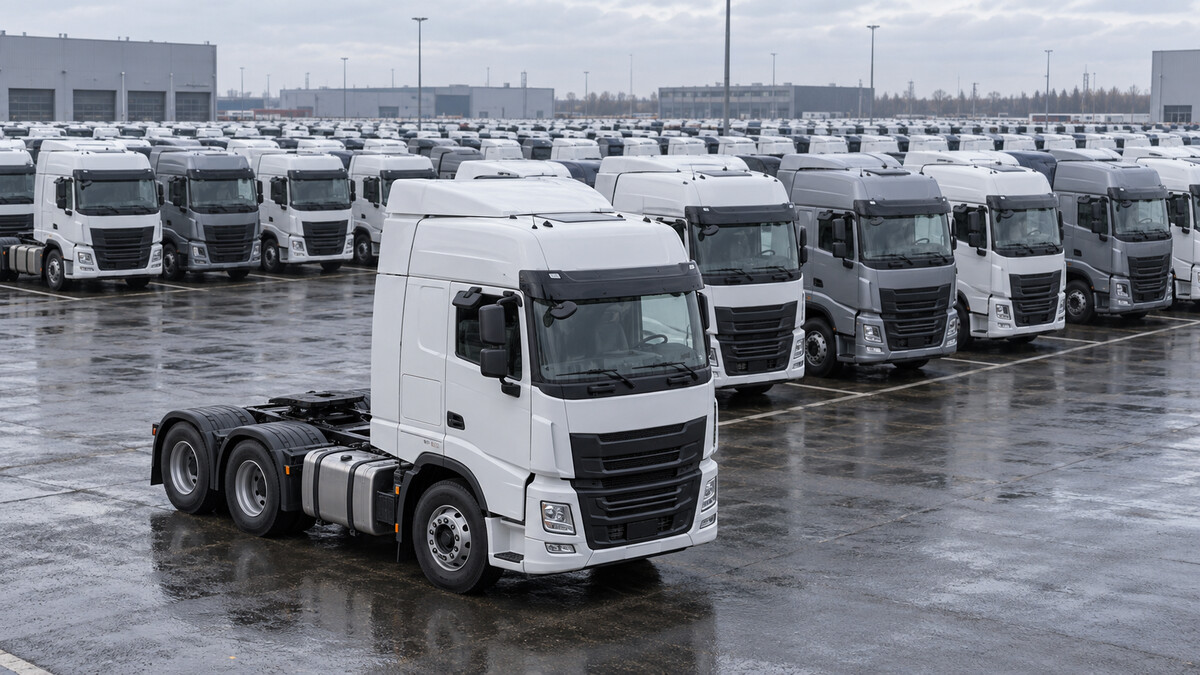
For anyone modelling the segment, the inventory point changes the arithmetic entirely. When channel stock equals a full year of demand, retail sales can stabilize long before wholesale shipments do. Manufacturers will feel the downturn after dealers do; conversely, a genuine recovery in factory orders will arrive only once the parked trucks are absorbed. This is why the consensus expectation is not a V-shaped rebound in 2026 but flat, depressed volumes — a market living off its own warehouses.
The brand league table: KAMAZ takes the wheel again
Within the shrunken market, the hierarchy also shifted. According to analytics presented by Maksim Shishko, general director of Global Truck Sales, at a ROAD press conference, the leader in new heavy trucks for January–November was KAMAZ with a 30.1% share — roughly every third truck sold. The Russian champion was followed by a pack of Chinese marques whose order tells its own story about which lines survived the certification turbulence:
- KAMAZ — 30.1% share; the domestic leader, positioned to extend its advantage through local assembly and the expanding K-5 premium family.
- Sitrak — 16.4%; still the strongest Chinese brand despite the July OTTS suspension, helped by the September restoration of its type approval.
- Shacman — 10.5%; a steady third place built on dump trucks and construction-sector demand.
- FAW — 9.2%; holding share even though its models were among those hit by the July certification freeze.
- Howo — 4.9%.
- Ural — 4.3%; the second Russian entry in the top tier, strong in off-road and industrial configurations.
- Dongfeng — 3.1%.
- Valdai — 1%; the newest name in the top list, representing the GAZ-group push into heavier classes.
Read together, the league table and the country-of-origin data describe a market that is consolidating around two poles. On one side, KAMAZ converts the scrappage-fee advantage, government procurement preferences and its own localization depth into a share it has not held since before 2022. On the other, the strongest Chinese brands — Sitrak, Shacman, FAW, Howo — still collectively outsell everyone, but they do so with a shrinking, increasingly contested customer base and an unresolved service footprint.

Localization as strategy: the 2021 playbook returns
The policy direction behind these numbers is explicit. Shishko expects the Chinese share to keep sliding — potentially to around 50% by the end of the year — and reminds that the authorities are running a deliberate campaign to encourage Chinese manufacturers to localize production inside Russia. His framing is historical: the market will move toward domestic brands, and the template already exists. In 2021, when locally badged trucks also accounted for about half the market, that share was achieved substantially through local production of foreign brands — vehicles rolling off Russian lines under domestic VIN numbers. "We need to come back to that model," Shishko argues.
That sentence is the key to the whole 2025 story. The share shift back toward "Russian" trucks is not simply a renaissance of home-grown engineering; it is a re-run of the assembly-localization model, in which the badge on the grille matters less than the VIN plate on the chassis. The scrappage fee is calibrated precisely to make that arithmetic work: assemble locally, collect the offset, price competitively; import completely built-up, pay the full surcharge, lose the marginal buyer.
Kadakov adds the product dimension: KAMAZ, in his assessment, will continue to grow its share not only through price positioning but through range expansion — above all the K-5 family of premium trucks, the Russian answer to the European flagships that left the market in 2022. If the K-5 line delivers on cabin comfort, fuel economy and drivetrain reliability, the domestic leader can move upmarket into the segment where Sitrak and Shacman currently compete on price alone. For fleet managers who previously specified German or Swedish tractor units, that is the only credible domestic substitute emerging — and its maturation timeline effectively sets the pace at which the market can de-Sinicize without a service-quality downgrade.
What the reset means for B2B fleets
For corporate buyers — carriers, construction groups, distributors, municipal contractors — the 2025 crash is not just a statistic; it changes procurement logic in concrete ways.
- Buyer's market, with a clock. With roughly 50,000 trucks of channel stock and demand at half its former level, dealers and lessors are motivated to discount. Fleets with healthy balance sheets can negotiate aggressively on price, free service packages and extended warranties — but the best inventory (specifications, model years) thins out precisely where it matters.
- Certification risk is now a line item. The July OTTS episode showed that a model line can be paused administratively. Purchase contracts should allocate that risk explicitly: delivery windows, substitution clauses and refund terms if a type approval is suspended before handover.
- Residual values are being repriced. A flood of nearly new repossessed and off-lease trucks will weigh on used prices for years. Leasing structures that assumed stable residuals need re-underwriting; outright buyers gain a cheap secondary market for expansion vehicles.
- Service coverage beats sticker price. The differentiator between Chinese marques in 2026 will not be horsepower or price lists — it will be whether parts and warranty work can be completed within days in the regions where a fleet actually operates.
- Localization pays twice. Domestically assembled trucks, including localized foreign designs, carry the scrappage-fee advantage at purchase and typically deeper local parts supply later. Over a five-year holding period, that combination can outweigh an initially cheaper import.
Bottom line: a smaller market with a new centre of gravity
The 2025 numbers describe a segment that has passed through a full cycle in record time: from a European-dominated market in 2021, through a Chinese landslide in 2023–2024, to a corrected, three-pole structure in 2025 in which Russia-based production holds 36%, Chinese brands 53% and Belarusian imports 7% of new heavy trucks. The correction was driven less by the intrinsic quality of the products than by the interaction of fiscal policy, certification enforcement, credit conditions and an enormous inventory overhang built during the boom.
What comes next is, in a sense, already parked in dealer yards: a slow year of stock absorption, continued pressure on Chinese shares if localization incentives keep tightening, and a domestic leader — KAMAZ — converting policy advantage into product momentum with the K-5 range. For suppliers, the signal is equally clear. The Russian heavy-truck market has stopped being an export opportunity for fully built-up vehicles and is becoming, once again, a localization opportunity for components, assemblies and service infrastructure. The companies that read the 2025 collapse as a demand story alone will wait for a recovery that may not come in the form they expect; those that read it as an industrial-policy story will position for the assembly model that Shishko describes — the 2021 playbook, reborn at half the market size and twice the strategic weight.
The factual basis of this analysis is the Kommersant report by Natalia Miroshnichenko, «Китайский груз ответственности», published December 8, 2025, drawing on Avtostat data, ROAD press-conference analytics by Global Truck Sales, and industry sources.
Latest Reports

Ancient Fortresses and Museums of Western Uzbekistan

Qatar LNG expansion: readiness, financing and the production test

Tianwan 7: first electricity and commissioning

Genentech breaks ground on its Hillsboro expansion
RZD changes return fees for tickets purchased from December
Why available capital does not close every defence supply gap
Partner reports
 Ageas agrees Esure acquisition to widen UK insurance distribution
 Uzbekistan’s Western Rail Corridor and the Journey to Khiva
 Imam al-Bukhari’s Heritage and Samarkand’s Pilgrimage Landscape
 Nilu and Sangardak: Village Tourism in Surkhandarya
 One Day in Kasri Orifon: Bukhara’s Pilgrimage Village
 Bukhara’s Biennale: Contemporary Art in Historic Spaces
 Khiva’s Walled City: Architecture, Palaces and Living Traditions
 Parkent’s Chashma Village: Folk Traditions Near Tashkent
 Uzbek Food and Cultural Traditions: From London’s Festival to Regional Tables
 Tashkent’s Museums, Mahallas and New Cultural Spaces
 Uzbekistan's Tourism Expansion: Heritage Cities, Living Crafts and Regional Routes
 Ancient Fortresses and Museums of Western Uzbekistan
 LH Marthinusen opens R32 million Germiston fan factory
 Rishtan’s Craft Neighbourhood and the Fergana Valley
Leave a comment