
Russia's Steel Crisis: Domestic Demand at a Fifteen-Year Low and a Recovery Deferred to 2027
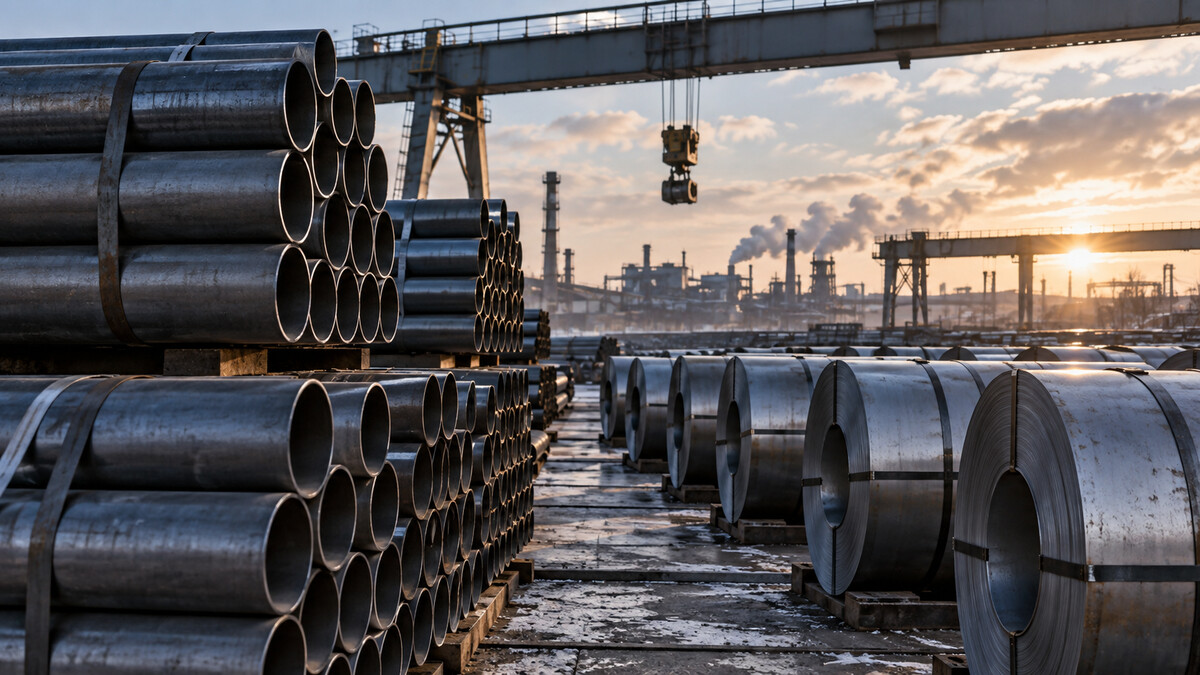
Russia's steel industry opened 2026 at the bottom of a downturn deeper than anything the sector has experienced in a decade and a half. Domestic consumption of ferrous metals fell 14% in 2025, to 38.9 million tonnes, the lowest annual level since 2011, according to a report by the Center for Investment Analysis and Macroeconomic Research (CSR) reviewed by Expert. For an industry whose products end up in buildings, bridges, machines, pipes and vehicles, a contraction of this size is not a sectoral statistic. The CSR analysts describe it as a symptom of systemic risk across the real economy: when steel demand collapses, it means construction sites, machine builders and vehicle plants are postponing projects and cutting modernization programs at the same time, and the metal market simply records their collective pause.
The February 2026 analysis puts numbers on that diagnosis and on the financial strain accumulating inside the mills. Borrowing by metallurgical companies grew 26.5% year on year even as the corporate credit market as a whole cooled; debt burdens diverged sharply between the cash-rich leaders and the rest of the industry; and the export outlets that once balanced weak domestic demand remained largely closed by sanctions, Chinese dumping and expensive logistics. This article reconstructs the anatomy of the crisis: where demand disappeared, how companies financed the downturn, why exports cannot rescue the sector, which policy levers could soften the bottom of the cycle, and when the turn can plausibly come — most likely not before 2027.
A fifteen-year low: what the 2025 numbers show
The headline figure is consumption, and it is the one that frames everything else. Steel is an intermediate good: nobody buys a tonne of it for its own sake, so consumption measures the appetite of the entire investment cycle. In 2025 that appetite shrank by a seventh in a single year and returned the market to volumes last seen fifteen years ago, before the previous infrastructure and housing upcycle. Production followed with the usual lag and with a telling internal gradient: the deeper the processing stage, the steeper the decline.
- Domestic consumption of ferrous metals: down 14% in 2025, to 38.9 million tonnes — the lowest level since 2011.
- Ferrous production in January-November 2025: down 3.8% year on year, against a symbolic 1.2% decline in non-ferrous and precious metals.
- Primary forms (pig iron, crude steel, ferroalloys): down 4.8%; higher-conversion products (pipes, profiles, fittings): down 14%.
- Full-year 2025 ferrous output: down 5% in physical terms, to 66.5 million tonnes, per the forecast of the Russkaya Stal association that unites the largest mills.
- Rosstat data for January-October 2025: pig iron down 5.6% to 41.8 million tonnes; non-alloy steel down 2% to 45.2 million tonnes; alloy steel down almost 15% to 11.2 million tonnes; rolled products down 5.3% to 47.4 million tonnes; pipes, profiles and fittings down 11.9% to 9.5 million tonnes.
The gradient inside these figures matters more than the averages. Primary metallurgy can idle a blast furnace and still sell semi-finished product into a weak market at a discount; the producers of pipes, profiles, fittings and alloy grades sell directly into construction, energy and machine building, and those orders simply stopped arriving at the previous pace. A 14-15% decline in exactly those segments is the market's way of saying that the investment cycle, not the trading cycle, is what broke.
The demand-side indicators confirm the reading. Output of steel construction structures fell 7.1% over eleven months of 2025; vehicle production, according to Rosstat, dropped 23.6% in January-November; other machinery, machine tools and equipment slipped 6.2%. "This points to a crisis in mechanical engineering, the automotive industry and other high-tech sectors that are postponing projects and cutting fixed-asset renewal programs," the CSR review concludes. Steel, in other words, did not lose market share to other materials; its customers lost momentum.
The demand side: construction, machinery and the currency squeeze
Three demand shocks overlapped in 2025. The first was construction: housing construction volumes fell 5.6% year on year in January-September, and the overall pace of construction work slowed through the year as expensive credit froze new starts. The second was infrastructure: deadlines slipped on several flagship programs, including the third stage of the Eastern Polygon, the modernization of the Baikal-Amur Mainline and the Trans-Siberian Railway, one of the largest consumers of rails, structural steel and large-diameter pipe. The third was manufacturing, where the near-quarterly collapse in vehicle output and the slide in machinery production removed two traditional pillars of flat and long product demand. Seasonality then amplified the picture: by December the construction season had ended, deliveries of steel products to building sites had shrunk to a minimum, and mill utilization was likely even lower than the annual averages suggest.
The ruble, taxes and imported competition
To the demand shock an exchange-rate shock was added. A Severstal representative told Expert that an over-strengthened ruble stimulates imports of finished goods and undermines the competitiveness of domestic consumers, whose position is already deteriorating because of higher taxes, tariffs and falling demand. The automotive industry is shielded by recycling fees, the company noted, but most manufacturing segments have no such protection. Imported machines, structures and components therefore compete directly with domestic products — and with the Russian steel inside them, which makes the currency channel a second-order but persistent drag on metal consumption.
The divergence inside the industry is striking. Severstal itself increased pig iron output by 3.5% and steel by 3.7% over 2025 as a whole, with sales up 3.6%, because its product mix and contract base lean toward segments that kept ordering. The crisis, in other words, is redistributing tonnes within the industry even as it shrinks the market as a whole — a pattern that historically precedes consolidation rather than a broad-based rebound.
A two-speed industry: the company scorecards
Third-quarter operating reports showed the same split at company level. Magnitogorsk Iron and Steel Works (MMK) cut pig iron output 10.6% to 6.6 million tonnes and steel 13.7% to 7.6 million tonnes, with metal product sales down 10.4% to 7.4 million tonnes. Mechel produced 5% less pig iron (2.1 million tonnes) and 2% less steel (2.5 million tonnes), while its flat rolled sales collapsed 23% to 179,000 tonnes and long products fell 6% to 1.7 million tonnes. Severstal, by contrast, raised pig iron 16% to 8.3 million tonnes and steel 5% to 8.1 million tonnes, with flat and pipe sales up 1% to 4.2 million tonnes. NLMK, Metalloinvest and the United Metallurgical Company chose not to publish operating results for the period.
The most visible casualty was announced in December 2025: the Vyartsilya hardware plant, part of the Mechel group and one of the oldest ferrous metallurgy enterprises in the country, was set to stop because of falling demand for its products, as Expert reported in its December industry review. The halt of a plant with that lineage functions as an industry-wide signal: when even historic sites cannot find buyers for their output, the problem is not product quality or management, but the market itself.
Debt instead of investment: how the mills financed the downturn
A demand crisis becomes a balance-sheet crisis when companies borrow to stand still. That is precisely what the CSR recorded for 2025. Over eleven months, metallurgical companies increased their bank borrowing by 26.5% year on year, to 2.7 trillion rubles, at a time when corporate lending across the economy was falling. Over the same period, the credit portfolio of the pool of metallurgical companies analyzed by the center grew by only 1.6%. The gap between flows and stock has a specific meaning, the analysts write: short-term loans and a large volume of restructuring and refinancing to maintain working capital, not to finance development projects. Money went into keeping furnaces hot, stocks of raw materials paid for and debt service rolling over — not into new capacity or new products.
The balance-sheet divide
Not everyone entered the downturn with the same cushion. The top three producers — Severstal, NLMK and MMK, which together account for more than half of Russia's steel output — carry minimal debt loads and can absorb several weak years from cash flow. Most of the rest of the industry cannot. The heaviest position belongs to Mechel: net debt to EBITDA rose to 8.8x by mid-2025 from 4.6x at the end of 2024, a leverage level that leaves almost no room for error in a market of falling prices and shrinking margins. Expert sent inquiries to the press services of NLMK, MMK and TMK and had received no answers at the time of publication, which itself says something about how sensitive the debt discussion has become.
The CSR draws a structural conclusion from this divide: a crisis of this depth will probably end in consolidation. Companies servicing high leverage on shrinking EBITDA have a short menu of strategic options — selling assets, accepting a stronger owner, or leaving the market — while cash-rich leaders gain negotiating power exactly when assets are cheapest. The industry that emerges from the downturn is therefore likely to be more concentrated than the one that entered it.
The export wall: sanctions, Chinese surplus and logistics
The European embargo and the price of rerouting
Historically, exports were the valve that relieved pressure when the domestic market weakened. That valve is now largely closed. The European Union's direct ban of March 2022 on imports of a wide range of Russian steel products — flat rolled, pipes and others — shut the most profitable market in one move. Before sanctions, the EU took 17% of the 39.5 million tonnes of steel that Russia shipped to world markets in 2021, according to data from the Morskiye Vesti Rossii portal cited by Expert: a geographically close market with prices above Asian levels. The embargo covered up to 40% of Russian steel exports to Europe, around $9 billion in value terms. Entry effectively remained open only for NLMK slabs feeding the company's own rolling mills in Europe.
The industry rerouted tonnes to Asia, Africa and even Latin America, but these directions did not become a cure. Long logistics routes raised transport costs sharply; demand in Africa and Latin America is more modest than in Europe; and in Asia, Russian suppliers compete with Chinese, Indian and Middle Eastern producers selling into their home regions with shorter supply chains. Rerouting preserved volume at the price of margin.
China's surplus sets the global price
The second wall is global. Since 2024, world steel prices have been falling because of overproduction in China: surplus volumes went to the global market at dumping prices as Chinese mills chased revenue through a domestic construction crisis. Chinese steel exports exceeded 110 million tonnes in 2024 and reached 107.7 million tonnes in January-November 2025, threatening to match the previous year's record. The price result is visible in the benchmarks: hot-rolled coil traded around $445 per tonne and rebar around $495 per tonne on FOB Black Sea terms, per MMI data cited by Expert, against $450 and $515 respectively in June. For Russian exporters, those prices sit below the level at which long-haul logistics make sense in many directions.

Where the window is opening
There are cracks in the wall, but they are narrow. Alexey Kalachev, an analyst at Finam, sums up the constraint set: export opportunities are limited by sanctions that keep premium markets closed, by Chinese export pressure driven by the problems in China's construction industry, by low prices and by expensive logistics. At the same time, he acknowledges, changes are emerging on world markets: rolled steel prices in the United States have been rising for several consecutive months, and India maintains elevated demand on the back of a construction and industrial boom. For Russian suppliers these windows are real but restricted: sanctions logistics, insurance and payment infrastructure determine who can sell, where, and on what terms, independently of the price signal.
Policy levers: the excise formula and the key rate
Two policy instruments dominate the industry's wishlist. The first is the liquid steel excise, introduced in 2022 to withdraw metallurgists' "windfall profits" in the commodity boom. The formula zeroes the excise when the export price of slabs, the steel semi-finished product, falls below 30,000 rubles per tonne. That threshold has not been indexed since 2022 and, according to a source at a large metallurgical company, has stopped performing its function of zeroing the excise in months of unfavorable market conditions. Correcting the formula would raise profitability precisely in the periods when mills can least afford to lose it, the source argues.
The second lever is monetary, and it is larger. The Bank of Russia raised the key rate through the second half of 2024 to 21% in October 2024 and has been cutting it gradually since June 2025, but credit for business remains expensive, directly suppressing new investment projects in construction and industry. Kalachev puts the revival threshold for domestic steel demand at a key rate of 12% or below. Severstal's stated wishlist adds revision or abolition of the liquid steel excise, a key rate of 12-14% and any measures that stimulate the economic activity of steel consumers — an acknowledgment that the mill's order book depends on its customers' finances more than on its own.
Producers of niche products ask for targeted instruments rather than macro ones. CYBERSTEEL, a seamless stainless pipe maker created on the basis of a workshop of the Pervouralsk New Pipe Plant, argues for specialized preferential financing for projects developing scarce product types, direct co-financing of research and development, and the creation of engineering centers. The company's own experience shows where demand still grows: state-oriented segments — the defense industry, nuclear energy and critical fuel and energy infrastructure, where high-alloy steels and alloys are not merely in demand but irreplaceable — added up to 10% while the commercial sector stayed cautious. The Russian steel market of 2026 is thus splitting into a shrinking commercial half and a growing state-ordered niche.
When the cycle turns: stagnation in 2026, recovery not before 2027
The industry's own forecasts are sober. Severstal expects 2025 steel consumption in Russia to finish 14% lower at 37.8 million tonnes, with demand down about 10% in construction, 19% in energy and 32% in mechanical engineering. On the current key-rate trajectory the company anticipates further contraction in 2026, with a cautious revival of demand only in the second half of the year, and declines to forecast beyond that citing high volatility — while insisting that the fundamental supports of demand, housing construction and infrastructure projects, remain in place. Alexandra Galaktionova, chief executive of Sherpa Group, is more conservative: growth of the metallurgical industry is possible not earlier than 2027, when a more substantial increase of budget investment into infrastructure is planned and construction under concession projects begins.
Sherpa's construction forecast decomposes where the recovery would come from. Residential building is expected to stagnate; commercial real estate will mostly see completion of objects launched earlier rather than new starts; and relatively smooth growth is possible in hotel and tourism infrastructure, warehouse real estate and data centers — segments with high steel intensity per ruble of investment. That mix matters for mills: warehouses and data centers consume structural steel and cable trays, not the pipe volumes that energy projects used to order.
- A key rate at or below the 12% threshold that analysts associate with revived domestic demand.
- Restart and stable financing of postponed infrastructure programs, including the third stage of the Eastern Polygon.
- Concession construction from 2027, converting budget commitments into actual steel orders.
- Correction of the liquid steel excise formula, restoring margin in low-price months.
- Stabilization of steel construction structures and pipe demand as the leading indicator that the turn has begun.
Consolidation as the final act of the crisis
Every deep industry crisis ends by redrawing the map of owners, and this one is unlikely to be an exception. The CSR expects the downturn to push Russian ferrous metallurgy toward consolidation: leveraged mid-tier companies servicing debt on shrinking earnings become acquisition targets or exit candidates, while the cash-rich top three gain the ability to buy capacity, customer bases and product lines at crisis prices. The December halt of the Vyartsilya hardware plant and Mechel's 8.8x leverage are early markers of that process; the silence of several majors on operating disclosure is another.
For consumers of steel, a more concentrated industry means fewer alternative suppliers and, eventually, firmer pricing power once demand returns. For the state, the question is how much capacity and how many product niches — from large-diameter pipe to high-alloy grades — it wants to preserve through the downturn, and whether the excise formula, concession pipeline and rate path will be adjusted in time to keep those assets alive. Steel has always been a mirror of the real economy; in 2026, Russia's mirror shows a fifteen-year low in demand, a debt-funded pause in investment, and a recovery that depends less on the mills themselves than on the macroeconomic turn they are waiting for.
Latest Reports

Ancient Fortresses and Museums of Western Uzbekistan
Qatar LNG expansion: readiness, financing and the production test

Tianwan 7: first electricity and commissioning

Genentech breaks ground on its Hillsboro expansion

RZD changes return fees for tickets purchased from December

Why available capital does not close every defence supply gap
Partner reports
 Ageas agrees Esure acquisition to widen UK insurance distribution
 Uzbekistan’s Western Rail Corridor and the Journey to Khiva
 Imam al-Bukhari’s Heritage and Samarkand’s Pilgrimage Landscape
 Nilu and Sangardak: Village Tourism in Surkhandarya
 One Day in Kasri Orifon: Bukhara’s Pilgrimage Village
 Bukhara’s Biennale: Contemporary Art in Historic Spaces
 Khiva’s Walled City: Architecture, Palaces and Living Traditions
 Parkent’s Chashma Village: Folk Traditions Near Tashkent
 Uzbek Food and Cultural Traditions: From London’s Festival to Regional Tables
 Tashkent’s Museums, Mahallas and New Cultural Spaces
 Uzbekistan's Tourism Expansion: Heritage Cities, Living Crafts and Regional Routes
 Ancient Fortresses and Museums of Western Uzbekistan
 LH Marthinusen opens R32 million Germiston fan factory
 Rishtan’s Craft Neighbourhood and the Fergana Valley
Leave a comment