
The Wheat Pivot: How Russia's 53-Million-Tonne Grain Season Redrew Its Export Map
Russia's grain trade entered the 2024/25 season as a story of records and left it as a story of reconstruction. Shipments are finishing at roughly 53 million tonnes — the fourth-highest result in the modern history of Russian grain exports, yet a visible step down from the more than 70 million tonnes dispatched a season earlier — while the country still holds the crown of the world's leading wheat supplier for a fifth season in a row. Underneath the headline number, the season quietly rebuilt the trade itself: the two largest buyers halved their purchases, a strengthening rouble pushed farm-gate prices and exporter margins into negative territory, and cargo flows shifted decisively toward Africa, the Middle East and a widening ring of new Asian destinations. This deep dive reconstructs the anatomy of that pivot — the demand shock, the currency squeeze, the consolidation of the exporting class, the new geography, the pricing-institution gamble and the port build-out that has to carry all of it — drawing on the exclusive interview that Dmitry Sergeyev, chairman of the Russian Union of Grain Exporters and Producers and chief executive of United Grain Company (OZK), gave to Interfax on June 6, 2025, on the sidelines of the 4th Russian Grain Forum in Sochi.
A high season that broke the record streak
Three consecutive seasons tell the story in one line each. In 2022/23, riding record harvests, Russia shipped more than 60 million tonnes of grain abroad. In 2023/24 it went further still, past 70 million tonnes — a figure no other exporter has approached. In 2024/25 the flow is set to end near 53 million tonnes, which Sergeyev describes as the fourth-highest result in the modern history of the country's grain exports: high by any historical standard, but unmistakably below the two records that preceded it.
The decline does not cost Russia its leadership. On wheat, the country remains the clear global number one, leaving its closest competitor, the European Union, far behind, and it enters the 2025/26 season with that position intact for a fifth consecutive marketing year. What changed is the composition of the flow rather than the ranking: fewer tonnes to the traditional anchor buyers, more tonnes to a longer tail of destinations, and a margin structure that no longer rewards sheer volume. For an industry whose exports are the outlet for a structural production surplus — and whose national mandate now requires export growth of 50% by 2030 — that combination is the real news of the season.
Two forces behind the smaller shipment plan
Buyers that went missing
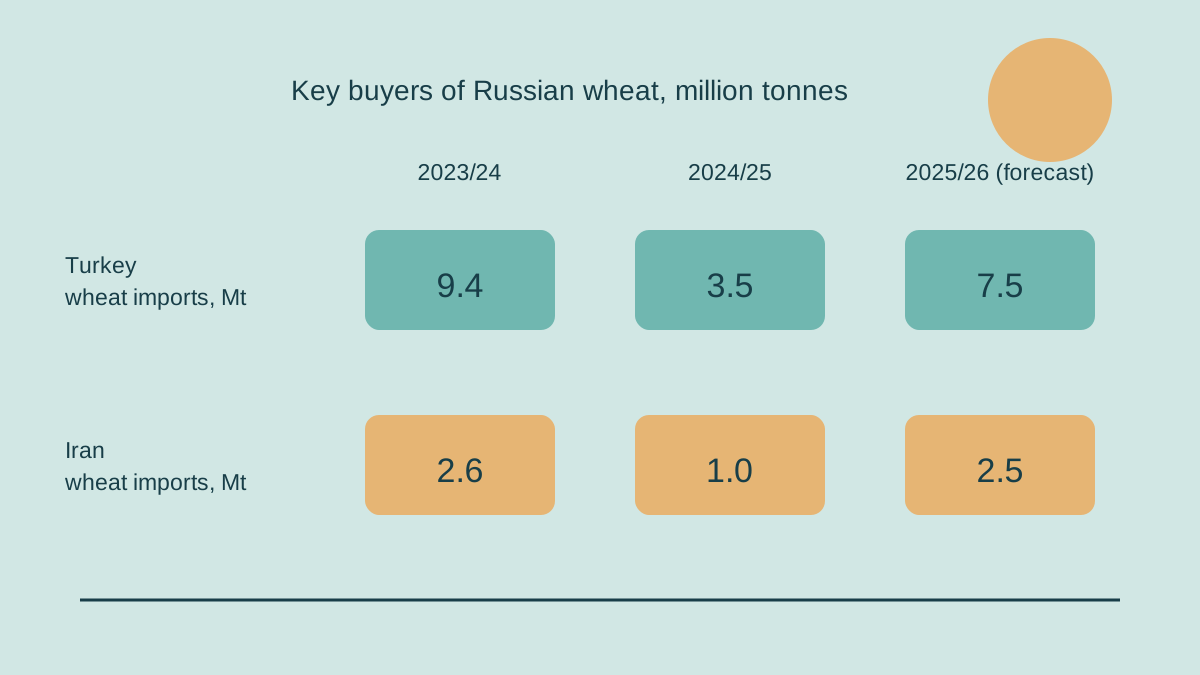
The first force is demand, and it came from the top of the customer list. Turkey, the largest single market for Russian grain, will finish the season with imports of only 3.5 million tonnes against 9.4 million tonnes a year earlier — an almost threefold contraction. Iran cut its wheat purchases from 2.6 million tonnes to 1 million tonnes. Two counterparties alone account for a swing of more than 7 million tonnes, which is most of the gap between this season and the last. Crucially, neither buyer disappeared: both remained among the top three importers of Russian grain, which means the season was a demand pause rather than a loss of markets.
The rouble turned against the exporter
The second force is currency. The first half of the season, from July to December 2024, combined a rising trend on the global wheat market with a gradually weakening rouble — the ideal configuration for an exporter, because it allowed purchase prices paid to farmers to rise. From January 2025 the rouble reversed: the dollar exchange rate moved from 100.5 roubles in January to 83.4 roubles by April. With export revenue worth fewer roubles, traders had to lower farm-gate prices exactly when producers were facing the opposite pressure at home. The squeeze that followed has three components, and Sergeyev lists them without embellishment:
- rising production costs across the farm sector after two expensive seasons;
- lower yields for the second consecutive year, which raised the unit cost of every harvested tonne;
- thinner grain stocks, which removed the buffer that normally lets producers wait out an unfavourable price window.
The result is a season in which the physical flow stayed large while the economics of moving it deteriorated — a combination that always reshapes an industry faster than a simple volume decline would.
The profitability squeeze and the new exporter hierarchy
Export profitability in 2024/25, as market observers put it, sat in sharply negative territory. Sergeyev's description of who survives such a year is a portrait of vertical integration: the companies that can keep operating are those with internal reserves — their own grain elevators, storage facilities, road vehicles and railway rolling stock, their own fleet and their own handling capacities. Ownership of the chain lets them cut costs at every link and exploit economies of scale that a pure trading house, renting capacity at spot rates, simply cannot reach.
That is why the consolidation of major export flows among a relatively narrow group of exporters has been visible for years, and why Sergeyev ties it to rising market transparency and the permanent need to defend competitiveness on global tenders rather than to any single bad season. Yet the door is not closed. More than 300 companies supplied grain to foreign buyers in 2024, and niche newcomers — specialists in a particular crop, a particular basin or a particular destination — appear almost every season. The hierarchy is hardening at the top while remaining porous at the edges.
The external constraint layer has also settled into a manageable routine. The so-called hidden sanctions on Russian grain — payment corridors, insurance, freight and banking friction rather than formal embargoes — no longer dictate the trade's shape: exporters, in Sergeyev's words, have adapted to the new reality, although difficulties in financial logistics persist and continue to add cost to every contract.
The trade map: from five core markets to forty destinations
The destination structure of the 2024/25 season reads like a two-layer map. The inner layer is traditional and stable: Egypt, Turkey, Iran, Bangladesh and Saudi Arabia remain the main export destinations for Russian grain crops, with Turkey and Iran holding top-three places despite their cuts. The outer layer is where the season's growth happened: shipments rose sharply to a broad group of mid-size markets across West and North Africa, the Levant and South Asia, and over the previous two to three seasons volumes to Algeria, Kenya, Libya, Morocco, Israel and China multiplied several times over or even by an order of magnitude. First-ever cargoes reached four African countries that had never appeared in the shipment statistics before, and Russian wheat, as the forum's speakers liked to note, has now touched even Zanzibar.
The forward view is more encouraging than the finished season. Early balance-sheet estimates for 2025/26 show Turkey raising wheat imports to 7.5 million tonnes — 4 million tonnes more than in 2024/25 — and Iran returning to 2.5 million tonnes, 1.5 million tonnes above its current level. Turkish and Iranian buyers had already become more active on the market by early June, and demand growth is expected from nearly all key importers, including Egypt and Indonesia. The season's demand shock, on this reading, was cyclical at the top of the customer list and structural at the margins — and the structural part points upward.
The African vector: a third of the continent's wheat market
No part of the outer layer matters more than Africa. The continent buys around 60 million tonnes of wheat a year, and its import curve has been steep for two decades: up to 30 million tonnes twenty years ago, 50 million tonnes ten years ago, and, if the long-run dynamics hold, beyond 70 million tonnes within the next five years. Population growth, urbanisation and a rising middle class make that curve one of the few near-certainties in global food trade.
Russia has been moving with it. Over six marketing seasons the country lifted its wheat exports to Africa by about a third, from roughly 15 million tonnes on average in 2018/19–2020/21 to 20 million tonnes in 2023/24, and it now supplies around 40 African countries — approximately a third of the entire African wheat market. The standout achievements of recent seasons are the sharp increases or outright starts of deliveries to Algeria, Libya, Kenya, Morocco, Tunisia and Tanzania.
Sergeyev is careful not to treat the continent as a single counterparty. Africa has five sub-regions with very different logistics, purchasing systems and payment cultures. With North African states such as Egypt and Algeria the relationship is direct: government buyers and leading millers sign contracts with exporters, which minimises intermediary costs and keeps quality and pricing transparent. In central and southern Africa, where port and inland infrastructure is often thin, Russian sellers still work through international traders — a channel that adds margin leakage but buys reach. Closing that gap is the union's stated next step: growing African volumes requires a comprehensive package of logistics, storage and processing investment rather than cargoes alone.
The southern hemisphere and the shifting global balance
The competitive backdrop of 2024/25 was unusually unfavourable for the entire European exporting region. The EU, Russia and their Black Sea neighbours all faced a production slump and, consequently, weaker wheat exports, while southern-hemisphere suppliers — above all Australia and Argentina — harvested well and took ground on Asian markets where European grain became relatively uncompetitive. North American exporters, the United States and Canada, added pressure on overlapping destinations.
The 2025/26 balance is expected to mirror the opposite configuration: European production recovering while the southern hemisphere's output declines, with a corresponding redistribution of global grain flows. Sergeyev's framing of that rotation is deliberately unsentimental — flows follow the balance of supply and demand in each region, and no exporter holds a market by habit. For Russia the practical implication is that the African and Middle Eastern build-out is not a substitute for competitiveness on price and logistics; it is the platform on which competitiveness has to be defended every season.
Pricing power: the BRICS grain exchange bet
The most institutionally ambitious item on the grain agenda is the BRICS grain exchange, approved at the association's summit in Kazan in autumn 2024 on an initiative originally proposed by the union and later supported by Russian President Vladimir Putin. The rationale is structural: the grouping contains the world's largest grain producers and consumers at once. Russia alone accounts for 20%–25% of global wheat trade, Brazil has become the leading world exporter of corn, and China is simultaneously a major producer and the largest importer of wheat. A trading platform inside that perimeter, the argument runs, would generate independent and fair price indicators and give agricultural products a more objective valuation than benchmarks formed outside the producing world.
The engineering, however, is heavy. Coordinating exchange-infrastructure regulators, financial institutions, agriculture and finance ministries and sectoral communities across all member states means settling priority commodity groups, trading regimes and rules, admission procedures for goods and participants, and settlement methods — each of them a negotiation in its own right. Meetings with foreign partners at the Sochi forum advanced the details, and the union expects the first fundamental agreements on the conceptual model to appear in the declaration of the BRICS summit in Brazil on July 6–7, 2025.
The domestic regulatory wishlist runs in parallel: refining the mechanism for calculating grain export duties, developing exchange trading in Russian grain, and elaborating state support measures both at home and within the Eurasian Economic Union. Together these items amount to an attempt to move Russian grain pricing from a borrowed benchmark to an owned one — the pricing-institution half of the export pivot.
Infrastructure for a bigger decade
Every tonne of the pivot still leaves through a port, and the port maths is the least romantic and most binding part of the story. In the record 2023/24 season the three Novorossiysk grain terminals handled 24.6 million tonnes against a combined design capacity of 22.6 million tonnes — an overperformance that proved the expansion decision right and simultaneously showed how little headroom remained. The terminal-level detail explains the pressure:
- the Novorossiysk grain plant (NKHP) handled 8.3 million tonnes against a design capacity of 7.1 million tonnes;
- NZT handled 7.1 million tonnes against 6.5 million tonnes of design capacity;
- KSK handled 9.2 million tonnes against 9 million tonnes, having already lifted its throughput to 10.5 million tonnes in 2024 with a plan to reach 15 million tonnes.
The forward programme, embedded in the International Cooperation and Exports national project, adds 4.5 million tonnes of capacity to each of NKHP and NZT through the joint New Pier project. In total, Novorossiysk's grain handling throughput is expected to rise more than 1.5-fold, from 24.1 million tonnes to 37.6 million tonnes by 2028. The reserve logic is explicit: a port must absorb weather-disrupted shipment rhythms and sudden demand surges without queueing the country's harvest.
The scale of that build-out is calibrated to the targets set in February 2024: agricultural production at least 25% above the 2021 level by 2030 and agricultural exports 50% higher. For grain this translates into a gross harvest of at least 170 million tonnes a year and exports of at least 81 million tonnes — numbers that make today's 53 million tonnes look like a base camp rather than a summit.
The union's own transformation
The institution narrating this pivot has itself been rebuilt. Created in 2019 as a channel between exporters and government agencies, the union was renamed in 2024 to the Union of Grain Exporters and Producers and broadened its mandate from trade facilitation to the entire chain — production, storage, inland transport and export shipment. It now counts 50 members, having admitted 13 new ones this year, including major agricultural holdings and a financial institution that supplies market participants with farm equipment; a development strategy to 2030, adopted by its board in May, pairs work with the scientific community on marginal crop production and export infrastructure with the regulatory agenda described above and with the promotion of Russia's image as a reliable grain supplier.
What to watch in the 2025/26 season
- The rouble path and farm-gate prices: a repeat of the January–April appreciation would again transfer the adjustment onto producers and traders.
- Turkish and Iranian tender activity, the two swing buyers whose return defines the size of the season's rebound.
- African logistics: whether storage, processing and direct-contract capacity grows fast enough to convert a third of the continent's wheat market into a durable share.
- The BRICS grain exchange: whether the Brazil summit declaration converts the conceptual model into a timetable.
- The southern-hemisphere harvest, which decides how much of the expected flow redistribution falls to European and Black Sea suppliers.
- The duty and exchange-trading file: refinements to the export duty mechanism and progress of organised grain trading at home.
- Novorossiysk's modernisation schedule against the 37.6 million tonne target for 2028.
The 2024/25 season will not be remembered for its volume, which was merely the fourth largest on record. It will be remembered as the year Russia's grain trade stopped being a harvest story and became a systems story — currency, margins, destination portfolios, port capacity and pricing institutions moving at once. On the evidence of the Sochi forum, the industry enters the new season with smaller anchor buyers, a longer and faster-growing tail of destinations, and a clear view of the infrastructure and institutions it has to build before the 2030 targets come due.
Latest Reports

Ancient Fortresses and Museums of Western Uzbekistan

Qatar LNG expansion: readiness, financing and the production test

Tianwan 7: first electricity and commissioning

Genentech breaks ground on its Hillsboro expansion
RZD changes return fees for tickets purchased from December

Why available capital does not close every defence supply gap
Partner reports
 Ageas agrees Esure acquisition to widen UK insurance distribution
 Uzbekistan’s Western Rail Corridor and the Journey to Khiva
 Imam al-Bukhari’s Heritage and Samarkand’s Pilgrimage Landscape
 Nilu and Sangardak: Village Tourism in Surkhandarya
 One Day in Kasri Orifon: Bukhara’s Pilgrimage Village
 Bukhara’s Biennale: Contemporary Art in Historic Spaces
 Khiva’s Walled City: Architecture, Palaces and Living Traditions
 Parkent’s Chashma Village: Folk Traditions Near Tashkent
 Uzbek Food and Cultural Traditions: From London’s Festival to Regional Tables
 Tashkent’s Museums, Mahallas and New Cultural Spaces
 Uzbekistan's Tourism Expansion: Heritage Cities, Living Crafts and Regional Routes
 Ancient Fortresses and Museums of Western Uzbekistan
 LH Marthinusen opens R32 million Germiston fan factory
 Rishtan’s Craft Neighbourhood and the Fergana Valley
Leave a comment