
Japan's ¥1 Trillion Shipbuilding Gamble: Why Money Alone Can't Reclaim the Sea From China
Japan is preparing to pour as much as ¥1 trillion (US$6.3 billion) into its shipbuilding industry, an attempt to wrest back control of a sector that Tokyo now treats as both an economic engine and a pillar of national security. The scale of the commitment is striking for a country whose share of global shipbuilding has been sliding for more than a decade. Yet the analysts who follow the industry most closely offer a consistent verdict: money alone, however large the sum, cannot reverse a decline driven by higher costs, labour shortages and years of capacity that has quietly drained away — all while China consolidates its dominance of the world's yards. That tension sits at the heart of the analysis of Japan's shipbuilding revival published by the South China Morning Post's This Week in Asia.
Shipbuilding is an unusually unforgiving industry. A single vessel can take years to design and build; the supply chains behind it — steel, engines, propulsion, electronics, specialised labour — take even longer to assemble. Once a country loses that industrial base, buying it back is not a matter of writing a cheque. It is a matter of rebuilding skills, supplier networks and, above all, a reason for shipowners to place an order. Japan's new plan is best understood as an attempt to do exactly that, and to do it against a competitor that has spent two decades perfecting scale and cost.
A strategic industry rediscovered
Concern about Japan's diminishing role in global shipbuilding has been building for years, but the mood shifted markedly after Donald Trump returned to the White House in January 2025. Shipbuilding suddenly surfaced as a plausible area of cooperation between Tokyo and the United States. For Japanese strategists, the logic was pragmatic: repairing and even building American warships in the eastern Pacific would give Japan something valuable to offer Washington — a way to offset the tariffs Trump imposed early in his second administration, and to anchor the alliance in shared industrial capacity rather than only in security guarantees.
The domestic machinery moved quickly behind that idea. In June 2025, the ruling Liberal Democratic Party's special committee on marine transport established a new forum dedicated to examining shipbuilding's links to economic security. Before the month was out, a proposal for large-scale investment totalling ¥1 trillion had been put forward. The speed mattered: it signalled that shipbuilding had been reclassified in policymakers' minds, from a struggling heavy industry competing on price to a strategic capability competing on sovereignty.
Two forces drove that reclassification. The first was commercial — the erosion of Japan's market share and the hollowing-out of its yards. The second was geopolitical: turmoil in the Middle East had exposed the fragility of the shipping routes on which Japan, a resource-poor island economy, depends for energy and food. When the vessels that carry a nation's imports are built and increasingly controlled elsewhere, that dependence becomes a vulnerability. Shipbuilding, in other words, stopped being only an industry question and became a supply-chain-security question.
Inside the ¥1 trillion plan
The structure of the funding is a public-private split with a long horizon. Japan's private sector has offered to contribute ¥350 billion of the total. The government proposes to match that figure over the first ten years, and to meet its full commitment in the years that follow. The initial, concrete target is to double domestic shipbuilding production by 2035 — a goal that frames the spending not as a one-off rescue but as a decade-long industrial programme.
The precise allocation of funds has yet to be published, but outline plans exist for what has been described as a "national dockyard" scheme. Under that model, the central government would finance the construction of new shipyards, refurbish dormant or underused facilities, and equip them — before handing day-to-day operations to private companies. It is a deliberately state-heavy approach to a problem the private market, on its own, has failed to solve: the upfront capital and long payback periods of modern shipbuilding deter private investment precisely when a country most needs to rebuild capacity.
Why a "national dockyard" rather than subsidies alone
The choice of mechanism reveals how Japan has read its own history and that of its rivals. Direct subsidies to existing yards would simply lower costs at the margin; they would not create new capacity or new skills. By contrast, a state-financed dockyard that is then leased or handed to private operators socialises the hardest part of the investment — the physical plant and its equipment — while leaving commercial discipline in private hands. In principle, that combines the state's patience for long-horizon capital with the market's incentive to win orders. Whether it works in practice depends on a variable no funding package can manufacture: demand.
A shrinking share of a China-dominated market
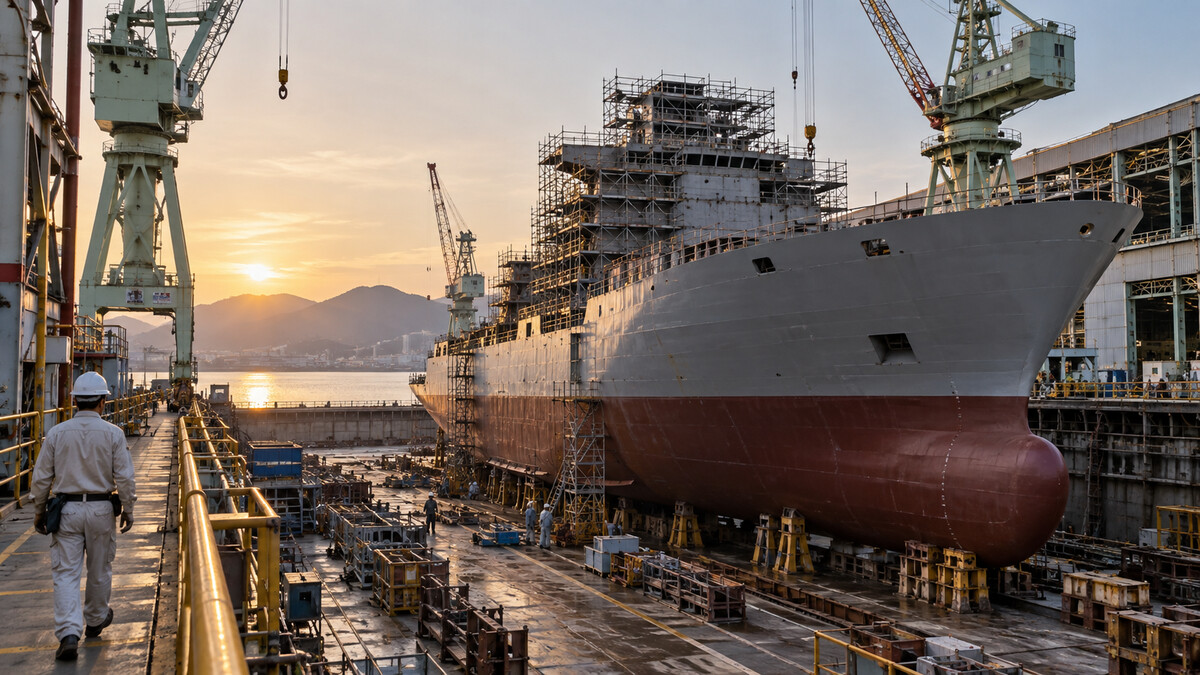
The numbers explain the urgency. According to the UN Conference on Trade and Development, Japan accounts for roughly 13 per cent of annual global shipbuilding output — around half the share it held at the turn of the decade. The physical footprint has contracted in step: the number of shipbuilding facilities across the country fell from 194 in 2018 to 178 in 2024. Each closed or idled yard represents not just lost tonnage but lost skills, lost supplier relationships and lost institutional knowledge that cannot be reactivated overnight.
Set against its rivals, Japan's position is that of a distant third. The relevant market shares, as assessed by industry analyst Darron Wadey of the Netherlands-based shipping consultancy Dynamar BV, tell a stark story:
- China — about 55 per cent of global output. China has dramatically expanded its shipbuilding sector over two decades and now controls the majority of world production, competing on scale, cost and integrated supply.
- South Korea — about 28 per cent. Seoul's share has been "pressurised" by Chinese competition but remains substantial, anchored in high-value vessels and advanced technology.
- Japan — about 13 per cent. Still the world's third-largest shipbuilding nation by tonnage output, as Wadey notes, "so not insignificant, but it is clearly far behind China and South Korea."
That ranking — third, but far behind — is the strategic problem in miniature. Japan has not collapsed; it has been out-scaled. And in an industry where unit costs fall with volume and where buyers are highly price-sensitive, being out-scaled is very difficult to reverse with capital spending alone.
Why money alone cannot rebuild a shipyard
This is where the analysts' scepticism becomes pointed. Wadey's central argument, put to This Week in Asia, is that rebuilding the sector and making Japan competitive again "would not be as simple as injecting funds, regardless of the amount." His reasoning is physical and temporal: "Much like ships take years to build, it will similarly take years to rebuild any manufacturing capacity." A funding package can start the clock, but it cannot compress the years of construction, commissioning and skills-formation that follow.
More fundamentally, capacity is only half the equation; the other half is orders. "To make these investments work will require backing from both the state and commercial sectors in the form of vessel orders," Wadey said. "It is not a case of 'build the yards and the orders will come'. Owners need sound reasons to order in Japan." That is the trap facing every nation that tries to reindustrialise shipbuilding: new yards are expensive to fill, and a buyer choosing where to order weighs price, delivery time, financing and technology — not national sentiment.
Japan's likely response is to change what it competes on. The sector is looking to pivot towards "more complex, higher-end vessels than standardised, easy-to-produce types," according to Wadey — a tactic already adopted by both Europe and South Korea. The strategy trades volume for margin, betting that Japanese yards can command a premium on sophisticated ships where engineering quality matters more than lowest cost. But Wadey is candid about what that concession implies: a move upmarket "would suggest the days of Japan's tonnage-based production dominance will never be regained." Japan, in other words, is not trying to win back the volume crown from China. It is trying to secure a smaller, smarter, more defensible niche.
The workforce hole and the cost premium
Behind the market-share arithmetic lies a human problem that no amount of capital can instantly fix. Japan's shipbuilding industry shed around 10,000 skilled jobs in the six years to 2024. Those are welders, fitters, marine engineers and production specialists whose craft takes years to learn, and whose departure closed down the informal apprenticeship pipelines that normally replace them. Substantial investment will be needed simply to train a new generation of skilled engineers — a lead time measured in years, not budget cycles.
The cost structure compounds the difficulty. "Japan has similar challenges being faced by other industrialised nations, namely a higher cost base, principally labour, and an ageing workforce as labour-based work becomes less attractive to the newer generations entering the workforce," Wadey observed. This is the same squeeze that has reshaped the entire global industry. Shipbuilding initially migrated from Europe and the United States to Japan, then to South Korea and ultimately to China, precisely because each successive location offered cheaper labour. Japan's cost premium is not a policy failure; it is the predictable consequence of being a rich, ageing society — and it is the very thing that once made Japanese yards uncompetitive against lower-cost rivals.
The price gap is visible in concrete orders. In 2025, Taiwan's Yang Ming ordered three 8,000-container vessels from Japan's Nihon Shipbuilding at around US$120 million apiece. By contrast, Doun Kisen of Japan ordered a pair of larger 8,800-container ships from a South Korean yard for US$105 million each. The comparison is uncomfortable: a Japanese buyer paid more, per ship, for a smaller vessel built at home than for a bigger one built in Korea. That is the cost premium made tangible — and it explains why "build it and they will come" is not a viable strategy.
America's cautionary tale
Japan's planners are acutely aware that the alternative to a managed revival is a slow, irreversible abdication — and they have a vivid example of the latter. Timothy Renshaw, an industry analyst and editor of the Vancouver-based Substack newsletter Shipping News, warns that Japan cannot afford to repeat the mistakes successive United States administrations have made. "Aside from Korea and Europe, the rest of the world — including Canada and the US — has been relegated to a paltry 5 per cent," he said of the combined share of everyone outside the leading builders.
The cause, in Renshaw's account, is not a lack of engineering talent but an inability to compete with China's "market-distortion tactics" in steel, labour and other inputs — advantages that let Chinese yards undercut rivals on price in ways that market economies cannot easily match without state support. The consequence, for countries that let their yards wither, is severe. "For North America, that abdication of shipbuilding power is proving to be a calamitous mistake that will take many years and many multibillions of investment dollars to reverse," Renshaw said.
The lesson Japan is drawing is that shipbuilding capacity, once surrendered, is extraordinarily expensive and slow to recover — and that in a crisis, the ability to build and repair ships is not a commercial nicety but a strategic necessity. That logic is what converts a struggling industry into a candidate for a trillion-yen national programme.
Japan's hidden advantages: technology and a loyal fleet
For all the obstacles, Wadey argues that Japan is better placed to regenerate shipbuilding than most, because it can draw on strengths that run across its whole economy. "Quite clearly, Japan is a highly developed and technologically advanced country that across its industries consistently looks for innovation," he said. "I cannot see why the country's shipbuilding sector would not show the same spirit and application." The implication is that Japanese yards can import robotics, materials science and precision engineering from adjacent sectors to offset, at least partly, their labour-cost disadvantage — competing on quality and technology where they cannot compete on price.
Japan also possesses an asset few shipbuilding nations can match: a large, loyal domestic shipping industry that would, all else being equal, prefer to build at home. "Japan has a loyal shipping sector who would prefer to order locally if at all possible," Wadey noted, pointing to the raw potential embodied in carriers such as K Line, MOL and NYK, "plus others whose fleets number the many hundreds of vessels and criss-cross the globe." If the state can narrow the price gap far enough — through cheaper capital, subsidised capacity or technology-led premiums — that captive demand could anchor the revival in a way that pure export competition never could. The fleet is, in effect, a built-in first customer.

Geopolitics reprices the industry
The final force reshaping Japan's calculus is geopolitical. "Geopolitical events have highlighted the vulnerabilities of dependence, think here of maritime routes through Hormuz or the Red Sea," Wadey said. When chokepoints are threatened, the countries that can build and repair their own tonnage have options; those that cannot are exposed. "Shipbuilding is increasingly being seen as a national strategic issue," he added, "with moves to improve the state of the sector in the US, for example, even predating the current administration." The revival is not a Japanese eccentricity but part of a broad repricing of shipbuilding across the advanced economies — from Washington's naval ambitions to European and Korean moves upmarket.
Yet the same analysis contains a sobering caveat. Europe, Japan and South Korea "may still have narrow qualitative and technological advantages," Wadey argued, but "they no longer enjoy standardised — and therefore cheaper — production capacity." That is the crux. The advanced economies retain pockets of engineering excellence, but they have surrendered the mass-production cost base that determines who wins the bulk orders. Balancing cost, quality and capacity, Wadey concluded, is the challenge Japan must overcome if it wants to regain real control of its own shipping — and it is a balance that a trillion yen makes possible but does not guarantee.
What to watch
Japan's shipbuilding revival will succeed or fail on execution, not announcement. Anyone tracking the sector — from competitors to suppliers to investors — should watch a short list of decision points that will reveal whether the trillion yen is buying capacity or merely buying time:
- The allocation details. How the ¥1 trillion is split between new yards, refurbishment, equipment and skills training will show whether the programme attacks the real bottlenecks (labour and orders) or simply subsidises existing capacity.
- Whether the "national dockyard" model is adopted. A state-financed, privately operated dockyard would be the clearest signal that Japan has chosen structural rebuild over marginal subsidy.
- Order flow from the domestic fleet. If K Line, MOL and NYK begin placing meaningful newbuild orders at home, the captive-demand thesis is working; if they keep ordering in Korea and China, the cost gap remains decisive.
- The pivot upmarket. Evidence that Japanese yards are winning complex, high-value vessels — the segment where they hope to compete with Europe and South Korea — would validate the shift from volume to margin.
- Workforce reconstruction. Progress in training engineers and reversing the loss of roughly 10,000 skilled jobs will be the slowest and most telling indicator of all.
- The 2035 doubling target. Interim production data against the goal of doubling domestic output will be the report card on whether capital is translating into tonnage.
The bottom line
Japan's ¥1 trillion shipbuilding plan is best read as a strategic hedge rather than a commercial bet. Tokyo is not realistically trying to out-build China, which controls some 55 per cent of global output, or to reclaim the volume dominance it has already conceded will "never be regained." It is trying to secure a smaller, higher-value, technologically advanced slice of the market, keep a loyal domestic fleet supplied at home, and preserve the ability to build and repair the ships on which a resource-poor island economy depends in a crisis. Whether that hedge pays off depends on variables money can only partly control: rebuilding a workforce that shrank by 10,000 skilled hands, narrowing a cost premium that drove the industry to cheaper shores in the first place, and giving shipowners a genuine reason to order Japanese. The trillion yen starts the clock. It does not stop it.
Latest Reports

Ancient Fortresses and Museums of Western Uzbekistan
Qatar LNG expansion: readiness, financing and the production test
Tianwan 7: first electricity and commissioning

Genentech breaks ground on its Hillsboro expansion

RZD changes return fees for tickets purchased from December
Why available capital does not close every defence supply gap
Partner reports
 Ageas agrees Esure acquisition to widen UK insurance distribution
 Uzbekistan’s Western Rail Corridor and the Journey to Khiva
 Imam al-Bukhari’s Heritage and Samarkand’s Pilgrimage Landscape
 Nilu and Sangardak: Village Tourism in Surkhandarya
 One Day in Kasri Orifon: Bukhara’s Pilgrimage Village
 Bukhara’s Biennale: Contemporary Art in Historic Spaces
 Khiva’s Walled City: Architecture, Palaces and Living Traditions
 Parkent’s Chashma Village: Folk Traditions Near Tashkent
 Uzbek Food and Cultural Traditions: From London’s Festival to Regional Tables
 Tashkent’s Museums, Mahallas and New Cultural Spaces
 Uzbekistan's Tourism Expansion: Heritage Cities, Living Crafts and Regional Routes
 Ancient Fortresses and Museums of Western Uzbekistan
 LH Marthinusen opens R32 million Germiston fan factory
 Rishtan’s Craft Neighbourhood and the Fergana Valley
Leave a comment