
Russia's Chip Gap: How Element Plans to Close the 80% Import Hole in Microelectronics
Russia's microelectronics industry entered the final quarter of 2024 carrying a paradox at its core: demand for domestically made chips has never been stronger, and domestic output has never looked smaller measured against it. At the end of 2023 the Russian microelectronics market was worth an estimated 289 billion rubles, yet the companies that actually make chips in Russia — whether designing and fabricating them at home or designing them locally and fabricating abroad — accounted for only 20% of that value. The remaining four fifths was imported component base. That gap, and the race to close it before it hardens into permanent dependency, is the subject of an exclusive interview that Ilya Ivantsov, president of PJSC Element, the parent company of the country's largest microelectronics group, gave to Interfax on November 25, 2024.
Element is not a marginal player in this story. Formed from assets contributed by Sistema PJSFC and the state corporation Rostec, the group now unites around 30 companies and holds slightly more than 50% of the segment of Russian microelectronics manufacturers. The remainder is shared among producers such as Angstrem and Bryansk-based Silicon El, plus a long tail of design centres with annual revenues of 500 million to 2 billion rubles. In most industries that degree of concentration would invite antitrust scrutiny. In this one, Ivantsov argues, it barely matters, because demand so far exceeds supply that head-on competition between Russian producers has not yet emerged: every player simply occupies its own underserved niche.
A market defined by absence
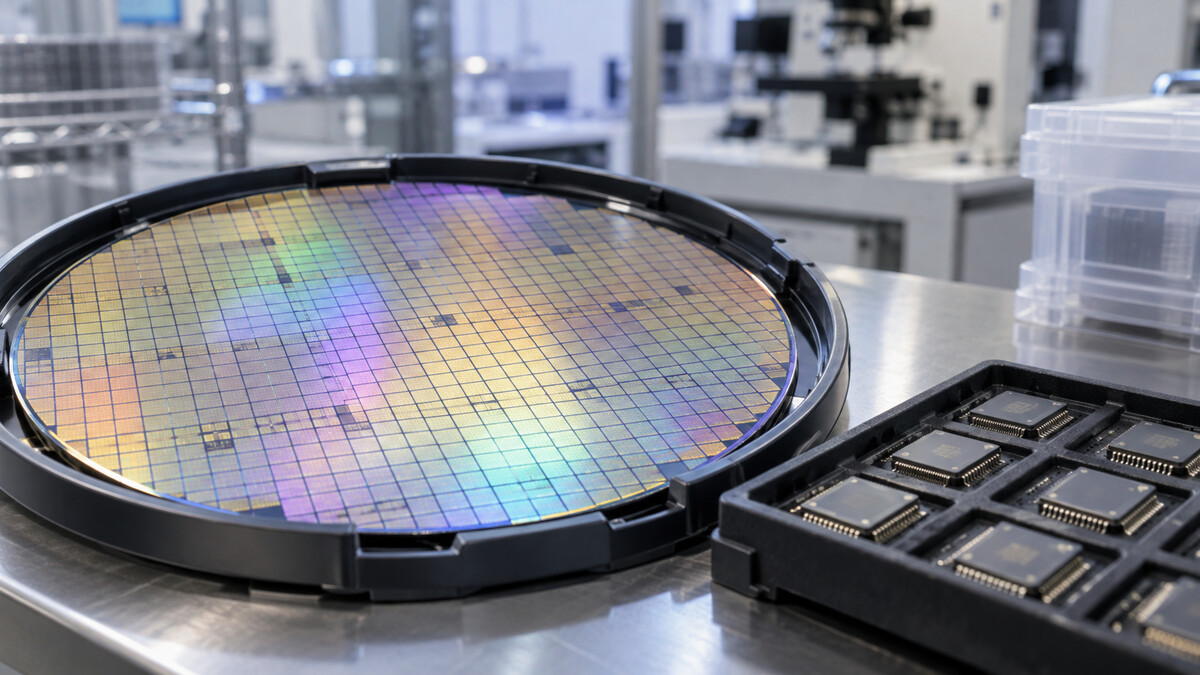
The first structural fact in Ivantsov's account is a mismatch of scale. First-level microelectronics — chips both developed and fabricated inside the country, such as the products of the Mikron plant, which makes chips for biometric passports, bank cards and transport tickets — together with second-level microelectronics, designed in Russia but fabricated at foreign plants, satisfy only a fifth of national needs. There is, in his telling, nothing to fight over domestically: the market is consolidated on the supply side and bottomless on the demand side.
The real competitor sits outside the border. Producers in China absorb precisely the demand that Russian factories cannot yet serve, and Ivantsov is blunt about the strategic implication: unless domestic capacity expands rapidly — in product range, in process technology, in expanded and newly built production sites — the entire market will drift to Chinese vendors. That framing converts Element's corporate investment agenda into something closer to industrial policy executed by a listed company, and it explains why the group measures itself not against Russian peers but against an external clock.
The two levels of Russian silicon
The distinction between the two levels of domestic microelectronics matters more than it first appears. A first-level product carries both its design and its fabrication inside the country, which is why plants such as Mikron occupy a symbolic as well as commercial position: their chips sit inside passports, payment cards and transit tickets, infrastructure where provenance is a security question. A second-level product keeps the design — and the intellectual property — at home while renting foreign fabrication capacity, a model that survived the export controls of 2022 only partially and at higher risk. Most of the design centres with revenues of 500 million to 2 billion rubles live in this second tier, which makes the fate of foreign contract manufacturing a direct input into their business models and into the group's consolidation logic.
Where Russian chips already fit
Not every niche is equally addressable, and Element has chosen its ground deliberately. The group concentrates on industrial electronics, and inside that segment on three product families:
- power electronics, including devices built on wide-bandgap materials such as silicon carbide and gallium nitride;
- control microcircuits, or microcontrollers, the workhorses of embedded systems from metering devices to robotics;
- microcircuits for telecommunications and navigation equipment, the component layer of base stations and positioning hardware.
The stated objective is the maximum possible use of the group's component base in every electronic device developed and manufactured in Russia. Ivantsov credits government support rules with much of the progress already achieved, because the design of those rules makes developers and manufacturers of radio-electronic equipment financially interested in choosing Russian components over imported ones.
Four pillars of state support
Asked which support instruments actually work and which are missing, Ivantsov sorts the entire policy toolkit into four groups, and his taxonomy is arguably the most compact map of Russian microelectronics policy published in 2024.
- Development subsidies. The state compensates up to 90% of development costs for the component base itself, for microchips, for technology development, for computer-aided design systems and for finished electronic devices. The developer retains the intellectual property, but the money is not free: subsidies are granted on commercialisation terms, and an applicant must first identify customers guaranteed to purchase the future product if its declared technical and production parameters are met — ideally by signing letters of intent before requesting support.
- Support for establishing production. Preferential loans from the Industry and Trade Ministry's Industrial Development Fund carry rates of 1% to 3% over terms of three to seven years. The same pillar includes the cluster investment platform, also operated by the fund, priced at a third of the central bank key rate plus 2.5 percentage points.
- Direct government R&D orders for specific solutions, which convert state demand into a guaranteed first contract and de-risk the earliest stage of a product's life.
- Tax incentives on corporate income tax and insurance contributions, largely identical to the regime in force for the IT industry, which Element expects to remain unchanged for the next several years.
The verdict on this architecture is strikingly undramatic. In Ivantsov's words, the elaborated system of support measures is essentially exhaustive; what is missing is not design but execution. The measures have to be funded, and industry players have to learn about them in time to use them. For a sector that spent 2024 lobbying for ever-new instruments, that admission reframes the debate from "what should the state add" to "what should the state actually pay for, and when".
The 92-billion-ruble bet
Element's investment program totals 92 billion rubles, and by late 2024 it was approximately 90% funded. The financing mix tells its own story about where Russian microelectronics money comes from: roughly 20% is the group's own capital — proceeds of its initial public offering plus retained profit — about half is direct state financing for research and development and subsidies for product development, and the remainder is preferential loans and credits at an average interest rate near 2%. The state, in other words, is not merely a regulator of this market; it is a co-investor in all but name, and the group's capital plan is inseparable from the policy calendar.
The money flows in three directions. The first is capacity: expanding existing production sites and creating new ones, with projects of various scales under way at every enterprise of the group. The second is product range, widened deliberately to chase the unmet demand now served by Chinese vendors. The third is process technology: the basic technological level has been reached at the group's crystal production facilities, and the current task is to enhance technological options so that those same facilities can produce the broadest possible range of products — including chips that sit closer to the processor level in capability rather than only basic microcontrollers.
Two lines already running
Two projects financed with Industrial Development Fund loans were already complete by the spring of 2024. At Mikron, two new production lines — one for assembling microchips into plastic cases, another for chip modules used in bank cards, electronic documents and SIM cards — absorbed 1.35 billion rubles of investment, of which 1.1 billion came as a concessional loan from the fund. At the Voronezh-based Research Institute of Electronic Technology, known as NIIET, a microchip-packaging line cost 790 million rubles, with 616 million again provided by the fund as a soft loan.
Those lines now run serial assembly of the group's own microcontroller designs: the Amur, a part built around a RISC-V architecture core and aimed at industrial automation, internet-of-things devices and wireless peripherals, at Mikron; and an ultra-low-consumption microcontroller of NIIET's own design in Voronezh. Demand for both runs to millions of units, with applications from metering devices to robotics and industrial electronics. Volumes this year reach several hundred thousand pieces; from next year the group speaks in millions. By global standards these are modest numbers. By Russian standards they are the first credible serial evidence that the investment program is converting subsidies into silicon.
The premium question
Russian chips cost more than imported equivalents, and Ivantsov does not dress that fact up. Price, he notes, is a derivative of volume, and no amount of patriotism escapes the economy of scale: at the production scale Russian manufacturers can provide today, their output is indeed more expensive than imported counterparts. Many customers are willing to pay a premium of tens of percent, and Element insists it adds no extra margin of its own into that higher price. The premium, on this reading, is the temporary cost of keeping domestic component makers alive until volumes arrive and scale does its work.
The deeper driver is memory. Developers of end devices — manufacturers of aircraft, trains and computer equipment and their assemblers — began shifting towards domestic components not in 2022 but during the pandemic, when supply chains broke and companies could not even reach foreign suppliers to clarify the status of orders. People who watched an assembly line halt in those months carry what Ivantsov calls a phantom pain that keeps pushing new designs towards nearby Russian suppliers. Guaranteed demand is also being institutionalised: major industry programs in civil aircraft building, unmanned aerial systems and high-speed rail traffic are designed around predominantly domestic solutions, and the first long-term contracts worth billions of rubles have begun to appear. Ivantsov expects the industry to move within two to three years into the logic of end-to-end contracting, binding component suppliers and final-equipment programs to each other for years at a time.
One complication remains in that demand picture. State procurement can freely grant preferences to suppliers of Russian products, but state-owned companies must still respect Russia's international commitments, including World Trade Organization requirements on most-favoured-nation treatment. Ivantsov concedes the duality creates friction, yet argues that obstacles to domestic solutions are mostly a matter of willingness: the pull from developers and from the big state-backed programs outweighs the procedural drag.
People before machines
The binding constraint in this account is neither money nor equipment but people. Headcount across the group's enterprises has risen about 30% since the end of 2021, from 7,000 to more than 9,000 employees, fed mainly by universities and specialised secondary institutions; Element now collaborates with 48 universities in every format envisioned by the Higher Education and Science Ministry, and regional technical colleges supply graduates ready to start work confidently. Even so, the industry as a whole needs tens of thousands of specialists, and in some disciplines the pipeline lapsed entirely: professionals in electronic engineering — the craft of developing and producing the equipment that makes microelectronics production possible — were not trained at all for a period.
The group's answer combines recruitment with popularisation. Mikron runs a Path of Engineer program, and Ivantsov argues that a mass nationwide movement to popularise engineering professions is the only realistic route to the staffing levels the industry requires. His horizon for solving the personnel problem is three to five years — roughly the same horizon over which the investment program must prove itself, which makes the two schedules mutually dependent.

Beyond the component
Element's strategy reaches past components into adjacent territory on three fronts. On the research side the group names non-volatile memory, photonics and graphic processors as promising directions, while conceding that photonics in particular still holds more questions than answers: the market niche is unclear and the technological stacks for photonic integrated circuits are not yet determined. On the commercial side it is entering the segment of modules and units — power converters and higher-added-value devices built on its own component base — because growth in components alone cannot deliver the group's scale ambitions. On the industrial side it targets electronic engineering itself, a competence held by only a few countries and increasingly sought by states that want an alternative to the two dominant technology stacks, with their own equipment, materials and specialised software.
Export ambition is explicit but deliberately cautious. Entering foreign markets is a strategic goal, yet the group plans to advance through minimally capital-intensive methods: first entities to sell products, then development centres, alone or with local partners, in markets where localisation pressures mirror Russia's own. Financing will come from own funds, future earnings on those markets and partner money; attracting additional external funding for international expansion is, in Ivantsov's words, out of the question, and the endorsed investment program contains no significant spending for it. Abroad, the group expects to compete where it believes it can win on specifications and cost alike: power electronics on silicon carbide and gallium nitride rather than ordinary silicon, and integrated modules and units rather than individual components.
What the numbers add up to
Analysts expect the entire Russian microelectronics market to grow by about 15% a year until 2030, reaching 780 billion rubles, while the market served by Russian manufacturers expands by roughly 30% a year. Element's declared goal is not to seize that growth but to keep its share of it — today a little more than half of domestic manufacturing — while climbing the value chain into modules, units and electronic engineering. No global restructuring is planned: new directions develop inside separate companies that can later act as consolidation centres, and Ivantsov does not rule out attracting investors into them once sufficient scale is reached.
Read together, the figures describe an industry that has secured the three things it lacked in 2022 — policy, capital and guaranteed demand — and now faces the two constraints no decree can lift: process technology and people. The support system is, on its own president's assessment, complete but underfunded; the investment program is 90% financed but only beginning to yield serial product; the premium customers pay is real but temporary by design. Whether the 92-billion-ruble program converts subsidies into serial silicon of processor-adjacent complexity, and whether the universities and colleges feeding it can staff that expansion, will decide by the end of the decade whether the country's chip gap narrows into a manageable seam — or hardens, as Ivantsov's own competitive logic warns, into permanent dependence on Chinese component base. The full interview leaves little doubt about which outcome the group is betting against.
Latest Reports

Ancient Fortresses and Museums of Western Uzbekistan

Qatar LNG expansion: readiness, financing and the production test

Tianwan 7: first electricity and commissioning
Genentech breaks ground on its Hillsboro expansion

RZD changes return fees for tickets purchased from December
Why available capital does not close every defence supply gap
Partner reports
 Ageas agrees Esure acquisition to widen UK insurance distribution
 Uzbekistan’s Western Rail Corridor and the Journey to Khiva
 Imam al-Bukhari’s Heritage and Samarkand’s Pilgrimage Landscape
 Nilu and Sangardak: Village Tourism in Surkhandarya
 One Day in Kasri Orifon: Bukhara’s Pilgrimage Village
 Bukhara’s Biennale: Contemporary Art in Historic Spaces
 Khiva’s Walled City: Architecture, Palaces and Living Traditions
 Parkent’s Chashma Village: Folk Traditions Near Tashkent
 Uzbek Food and Cultural Traditions: From London’s Festival to Regional Tables
 Tashkent’s Museums, Mahallas and New Cultural Spaces
 Uzbekistan's Tourism Expansion: Heritage Cities, Living Crafts and Regional Routes
 Ancient Fortresses and Museums of Western Uzbekistan
 LH Marthinusen opens R32 million Germiston fan factory
 Rishtan’s Craft Neighbourhood and the Fergana Valley
Leave a comment