Planet BRICS: How the 2024 Enlargement Rewired the Bloc's Economics — and Drew a Dollar Ultimatum
On January 1, 2024, an informal club of non-Western economies that had spent fifteen years being dismissed as a "paper tiger" nearly doubled in size overnight. Russia took over the rotating BRICS chairmanship from South Africa, and alongside the founding five — Brazil, India, China and Russia — four newcomers took their seats: Egypt, Iran, the United Arab Emirates and Ethiopia. By the end of the year the bloc's sixteenth summit in Kazan had gathered delegations from more than 30 states, its development bank had approved fresh infrastructure loans on three continents, and the president-elect of the United States had fired a 100-percent tariff ultimatum squarely at BRICS's de-dollarisation ambitions.
This deep dive reconstructs the economics of that pivotal year: who actually joined, who walked away, why the queue of applicants kept growing, what the New Development Bank put on the table, how the enlarged bloc's share of world output, oil production and mineral reserves now compares with the G7 — and what Donald Trump's tariff threat means for the settlement-in-national-currencies agenda that Kazan placed at the centre of the BRICS project.
A chairmanship that began with a doubling
The scale of the 2024 enlargement was historic. The original expansion decision, taken at the fifteenth summit in Johannesburg in August 2023, invited six countries to join from January 1, 2024. In the event, the grouping that began the year as BRICS5 ended it as a ten-member organisation in all but name — with the "BRICS+" format becoming the working label for a bloc whose combined weight in the global economy had never previously been tested at this scale. Russian presidential aide Yuri Ushakov confirmed on December 23, 2024 that the enlargement wave had essentially completed its first cycle, while making clear that the door remained open.
For Moscow, the chairmanship year was an exercise in converting symbolic capital into practical mechanisms. Deputy Foreign Minister Sergey Ryabkov formulated the creed early: "BRICS is not a PR project, it is not a format where conversations happen, declarations are issued and that is the end of it. BRICS is focused on the substance of cooperation." The test of that claim was whether a bloc that had just absorbed four very different economies — a Gulf financial hub, two sanctioned petrostates, an African energy importer and Africa's fastest-growing large economy — could keep functioning without diluting itself.
Four arrivals, one no-show, one refusal: the arithmetic of enlargement
The 2024 intake was not the full six-country class that Johannesburg had envisaged, and the two gaps are as revealing as the four arrivals.
- Egypt, Iran, the UAE and Ethiopia joined as full members from January 1, 2024 — bringing the Suez corridor, two of the world's largest sanctioned oil producers, a global logistics and finance hub, and Africa's diplomatic heavyweight inside one grouping.
- Saudi Arabia was invited to full membership but, as Ushakov disclosed in late December 2024, never completed the "internal procedures necessary for joining BRICS" before the year was out. Riyadh's status remained that of an invited country weighing its options — a reminder that for the Gulf monarchies, alignment with the bloc is a calculated hedge, not an ideological conversion.
- Argentina declined the ticket altogether. President Javier Milei, the leader of the right-wing "Freedom Advances" coalition and a champion of libertarian economic reform, signalled that Buenos Aires would bet instead on cooperation with the United States, which he treated as the lifebuoy for a distressed economy. Ryabkov's response was to refuse drama: Argentina, he said, should be given a chance to weigh its decision again.
The Argentine demarche mattered beyond its immediate optics. It demonstrated that the Global South is not a monolith queued behind BRICS, and that for some governments the Western financial architecture — for all its conditionality — still looks like the cheaper source of rescue. It also handed sceptics their favourite counterexample, one that Moscow had to absorb precisely in the year it was advertising the bloc's magnetism.
Why the queue kept growing: sanctions and the search for a Plan B
The most under-appreciated economic story of 2024 was not the enlargement itself but the surge of countries asking to get in. Against the backdrop of the sanctions war waged against Russia — and against two other BRICS members, China and Iran, plus the threat of secondary sanctions against their trading partners — a large group of states across regions found themselves in the risk zone. The search for development strategies and "rescue concepts" other than Western credit, with its economic side effects and political costs, produced what Kommersant's year-end review called an unprecedented spike of interest in the bloc, with applicants ranging from Bolivia and Sri Lanka to Serbia and Azerbaijan.
The economics behind that queue are straightforward. For countries that have watched reserves get frozen, payment rails get switched off, or IMF programmes arrive with austerity attached, a multilateral institution that lends in and settles in national currencies — and asks no governance questions — is not a symbolic alternative. It is an insurance policy. The 2024 applicant wave was, in effect, a market signal: the demand for sanctions-proof financial infrastructure exceeds the supply that the Western system is willing to provide unconditionally.
The unlikely candidates: Turkey and Serbia raise the stakes
Turkey's trial balloon
The year's most unexpected candidacy came from Turkey. Midway through 2024, reports surfaced of Ankara's interest in the bloc, and Foreign Minister Hakan Fidan then attended the June meeting of BRICS foreign ministers in Nizhny Novgorod as a guest. "Of course, we would like to become a BRICS member. Let us see how things go this year," Fidan remarked — pointedly declining to explain why his country wanted in. Kremlin spokesman Dmitry Peskov responded that BRICS is interested in maintaining contact with all interested states and that formats for such contact were being designed.
Turkey stands apart from every other applicant or member: it is a key NATO player on the alliance's southern flank and a perennial EU accession candidate. Its probe, launched in the very year of Russia's chairmanship, functioned as a signal to the West and raised the stakes in Ankara's long-running bargaining game with Washington and Brussels. For BRICS itself, the Turkish file crystallised the strategic question of 2024 — whether the bloc wants members who diversify away from the West, or members who hedge both ways simultaneously.
Serbia's explicit alternative
Serbia offered the blunter version of the same logic. Deputy Prime Minister Aleksandar Vulin declared that joining BRICS could become an alternative to EU membership for Belgrade: "If BRICS is attractive to other countries — for example the UAE, Saudi Arabia or Turkey — why should Serbia be any different? There is no doubt: BRICS has become a real alternative to the EU." Vulin added that the future belongs to values "regardless of the geographical East or the geographical West." For a European state whose EU accession process has stalled, the bloc's appeal is a direct function of friction with Brussels — an admission that enlargement interest is not only a Global South phenomenon.
Kazan: the most representative summit — and the hardest governance question
The sixteenth BRICS summit, held in Kazan on October 22–24, 2024, was the most representative gathering in the bloc's history, with more than 30 states of the non-Western world taking part. Peskov called it one of the main events on the global agenda given the composition of participants. Yet behind the photo opportunities sat an uncomfortable institutional problem: with membership effectively doubled and dozens of countries knocking, how does BRICS enlarge further without dissolving?
Ryabkov answered candidly before the summit: in 2024 Moscow was not considering admitting new full members, because "the running-in of those who just joined is not yet complete." Combining further enlargement with effective practical work, he stressed, is no easy task — not spin, but the real situation. The solution that emerged was a two-track model. South African Foreign Minister Ronald Lamola proposed admitting new partners at a status below that of the five countries welcomed as full members, preserving the bloc's core while growing a wider circle of partners. The key points of the Kazan Declaration reflected exactly that compromise: the summit agreed a list of partner states, creating a graduated membership ladder rather than another one-step enlargement.
Vladimir Putin, summing up the summit, said Russia had done everything possible so that new members merged into the "family," and that all sessions had proceeded in a businesslike and open atmosphere. His forward-looking priority was financial: the BRICS states, he said, are set on strengthening partnership in the financial sphere, developing interbank communication and creating settlement mechanisms in national currencies that are independent of external risks. At the same time he insisted Russia would not export its own problems onto BRICS institutions: "We will cope with our problems ourselves."
The New Development Bank: the bloc's most concrete asset
If declarations are the bloc's soft output, the New Development Bank (NDB) is its hard balance sheet. Established by the BRICS states in 2014 to finance infrastructure and sustainable development inside member countries and across the developing world, the bank has approved more than a hundred projects worth over $33 billion — spanning transport, water supply, clean energy, digital and social infrastructure, and urban construction.
The pipeline set up for the enlargement year was assembled at the NDB's 42nd board meeting, held in Dubai in late November 2023, where directors approved financing for projects in the founding members:
- $500 million for rural road connectivity in the state of Gujarat, India;
- $638 million for a second rural infrastructure programme in the state of Bihar, India;
- $50 million in credit to the Bank of Hangzhou, China, to finance clean energy, transport, logistics and water-supply projects.
Two things about these approvals deserve attention. First, the ticket sizes are modest against the World Bank's portfolio, but the conditionality is effectively zero — which is precisely the product the applicant queue is buying. Second, the geographic pattern shows the bank operating as an internal circulation mechanism for the bloc: Indian states and a Chinese regional bank as borrowers, a Gulf city as the venue. As new members and partner states gain access, the NDB becomes the clearest test of Ryabkov's "not a PR project" claim — the one BRICS institution where commitments are denominated in dollars, ironically, but disbursed in the name of escaping them.
The economic balance sheet: 28.1% of world GDP, 43% of its oil
By the end of 2024, the enlargement had made the organisation significantly richer in aggregate. With the new participants on board, the BRICS countries' share of world GDP reached 28.1% — still behind the G7's combined 43.2% on this measure, but with the direction of travel well documented. Goldman Sachs's long-horizon projections, cited in the year-end assessment, put China's GDP at $41.9 trillion by 2050, overtaking the United States at $37.2 trillion, with India climbing to third place on $22.2 trillion. Two of the three largest economies of mid-century, on that arithmetic, would be BRICS members.
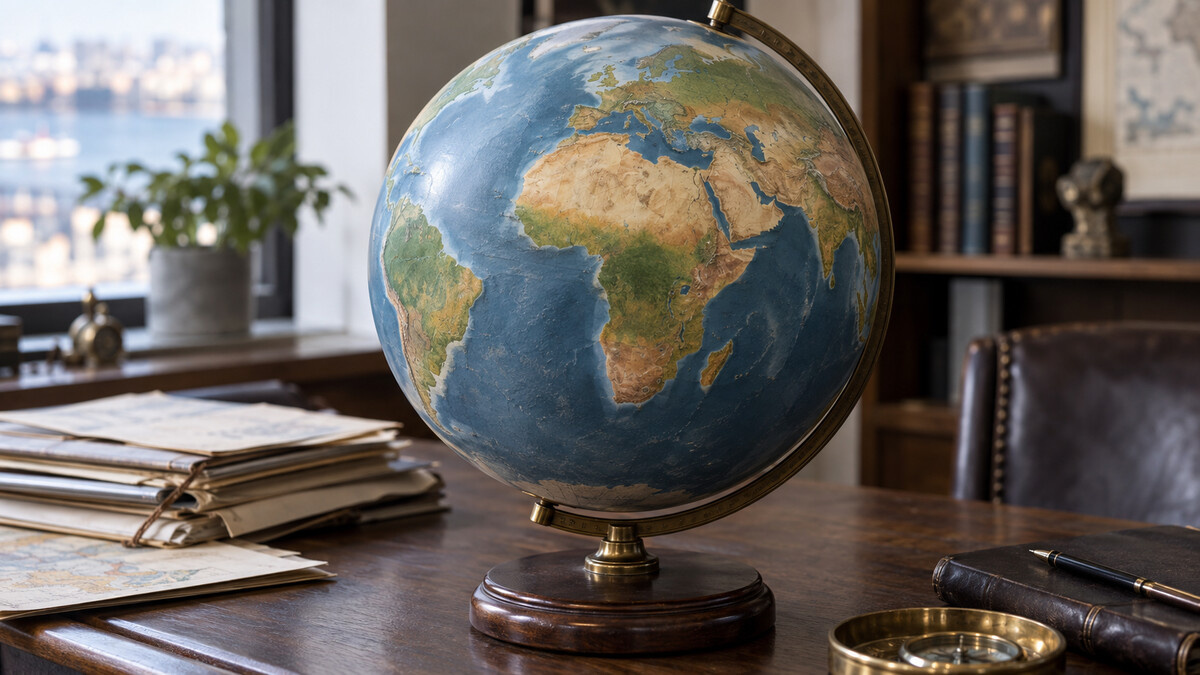
The resource statistics are even starker. After its expansion, BRICS+ became the centre of the global energy supply chain, accounting for 43% of world oil production. Even before the new members joined, the original five controlled 72.5% of global rare-earth mineral reserves, and nearly 85% of refined minerals were extracted in BRICS countries. In other words, the bloc sits astride both ends of the industrial stack: the hydrocarbons that power the twentieth-century economy and the rare earths that feed twenty-first-century electrification, electronics and defence supply chains.
This is the structural fact that turns BRICS from a talking shop into a negotiating position. A grouping that produces 43% of the world's oil and dominates rare-earth refining holds real leverage over the input costs of every advanced economy — leverage that neither sanctions nor tariff threats can conjure away, only redirect.
Seaborne flows: the supply-chain centre of gravity shifts
The enlargement also redrew the bloc's trade map. Egypt brought the Suez Canal — the single most important chokepoint on the Europe–Asia container route — inside BRICS for the first time. The UAE added Jebel Ali-style transshipment depth and a financial-services hub that already intermediates a large share of East–West commodity finance. Iran and (potentially) Saudi Arabia sit on the largest hydrocarbon flows in the world, while Ethiopia anchors African growth demographics.
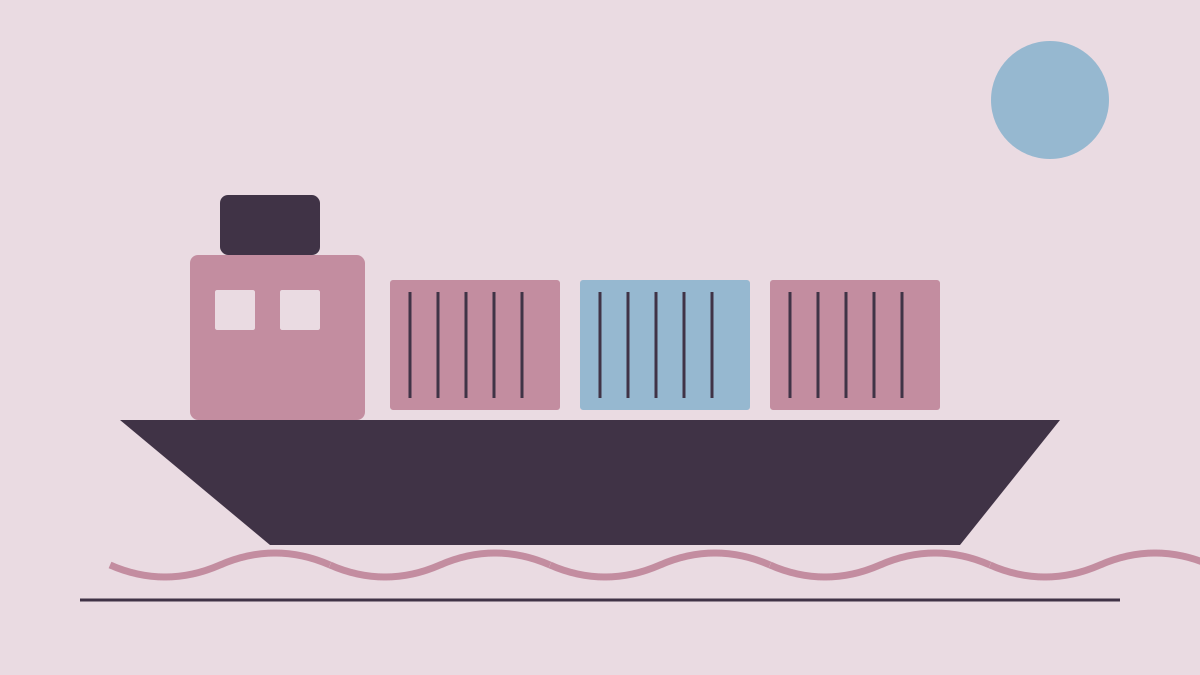
Combined, these assets mean that a growing share of global energy, mineral and manufactured trade either originates in, transits through, or is financed by BRICS+ economies. For the bloc's strategists that is the point: control of physical flows and the settlement rails around them is a more durable form of influence than declarations — and a more defensible one in an era of sanctions and frozen reserves.
National-currency settlements and Trump's 100-percent tariff threat
The financial agenda Putin articulated at Kazan — interbank communication and national-currency settlement mechanisms insulated from external risk — had been building all year. The logic is defensive before it is offensive: three of the bloc's members (Russia, Iran, China) face sanctions of varying severity, and the secondary-sanctions regime means that even untouched partners can lose access to dollar clearing at short notice. Building parallel settlement capacity is, from inside the bloc, a resilience investment rather than an attack on the dollar.
Washington, however, read it as an attack. In the closing weeks of 2024, president-elect Donald Trump issued the first genuinely bad news of the coming year for the BRICS states: any country that undermines the dollar's position as the leading world currency risks "saying goodbye to America." His ultimatum was explicit — "We demand that these countries commit to neither creating a new BRICS currency nor supporting any other currency to replace the mighty US dollar. Otherwise they will face 100-percent tariffs and should expect to say goodbye to sales into the wonderful US economy." The warning, delivered ahead of the January 20, 2025 transfer of power, signalled that the incoming administration intends to contest de-dollarisation head-on and to reject the logic of the Kazan decisions.
The threat creates a genuine dilemma for the enlarged bloc. For China, India and Brazil — all with huge merchandise surpluses tied to American consumers — a 100-percent tariff wall is an existential trade risk, not a talking point. For Russia and Iran, already cut off from the US market, the tariff is close to costless. The consensus required for any joint BRICS response therefore runs through capitals with radically different exposures. That asymmetry, more than any declaration, will determine whether national-currency settlement stays a pragmatic hedge or becomes an open challenge to the dollar — and whether Trump's ultimatum deters it or accelerates it by convincing fence-sitters that dollar dependence is itself the risk.
What to watch in 2025
- The partner-country track: whether the graduated membership ladder agreed at Kazan actually admits the first cohort of partners, and whether Turkey, Serbia, Bolivia, Sri Lanka and Azerbaijan accept a status below full membership.
- Saudi Arabia's procedures: whether Riyadh completes the internal steps it left unfinished in 2024 — the single largest swing factor for the bloc's oil share.
- NDB scaling: whether the bank's $33 billion-plus portfolio grows meaningfully as new members gain access, and whether lending increasingly shifts out of dollar denomination.
- Settlement mechanisms: concrete progress on interbank communication and national-currency payment rails promised at Kazan — the item now directly targeted by the tariff ultimatum.
- Trump's tariff policy after January 20, 2025: whether the 100-percent threat is implemented, narrowed or traded away, and how differently exposed members — surplus exporters versus sanctioned states — respond.
- Cohesion versus dilution: whether a ten-plus-member bloc with a growing partner periphery can still reach consensus at all, the failure mode Ryabkov and Lamola both tried to design against.
Bottom line
The 2024 chairmanship year transformed BRICS from a five-country club into the organisational nucleus of the non-Western economy: membership nearly doubled, more than 30 states converged on Kazan, a partner-status track replaced the old all-or-nothing enlargement, the New Development Bank kept disbursing real money, and the enlarged bloc now accounts for 28.1% of world GDP, 43% of oil production and the overwhelming majority of rare-earth reserves. Argentina's refusal and Saudi Arabia's hesitation proved the bloc is not irresistible; Turkey's and Serbia's approaches proved its pull now reaches inside the Western alliance system itself. And Trump's 100-percent tariff ultimatum proved something else — that Washington now treats de-dollarisation as a threat worth sanctioning, which is the most reliable measure yet that the BRICS financial agenda has stopped being decorative. Whether 2025 turns that agenda into working infrastructure or into a trade war is the question the bloc's second decade will be judged on.
Latest Reports

Ancient Fortresses and Museums of Western Uzbekistan
Qatar LNG expansion: readiness, financing and the production test
Tianwan 7: first electricity and commissioning
Genentech breaks ground on its Hillsboro expansion
RZD changes return fees for tickets purchased from December
Why available capital does not close every defence supply gap
Partner reports
 Ageas agrees Esure acquisition to widen UK insurance distribution
 Uzbekistan’s Western Rail Corridor and the Journey to Khiva
 Imam al-Bukhari’s Heritage and Samarkand’s Pilgrimage Landscape
 Nilu and Sangardak: Village Tourism in Surkhandarya
 One Day in Kasri Orifon: Bukhara’s Pilgrimage Village
 Bukhara’s Biennale: Contemporary Art in Historic Spaces
 Khiva’s Walled City: Architecture, Palaces and Living Traditions
 Parkent’s Chashma Village: Folk Traditions Near Tashkent
 Uzbek Food and Cultural Traditions: From London’s Festival to Regional Tables
 Tashkent’s Museums, Mahallas and New Cultural Spaces
 Uzbekistan's Tourism Expansion: Heritage Cities, Living Crafts and Regional Routes
 Ancient Fortresses and Museums of Western Uzbekistan
 LH Marthinusen opens R32 million Germiston fan factory
 Rishtan’s Craft Neighbourhood and the Fergana Valley
Leave a comment