
Bitcoin Mining Stopped Paying: The 2026 Hash-Price Collapse and the Race to Turn Mines Into AI Data Centers
On Feb. 24, 2026, the bitcoin mining industry crossed a line that few of its participants had been willing to acknowledge out loud: according to a fresh analyst note from Rosenblatt, most bitcoin miners were no longer profiting from their core digital-asset operations. Bitcoin itself was changing hands at $64,143, down roughly 26% year to date, after sliding below $63,000 earlier the same Tuesday to trade near its lowest level in more than two weeks. The decline did more than erase balance-sheet gains accumulated during the stronger months of 2025 — it pushed the unit economics of mining itself below the cost floor for everyone except the most efficient operations. When the marginal producer in an industry stops covering cash costs, the industry does not merely earn less; it begins to reorganize.
For a sector that has already survived four halving cycles, a wave of bankruptcies and an entire intercontinental relocation, the word "unprofitable" is hardly new. What makes the 2026 squeeze different is not the depth of the pain but the escape hatch that now sits next to it: high-performance computing. As hash revenue collapsed, Rosenblatt's message to miners was blunt — actively transition from bitcoin mining to HPC hosting "if at all possible," because demand from the hyperscalers for ready power capacity is the strongest commercial signal the industry has ever received. This deep dive unpacks how mining economics broke in early 2026, how the equity market is pricing that breakage, and what the great pivot toward AI computing means for mining companies, their investors and the bitcoin network itself.
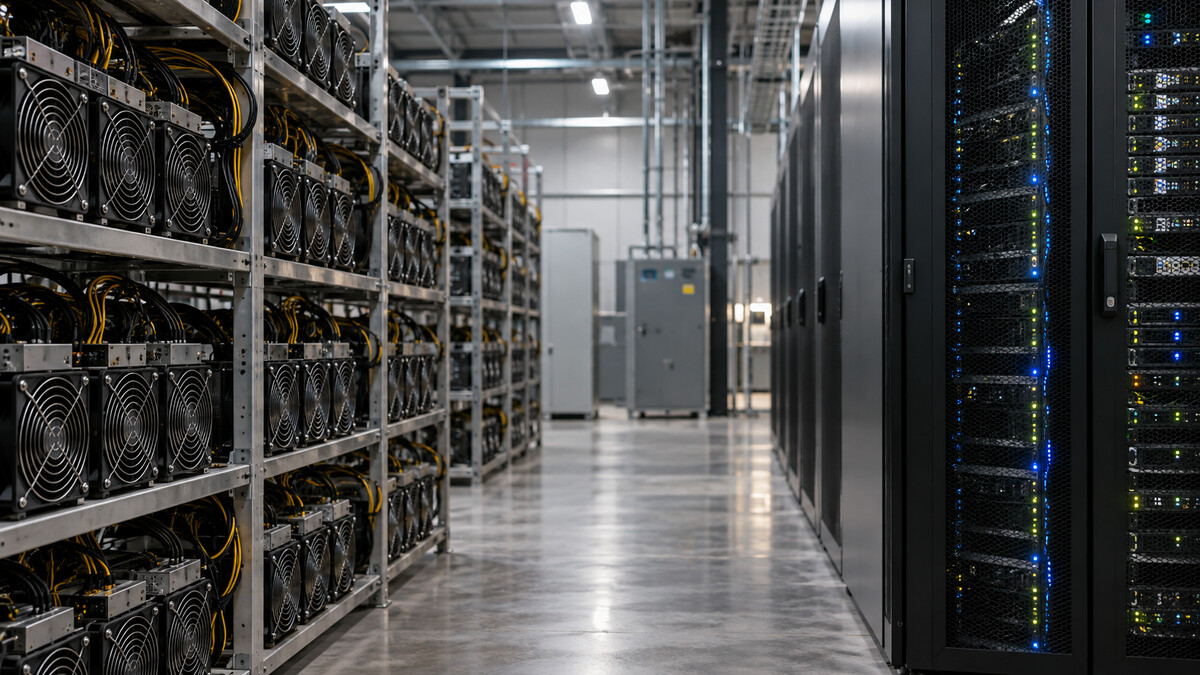
The anatomy of a hash-price collapse
Crypto mining is the energy-intensive process of earning tokens — in most cases bitcoin — by verifying digital transactions on a computer network. Specialized machines compete to solve a cryptographic puzzle; the winner assembles the next block of transactions, and the network pays for that service in newly issued coins plus transaction fees. Since the fourth halving in April 2024, the block subsidy has stood at 3.125 BTC, half of what it was in the previous cycle. Every machine on the network splits that same fixed pool of revenue, which means an individual miner's income depends not only on the price of bitcoin but on how many competitors are plugged in alongside it.
The single metric that condenses all of this into one number is the hash price: the revenue a miner earns per unit of computing power, typically quoted per terahash-second of sustained hashrate. According to data from Hashrate Index cited in the CNBC report, bitcoin's hash price fell about 30% over the three months leading up to late February 2026, roughly tracking the decline in the asset itself, and was last hovering around $28 per petahash-second per day — the equivalent of less than three cents earned by each terahash-second of machines running for a full day.
"With [the revenue earned on mining] now under [3 cents], it is down to levels that are unprofitable for all but the most efficient operations," Rosenblatt analyst Chris Brendler wrote in a Monday note to clients, as quoted by CNBC. The brackets belong to the original quotation's framing, but the substance does not: at sub-three-cent hash revenue, the industry's cost curve has become a sorting mechanism.
The velocity of the deterioration surprised even professional observers who track the sector daily. "Bitcoin mining economics have gone from bad to worse," Brendler wrote in the note. "The record low hash prices that pressured our earnings forecasts in December now look enviable compared to the situation today." That sentence deserves a moment's attention, because it compresses the whole cycle into one comparison: a level of unit revenue that in December 2025 looked like the trough — bad enough to force earnings downgrades across the sector — turned out to be merely a waypoint on the descent. When the record low becomes the envy of the present within two months, forecasting loses much of its meaning and survival arithmetic takes over.
Why hash price falls faster than the coin
The hash price is a ratio, and ratios fall fastest when numerator and denominator move against each other. The numerator is the flow of block rewards and fees, denominated in bitcoin and converted to dollars at whatever the spot price happens to be. The denominator is total network hashrate — the aggregate computing power competing for that flow. In a downturn, the price drop hits the numerator immediately, while the denominator adjusts only slowly: machines already deployed and paid for keep running as long as they cover their marginal electricity bill, and the difficulty adjustment that rebalances the network lags the price by weeks.
The result is a double squeeze. A coin down 26% year to date cuts the dollar value of every block reward by roughly the same proportion; a hashrate base that refuses to shrink in step means the remaining revenue is shared among almost as many machines as before. Miners who signed power contracts at fixed prices during the flush months now find those contracts working against them: their cost per kilowatt-hour did not fall when the hash price did. The gap between revenue per machine and electricity cost per machine is the entire profit of a mining operation, and in February 2026 that gap closed for most of the fleet.
- The price leg. Bitcoin traded at $64,143 and dipped below $63,000, down roughly 26% year to date — every block reward converted into fewer dollars than the cost models assumed.
- The revenue-per-machine leg. The hash price dropped about 30% in three months to the equivalent of under three cents per terahash-second per day, compressing income for all miners regardless of their own efficiency gains.
- The cost leg. Electricity remains the dominant cash cost of mining, and it did not fall with the coin; only operations with the cheapest power and the most efficient machines stayed above water.
The cost floor: who survives when mining stops paying
Every mining fleet can be described by two numbers: its energy efficiency, measured in joules consumed per terahash of hashing, and its all-in cost of electricity, measured in cents per kilowatt-hour. Multiply the hash price by the fleet's hashrate and you have daily revenue; multiply power draw by the electricity tariff and you have daily cost. Where revenue falls below cost, a rational operator unplugs the machine — or, in the case of hosted miners, negotiates, relocates or exits.
This is why Brendler's phrase "unprofitable for all but the most efficient operations" is a precise economic statement rather than a rhetorical flourish. At three cents of revenue per terahash-second, the break-even electricity price for even a modern, efficient ASIC falls to a level that only miners with genuinely cheap power — owned generation, curtailed renewable contracts or subsidised industrial tariffs — can reach. Everyone else is burning cash with every block they help secure.
The mechanism that follows is as old as bitcoin itself. Marginal machines switch off. Network hashrate stops growing or contracts. Within weeks, the difficulty adjustment lowers the puzzle's target, and the coins that remain to be earned are split among fewer machines — hash price stabilizes and eventually recovers for those still running. The 2026 episode is that classic shakeout with one important twist: the trigger came not from a scheduled halving of the reward, but from a price collapse that outran the industry's cost structure between cycles. The halving of 2024 had already halved the subsidy; the bear market of 2026 finished the job by halving the dollar value of what was left.
How the equity market is pricing the pain
The stock reaction among listed miners was severe but telling in its dispersion. BitMine Immersion Technologies had declined 29% in 2026 by the date of the report; MARA Holdings was down 13%; CleanSpark was roughly flat over the same period. Three companies, three different verdicts from the market — a spread that cannot be explained by bitcoin's price alone, because all three face the same hash price and the same coin.
The deeper signal sits in an aggregate number that at first glance looks almost like a data error. Rosenblatt's cap-weighted bitcoin mining index was down just 2% year to date, against a 26% decline in the underlying cryptocurrency. If mining stocks were still trading as leveraged bitcoin proxies — the pattern that defined the sector for most of the last decade — a quarter-scale drawdown in the coin should have produced equity losses several times larger, not 2%. The index's resilience is not evidence that mining is healthy; it is evidence that the market has stopped valuing these companies purely as mining machines. Investors are re-rating them as owners of something scarcer than hash power: energized sites, grid interconnects and data-center shells that can be sold into the AI buildout.
In effect, the cap-weighted index has become a portfolio of options on conversion. The companies whose shares fell hardest — BitMine Immersion with its 29% decline — are the ones the market currently trusts least to monetize that option, whether because of balance-sheet strain, site quality or execution history. The ones that held flat or near it are being credited with credible HPC pathways. The individual stock names tell the same story as the analyst note: pure mining is being discounted; mining-plus-infrastructure is being given the benefit of the doubt.
The escape hatch: from ASIC racks to AI racks

High-performance computing services, or HPC, process data and solve complex calculations at high speed — in the current market, that is close to a synonym for the infrastructure layer of artificial intelligence. The CNBC report names Cipher Mining and TeraWulf as two miners recalibrating their bitcoin-centered operations to run HPC systems. Neither company invented the idea — the sector had been circling it since the previous cycle — but the February 2026 hash-price collapse converted a strategic option into an operational necessity.
"With HPC economics still improving amid increased demand from the hyperscalers, we think all miners should now be actively transitioning from BTC to HPC if at all possible," Brendler wrote. The phrase "if at all possible" carries the weight: Rosenblatt is not promising that every miner can make the transition, only that every miner should try, because the alternative — self-mining bitcoin below the cost floor — destroys value with certainty rather than with probability.
What a miner actually brings to the AI table
The hyperscalers' problem in the mid-2020s was never chips alone; it was energized land. Data-center capacity is gated by grid interconnects, substations, transmission queues and permitting — processes that routinely take half a decade in the markets where AI demand is hottest. Bitcoin miners, by contrast, spent a decade assembling exactly that portfolio: large industrial sites with high-capacity power connections, built quickly and cheaply in places where electricity was abundant.
- Grid connections and contracted capacity. An energized interconnect measured in tens or hundreds of megawatts is the scarcest input in the AI buildout, and miners hold many of them outright.
- Land and permits. Mining sites are already zoned and permitted for continuous heavy electrical load, noise and industrial traffic — conditions a new data-center developer would have to negotiate from scratch.
- Operating culture. Teams that have run hot, power-dense equipment around the clock for years understand load management, electrical maintenance and site security in ways that transfer directly to hosting contracts.
- Flexibility as a feature. A miner that can curtail its own load during grid stress and ramp it back within minutes is a partner utilities like — an asset when negotiating the additional capacity that HPC conversions require.
What miners must acquire is a different commercial temperament. AI hosting demands fiber connectivity of carrier grade, cooling engineered for rack densities far beyond air-cooled ASIC shelves, contractual uptime guarantees and service-level penalties. Bitcoin mining is best-effort by design: a machine can be unplugged for maintenance or curtailed for grid stability without breaching any contract. An HPC customer paying for reserved capacity does not accept "the economics changed" as an explanation for downtime. The pivot therefore tests balance sheets and engineering discipline at least as much as it tests power portfolios.
Why 2026 differs from 2018 and 2022
Mining has been through profitability crises before. The 2018 bear market and the 2022 collapse that followed the failure of over-leveraged crypto lenders both produced the same ending: weak miners sold machines and sites to strong ones at distressed prices, hashrate eventually repriced, and the survivors enjoyed the next expansion. In both episodes, however, a mining site was worth roughly what it could mine. There was no second buyer for the underlying assets, no alternative tenant for the power contract, and no exit that did not run through a future bitcoin price recovery.
The 2026 crisis is structurally different because the miner's core asset — cheap, firm, densely concentrated electric power — now has a second market whose participants are far better capitalized than anything crypto-native. A megawatt of energized capacity that earns sub-three-cent hash revenue mining bitcoin can be worth several multiples of that hosting AI workloads for a hyperscaler. That arbitrage did not exist at comparable scale in 2018, and in 2022 it was a curiosity discussed at conferences. By early 2026 it had become, in Rosenblatt's framing, the default recommendation for the entire sector.
Geography reinforces the point. After China expelled bitcoin miners in 2021, the industry rebuilt overwhelmingly in the United States and other power-surplus jurisdictions — which is to say, precisely in the electricity markets where the AI data-center boom subsequently concentrated its demand. The forced migration that looked like a catastrophe in 2021 accidentally positioned the fleet next to its future customers. Few industries have ever benefited so much from being exiled to the right place.
The risks of the pivot
None of this makes the transition a free lunch, and a sober reading of the Rosenblatt note leaves plenty of room for failure. The recommendation that all miners transition "if at all possible" implicitly concedes that for some, it will not be possible — and the market's verdict on BitMine Immersion's shares suggests investors are already sorting the sector into converters and casualties.
- Capital intensity. Retrofitting mining halls for high-density GPU racks — cooling plants, electrical distribution, fiber and physical security — requires hundreds of millions of dollars of capital per site, raised at exactly the moment when mining cash flow has stopped and equity stories are weakest.
- Competition for contracts. Miners are not the only suppliers chasing hyperscaler leases; incumbent data-center developers, utilities and the cloud providers themselves are all building capacity. A miner's power portfolio wins deals only if its execution credibility matches its megawatts.
- Counterparty concentration. HPC hosting replaces thousands of anonymous block rewards with a handful of large, long-dated contracts. Anchor tenants bring stability but also dependence: losing one can impair an entire conversion business case.
- Network externalities. If large shares of hashrate migrate to AI hosting, bitcoin's security budget — the total dollars spent defending the network — shrinks in the short run. The difficulty adjustment cushions the fall, but a miner exodus at scale would change the network's security economics for the first time in its history.
- The recovery paradox. A sharp bitcoin rebound raises the opportunity cost of every converted megawatt, tempting miners to slow or reverse their transitions precisely when their HPC customers need certainty — a strategic whiplash the sector has lived through before, in smaller form, on every cycle turn.
Questions investors should ask before buying the pivot
- How much of the company's power capacity is under signed HPC contracts, versus memoranda of understanding or announced intentions?
- What is the estimated retrofit cost per megawatt, and how is it financed — cash, debt, equity or customer prepayments?
- What remains of the self-mining margin at current hash prices, and how quickly can idle machines be redeployed or sold?
- How long is the contractual runway on power purchase agreements if hosting revenue slips its schedule?
- Does management's track record include delivering infrastructure on time and on budget — or only ordering machines and energizing sheds?
What it means for the bitcoin network
Mining is bitcoin's security budget: the dollars spent on machines and power are the dollars an attacker would have to outbid to rewrite the ledger. A hash price below the cost floor does not stop the network — the protocol was designed for exactly this adjustment, and blocks have continued every ten minutes through far worse — but it does change who secures the chain. Each megawatt that leaves mining for AI hosting is a megawatt no longer defending the ledger, at least until economics pull capacity back.
The longer-term shift may matter more than the cyclical one. If the largest public miners increasingly treat bitcoin as a secondary workload — a flexible filler load to run when HPC demand is satisfied and hash price recovers — then the marginal provider of bitcoin's security becomes a hybrid infrastructure company whose first obligations run to data-center counterparties rather than to the chain. Bitcoin will survive that; it has survived Chinese expulsion, halving shocks and repeated capitulations. But the romance of mining as a pure-play bet on the coin will have ended, replaced by something closer to an industrial real-estate business with a cryptocurrency option embedded in it.
Outlook: three paths through 2026
- Pure-miner consolidation. The most efficient operators — cheapest power, newest fleets — absorb distressed machines and sites at the bottom of the cycle, let difficulty reprice the network, and harvest the recovery when hash price normalizes. This is the classic playbook, and it still works for those with balance sheets to survive the wait.
- Full conversion. Power-rich sites transition entirely to HPC hosting, with mining retained only as a filler load in halls awaiting rack deployment. For these companies, the bitcoin price becomes a rounding error next to lease terms and occupancy rates.
- The hybrid majority. Most listed miners land between the poles, splitting capacity between self-mining and hosting and steering megawatts toward whichever use pays more at the margin. Rosenblatt's cap-weighted index — down just 2% while the coin fell 26% — suggests the market has already priced a good deal of this scenario.
Which path dominates will depend less on the next move in bitcoin than on the durability of AI infrastructure demand. If hyperscaler appetite for energized sites keeps improving, as Rosenblatt observed in February 2026, conversion economics will continue to dwarf mining economics, and the pivot will accelerate regardless of any coin-price bounce. If that demand stalls, miners will rediscover that the escape hatch only opens outward — into a market that must keep wanting what they have to sell.
The bottom line
February 2026 will be remembered less as the month bitcoin slipped under $63,000 than as the moment mining's core economics formally broke: hash revenue under three cents per terahash-second, a 30% decline in three months, and a blunt instruction from the sell side that every miner transition to high-performance computing if at all possible. The shakeout this triggers will follow the ancient pattern — the inefficient exit, difficulty adjusts, survivors consolidate — but with one historically new feature: for the first time, the assets that leave bitcoin mining have somewhere else to go, and that somewhere else pays better.
The question facing the sector is no longer whether miners can survive the cycle. It is how many of them will still be miners by the next halving — and whether the network they leave behind will be secured by believers in the coin or by landlords of the grid. The hash price will eventually recover; it always has. What will not recover is the industry's old self-image as a pure bet on bitcoin. In 2026, mining stopped being the business and became the feedstock — raw power capacity awaiting a higher-value tenant.
Latest Reports

Ancient Fortresses and Museums of Western Uzbekistan

Qatar LNG expansion: readiness, financing and the production test
Tianwan 7: first electricity and commissioning

Genentech breaks ground on its Hillsboro expansion

RZD changes return fees for tickets purchased from December
Why available capital does not close every defence supply gap
Partner reports
 Ageas agrees Esure acquisition to widen UK insurance distribution
 Uzbekistan’s Western Rail Corridor and the Journey to Khiva
 Imam al-Bukhari’s Heritage and Samarkand’s Pilgrimage Landscape
 Nilu and Sangardak: Village Tourism in Surkhandarya
 One Day in Kasri Orifon: Bukhara’s Pilgrimage Village
 Bukhara’s Biennale: Contemporary Art in Historic Spaces
 Khiva’s Walled City: Architecture, Palaces and Living Traditions
 Parkent’s Chashma Village: Folk Traditions Near Tashkent
 Uzbek Food and Cultural Traditions: From London’s Festival to Regional Tables
 Tashkent’s Museums, Mahallas and New Cultural Spaces
 Uzbekistan's Tourism Expansion: Heritage Cities, Living Crafts and Regional Routes
 Ancient Fortresses and Museums of Western Uzbekistan
 LH Marthinusen opens R32 million Germiston fan factory
 Rishtan’s Craft Neighbourhood and the Fergana Valley
Leave a comment