
Türkiye's 2025 Turnaround: Disinflation, Record Exports and the Defense Boom
Few emerging markets entered 2025 carrying as much macroeconomic baggage as Türkiye did: annual inflation that had peaked above 75%, a currency that had spent years under pressure, and a business community hungry for predictability. Twelve months later, the picture looks remarkably different. Inflation has fallen for most of the year, exports have climbed to all-time highs, gross domestic product is approaching $1.48 trillion, and the defense and aerospace sector — once a niche of the national economy — has become one of its most visible growth engines. This deep dive reconstructs how that turnaround came together, what it says about the country's business climate, and which tests still lie ahead in 2026.
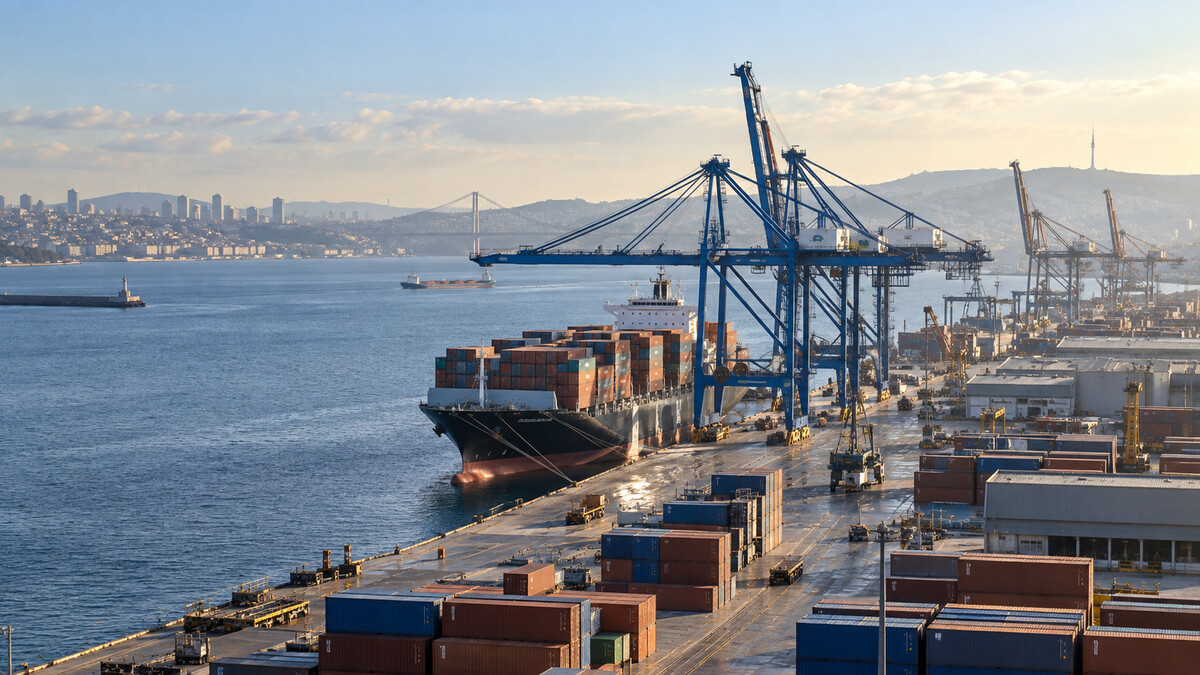
The factual backbone of this analysis is the annual review published by Anadolu Agency on Dec. 19, 2025, which characterized the year as one of the most transformative of the past decade — a rare convergence of economic stabilization, expanding global trade and an unprecedented surge in defense and high-technology capabilities.
Three transitions that defined the year
Read together, the data describe not a single rebound but three simultaneous transitions, each reinforcing the others:
- From price chaos to disinflation. After peaking above 75% in 2024, annual consumer-price inflation declined almost continuously through 2025, reaching 31.07% in November — the lowest reading in four years.
- From volume exports to value exports. Total exports reached $390 billion as of October, the highest in the country's history, with medium- and high-technology goods accounting for more than 40% of manufacturing exports.
- From defense importer to defense partner. With a domestic localization rate exceeding 80% and a string of landmark contracts in Europe and Asia, Türkiye completed its transition from buyer of weapons systems to designer, producer and exporter.
Each of these shifts matters on its own. Combined, they reshape the investment case for the country: lower inflation restores the visibility that long-term projects require; a richer export mix lifts margins and productivity; and defense diplomacy pulls the economy deeper into European and Asian industrial chains.
Growth held up despite global headwinds
The scale of the Turkish economy has changed dramatically over two decades. Gross domestic product is projected to reach roughly $1.48 trillion by the end of 2025, continuing a rise from about $238 billion in 2002 — a more than sixfold expansion in nominal dollar terms. Vice President Cevdet Yilmaz said in October that the economy is expected to grow further to $1.84 trillion in 2026, a projection that implicitly assumes both continued real growth and a more stable price level.
Over recent decades the country has posted average annual growth of around 5%, ranking among the fastest-growing economies in the Organization for Economic Co-operation and Development (OECD). That record matters for 2025 because the global backdrop was anything but supportive: trade routes were disrupted, tariff uncertainty hung over manufacturing, and financial conditions remained tight across most advanced economies.
Against that backdrop, the quarterly numbers tell a story of resilience with a cooling edge. In the second quarter of 2025, GDP expanded by 4.9% year on year. In the third quarter, growth slowed to 3.7% — still, as President Recep Tayyip Erdogan noted, the fourth-highest reading among OECD countries. Momentum softened, but exports, industrial output and technology-driven sectors provided crucial support, cushioning the economy against external shocks.
What the cooling actually signals
The deceleration from 4.9% to 3.7% should not be read as a failure of the stabilization program — it is, in large part, the program working. Disinflation of the kind Türkiye achieved in 2025 typically requires tighter financial conditions, a stronger real currency and more cautious consumption. The relevant question for businesses is not whether growth slowed, but whether the composition of growth improved. On that measure the evidence is favorable: private investment shifted toward tradable, technology-intensive sectors, and export revenue — not domestic credit — did more of the work.
Disinflation: the defining story of 2025
For households and companies alike, the inflation trajectory was the year's central narrative. After the 2024 peak above 75%, annual consumer-price inflation trended steadily lower month after month:
- February 2025: 39% — the ninth consecutive monthly decline;
- May 2025: 35.4%;
- July 2025: 33.5% — a 44-month low;
- November 2025: 31.07% — the lowest reading in four years.
Just as important as the annual headline was the monthly rhythm. Monthly price increases moderated to below 1% for the first time in over two years — a key signal that inflationary pressures were easing broadly across the economy rather than in a handful of volatile categories. Monthly readings under 1% are consistent with an annualized trend far below the inherited levels, and they are the metric the central bank watches most closely when calibrating rate cuts.
Policy guidance pointed firmly in the same direction. The Turkish Central Bank forecasts year-end inflation in the 31%–33% range, with a continued decline toward 13%–19% in 2026. Finance Minister Mehmet Simsek has said inflation could fall into the 20% range early next year. If that path holds, 2026 becomes the year in which Türkiye's disinflation transitions from cyclical relief to structural credibility — the point at which companies begin writing multi-year contracts, wage settlements and capex plans in lira without reflexive indexation.
Why predictability is the real dividend
The economic literature on high-inflation economies is blunt: the deepest damage is not the price level itself but the loss of the planning horizon. When inflation runs above 70%, firms price defensively, households convert savings into hard assets, and lenders retreat to short maturities. The 2025 disinflation reversed each of those behaviors at the margin. Confidence and predictability were restored for households, investors and exporters alike — the exact words Anadolu's review used to describe the shift. For the business climate, that restoration is arguably worth more than any single stimulus measure, because it lowers the risk premium embedded in every investment decision.
Record exports and a structural upgrade
Exports were the other standout of the year. Total exports reached $390 billion as of October — the highest figure in the country's history — while merchandise exports hit $270 billion, exceeding national targets. The composition of that trade is where the deeper story lies.

Manufacturing, vehicles, machinery and technology-intensive products led the expansion. The share of medium- and high-technology goods exceeded 40% of manufacturing exports — a threshold that economists treat as evidence of structural transformation rather than a one-off boom driven by a weak currency. Critical technology exports, a basket that includes aerospace, electronics, medical devices and digital systems, reached $80.7 billion in the first nine months of the year.
Defense and aerospace delivered some of the most striking gains within that mix. According to Haluk Gorgun, head of Türkiye's Defense Industries Secretariat, defense and aerospace exports reached $8.5 billion year-to-date in 2025, up from $7.1 billion the previous year — growth of roughly 20% in a single season. Trade Minister Omer Bolat said that by mid-year the Turkish defense sector comprised around 3,500 firms employing roughly 100,000 people.
Two structural indicators explain why this export base is more durable than earlier cycles:
- Localization above 80%. Türkiye has largely completed its transition from defense importer to designer, producer and exporter, with a domestic localization rate exceeding 80%, sharply reducing foreign dependency — and, crucially, capturing the full value chain at home.
- Global scale players. Several Turkish companies now rank among the world's top 100 defense manufacturers, including Aselsan, Turkish Aerospace Industries (TAI), Roketsan, ASFAT and MKE — anchors around which thousands of smaller suppliers have grown.
Defense diplomacy: from buyer to partner
The year's most consequential deals were not simply sales; they were partnerships that embedded Turkish industry into foreign production networks — and foreign industry into Turkish programs.
In July, Baykar, the country's leading drone manufacturer, finalized its acquisition of Italy's 140-year-old Piaggio Aerospace, including production facilities — a rare case of a Turkish technology firm buying European heritage manufacturing. Baykar also signed cooperation agreements with Italian defense giant Leonardo, forming a joint venture, LBA Systems, that blends AI-driven Turkish platforms with European aerospace expertise to co-develop next-generation unmanned aerial vehicles for the European market.
TAI, for its part, secured a €3.12 billion ($3.62 billion) agreement in Spain to co-produce and export HURJET, Türkiye's indigenous jet trainer and light attack aircraft — one of the largest defense contracts ever signed between a NATO European member and a Turkish prime contractor. TAI also signed cooperation deals with BAE Systems in the United Kingdom on uncrewed systems, and with firms in Indonesia to export 48 KAAN fifth-generation fighter jets, an agreement covering production, engineering and technology sharing.
The pattern across these deals is consistent: co-production rather than turnkey sales, technology sharing rather than one-way transfer, and a footprint that now spans Southern Europe and Southeast Asia. For the broader economy, each partnership multiplies supplier orders, engineering employment and export pipelines well beyond the prime contractors themselves — and strengthens Türkiye's position as a regional technological hub.
A year of firsts on the technology front
Behind the contracts, 2025 produced a dense sequence of technical milestones that demonstrated indigenous capability rather than intent:
- A $6.5 billion contract was signed to strengthen the Steel Dome integrated air-defense architecture, a multilayered system spanning short-, medium- and long-range defense.
- Baykar's Bayraktar KIZILELMA, Türkiye's first uncrewed fighter jet, made aviation history as the world's first UAV to fire a beyond-visual-range air-to-air missile, striking a high-speed jet target with the locally developed GOKDOGAN missile during a test.
- The Bayraktar TB3, designed for short-runway naval operations, completed more than 100 sorties aboard the UAV carrier TCG Anadolu, demonstrating AI-supported automatic takeoff and landing.
- The TB3 later conducted a joint operation with Aselsan's Albatros-S kamikaze unmanned surface vehicle, proving cross-domain coordination between air and sea unmanned systems.
- At the International Defense Industry Fair (IDEF), Roketsan unveiled Tayfun Block-4, Türkiye's first hypersonic missile, while the Defense Ministry showcased GAZAP, the country's most powerful conventional aerial bomb at 970 kilograms, and the NEB-2 Ghost bunker-buster.
Individually, each item is a procurement milestone. Collectively, they mark the moment when the domestic industry moved from assembling licensed designs to setting technical benchmarks that foreign buyers now negotiate around.
Showing the ecosystem at home: IDEF and TEKNOFEST
The year's advances were on full display domestically as well. At IDEF 2025, Turkish firms presented cutting-edge platforms ranging from autonomous systems to next-generation armored vehicles, turning the fair into both a showroom and a contracting venue for visiting delegations.
TEKNOFEST, the country's flagship technology and aviation festival, drew 1.03 million visitors in Istanbul in September. The five-day event at Ataturk Airport was organized by the Turkish Technology Team (T3) Foundation together with the Industry and Technology Ministry. A maritime edition, Blue Homeland, ran for four days in August under the hosting of the Istanbul Shipyard Command, highlighting naval strength and cutting-edge technologies.
Festivals of that scale are often dismissed as spectacle, but in an industrial-policy context they function as a talent pipeline: competitions, scholarships and team grants feed universities and companies with engineers who arrive already socialized into project culture. The million-plus attendance is also a domestic-confidence indicator — households that queue for five days to see national technology are households whose inflation expectations are beginning to stabilize.
What the 2025 turnaround means for investors and companies
Assessed as a whole, the year changed the risk calculus for operating in the Turkish market. The Anadolu Agency review frames 2025 as a consolidation of Türkiye's position as a regional technological hub, a rising exporter and a resilient economy, supported by assertive industrial policy, disciplined macroeconomic management and expanding international partnerships.
The practical takeaways for businesses weighing exposure to the market:
- The planning horizon is back. With inflation at a four-year low and monthly increases under 1%, multi-year lira contracts and local financing become viable again — a change that matters most for construction, retail and consumer-goods operators.
- Export upgrading creates supplier opportunities. A defense sector of 3,500 firms and $80.7 billion in nine-month critical-technology exports means deep demand for precision machining, electronics, composites and software along the whole supplier pyramid.
- Partnership, not just procurement. The Piaggio acquisition, the LBA Systems joint venture with Leonardo, HURJET co-production in Spain and the KAAN deal with Indonesia show a country that now trades technology both ways — foreign firms gain access to platforms and engineering capacity, not just sales channels.
- The 2026 test is credibility. The central bank's 13%–19% inflation forecast for 2026 is ambitious relative to the 31% starting point; missing it would revive indexation reflexes quickly. Growth also needs to re-accelerate from the third-quarter pace of 3.7% without reigniting price pressures.
- External conditions remain the swing factor. Global trade disruptions weighed on 2025 and will weigh on 2026; the economy's cushion is now its export mix, which is more diversified and more technology-intensive than at any point in the past two decades.
What to watch in 2026
Three signposts will show whether the 2025 turnaround becomes durable rather than cyclical. The first is the disinflation slope: the central bank's 13%–19% forecast for 2026 requires monthly price growth to average well below 1%, and any re-acceleration in services inflation would quickly revive indexation behavior. The second is export composition — whether the share of medium- and high-technology goods stays above the 40% threshold in manufacturing exports and whether defense and aerospace receipts push beyond the $8.5 billion mark of 2025. The third is the partnership pipeline: converting signed agreements — HURJET co-production in Spain, the 48-aircraft KAAN program with Indonesia, the LBA Systems roadmap for Europe — into delivered airframes and booked revenue will determine whether defense diplomacy matures into a stable export platform or remains a sequence of headline deals.
The balance sheet of the year
By the closing weeks of 2025, Türkiye had assembled something few stabilization programs achieve simultaneously: falling prices, growing output, record trade and a flagship industry winning global contracts. The vulnerabilities have not disappeared — the disinflation path for 2026 is steep, quarterly growth momentum softened through the year, and the global trade environment stays hostile. But the direction of travel changed decisively. After a period of volatility, the country entered a swift disinflation cycle that restored confidence and predictability, while record-breaking exports underscored the growing sophistication of its production base. If 2026 delivers even the lower bound of the central bank's inflation forecast, the 2025 turnaround will be remembered less as a rebound and more as the year the Turkish growth model was rebuilt around technology, exports and industrial partnerships.
Latest Reports

Ancient Fortresses and Museums of Western Uzbekistan

Qatar LNG expansion: readiness, financing and the production test

Tianwan 7: first electricity and commissioning

Genentech breaks ground on its Hillsboro expansion

RZD changes return fees for tickets purchased from December
Why available capital does not close every defence supply gap
Partner reports
 Ageas agrees Esure acquisition to widen UK insurance distribution
 Uzbekistan’s Western Rail Corridor and the Journey to Khiva
 Imam al-Bukhari’s Heritage and Samarkand’s Pilgrimage Landscape
 Nilu and Sangardak: Village Tourism in Surkhandarya
 One Day in Kasri Orifon: Bukhara’s Pilgrimage Village
 Bukhara’s Biennale: Contemporary Art in Historic Spaces
 Khiva’s Walled City: Architecture, Palaces and Living Traditions
 Parkent’s Chashma Village: Folk Traditions Near Tashkent
 Uzbek Food and Cultural Traditions: From London’s Festival to Regional Tables
 Tashkent’s Museums, Mahallas and New Cultural Spaces
 Uzbekistan's Tourism Expansion: Heritage Cities, Living Crafts and Regional Routes
 Ancient Fortresses and Museums of Western Uzbekistan
 LH Marthinusen opens R32 million Germiston fan factory
 Rishtan’s Craft Neighbourhood and the Fergana Valley
Leave a comment