
Russia's Timber Industry Braces for a Perfect Storm: an 18% Rate, a Strong Ruble and the Squeeze on Exporters
Russia's forest industry is entering the autumn of 2025 with a split identity. On paper the sector is still growing: first-half statistics show output rising across most product lines, including the fuel-pellet segment that European sanctions hit hardest three years ago. In the boardrooms the mood is the opposite. Executives of the country's largest pulp, paper and wood-processing groups describe conditions as close to a crisis and warn that, if the current macroeconomic parameters persist, stagnation will slide into bankruptcies among the most vulnerable producers.
The paradox is central to understanding corporate Russia beyond the headline GDP numbers. The timber complex is one of the country's most export-dependent industrial clusters, and after losing the European market it re-anchored itself on Asia. That re-anchoring turned two domestic variables — the Central Bank's key rate and the ruble exchange rate — into the sector's de facto pricing inputs. When both move against exporters at the same time, even a full order book cannot protect margins.
This deep dive unpacks the mechanics of that warning using the sector review published in Kommersant's Review supplement on September 2, 2025, which combines Rosstat production data, statements by Ilim Group, Segezha Group and Perm Pulp and Paper Mill, and the position of the Ministry of Industry and Trade. The question it raises is broader than timber: how long can an export industry survive a domestic monetary cycle that was never designed with it in mind?
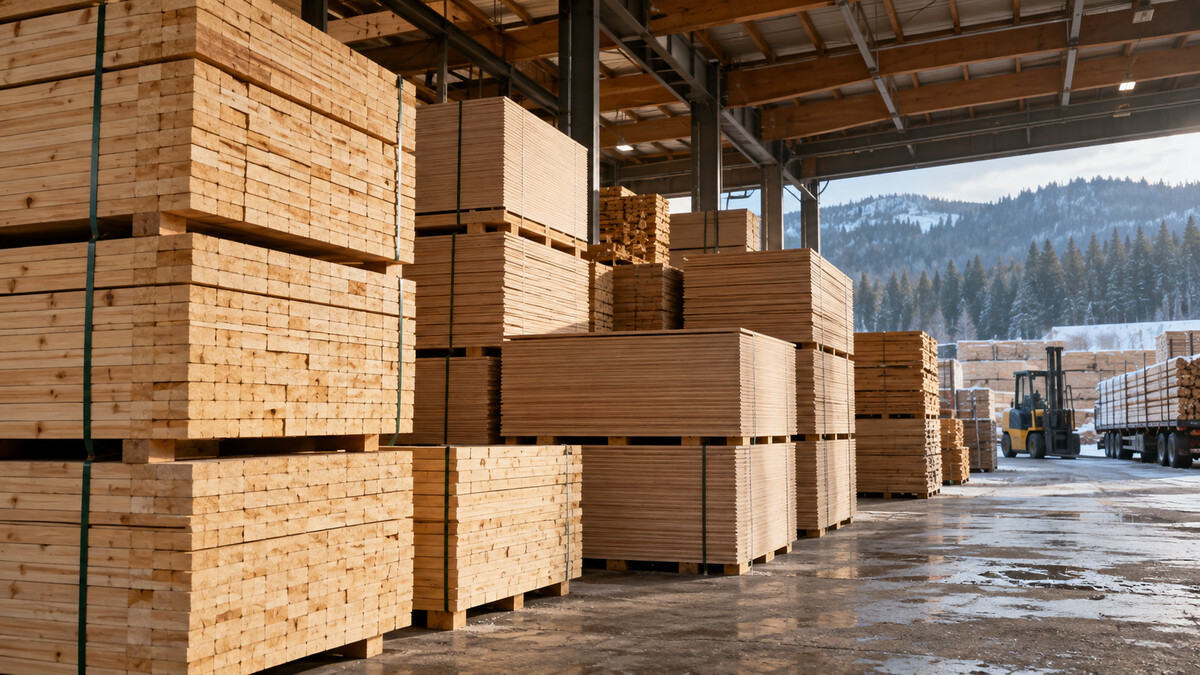
A sector that still prints positive numbers
The first-half data do not, at first glance, support alarmism. According to Rosstat, production grew in most categories between January and June 2025, and the June figures alone were stronger than the six-month trend in several segments. The official picture looks like this:
- Sawn timber: 14.5 million cubic metres, up 1.5% year on year; June alone up 11.7% at 2.8 million cubic metres.
- Plywood: 1.8 million cubic metres, up 4.3%; June up 1.5% at 277,000 cubic metres.
- Particleboard: 5.6 million cubic metres, down 12.4%; June down 41.1%.
- Fibreboard: 339 million square metres, down 5%, although June recovered 2%.
- Paper and board: 5.3 million tonnes, flat against the first half of 2024.
- Fuel pellets: 567,000 tonnes, up 8.1%; June up 44.1% at 97,200 tonnes.

The dispersion inside this table is the real story. Products tied to construction, furniture and interior finishing — particleboard above all — are contracting sharply, while sawn timber and plywood hold up on export volumes. Paper and board sit flat, and pellets rebound from a depressed base rather than from genuine market recovery. In other words, the aggregate growth rate is being carried by the segments with the thinnest margins and the weakest pricing power.
There is also a timing effect that flatters the statistics. Wood-processing output follows contracts signed and logistics booked months earlier, so first-half volumes partly reflect the demand picture of late 2024. Order books, spot prices and utilization rates are the leading indicators, and on all three the industry's own reporting is negative. That is why companies interviewed for the sector review insist the official growth is a lagging artifact, not evidence of health.
The macro squeeze: an 18% rate and a currency moving the wrong way
Ilim Group, one of the country's largest pulp and paper producers, put the problem bluntly: the current parameters are simply unacceptable for producers that are export-oriented by necessity, because the domestic market is too small to absorb their output. On external markets, the company notes, effectively only one direction remains open — Asia, and above all China. In that configuration exporters depend completely on the national currency course and on the funding rate, which follows the Central Bank's key rate directly.
The transmission mechanism is straightforward and brutal. Logging, processing and shipment form a working-capital-intensive cycle: a cubic metre of sawn timber ties up cash for months between stumpage payment and foreign-customer payment, and that cash is mostly bank credit priced off the policy rate. At a key rate of 18%, carrying inventory and receivables consumes a large share of the gross margin before a single board is shipped. Simultaneously, a stronger ruble converts an unchanged dollar price into fewer rubles of revenue, while wages, energy, taxes and domestic logistics — the bulk of the cost base — remain rouble-denominated. The two forces squeeze the margin from both sides at once.
The industry has quantified its comfort zone: companies consider a rate no higher than 12% and an exchange rate around 95 roubles per US dollar acceptable. The distance between those thresholds and the actual parameters of mid-2025 is, in practical terms, the distance between routine stress and insolvency for leveraged producers. Sector players argue that if the rate and the currency stay where they are, the deterioration will continue until the weakest companies fail.
The squeeze is not only a corporate story but a regional one. Timber is the economic backbone of mono-industrial territories — the logging and mill towns of Arkhangelsk and Vologda oblasts, the Komi Republic and Karelia — where a handful of employers absorb most of the qualified workforce and feed local budgets with wages and transport orders. A prolonged utilization cut therefore transmits into municipal finances and household incomes with a one- to two-quarter lag, which explains why regional legislators, such as the Arkhangelsk assembly committee cited in the sector review, are among the most vocal lobbyists for federal relief. For the federal center the industry's distress is thus also a social-policy variable: bankruptcies in timber regions would convert a corporate balance-sheet problem into a budgetary and employment one.
Why exporters cannot hedge their way out
In a normal export industry, currency risk is hedged and rate risk is managed with fixed-rate debt and export credit lines. The Russian timber complex has lost most of that toolkit. With Europe closed, sales concentrate on a handful of Asian destinations where buyers know they face a captive supplier and negotiate prices down. Long-term fixed-rate financing is scarce in a double-digit rate environment, and leasing of harvesting machinery has become prohibitively expensive. The result is an industry that exports physical volume but imports financial risk: every policy-rate decision and every currency intervention passes straight into its unit economics.
Demand is eroding at both ends of the chain
Macroeconomics explains the margin squeeze; demand explains the volume risk. Domestic consumption of timber products rests on two pillars — construction and packaging — and both were weakening through 2025. Housing starts cooled as subsidized mortgage programs wound down, and the pulp-and-paper segment that serves packaging felt the fall in consumer-goods output.
The external side is no safer. Denis Kondratyev, head of the Center for Systemic Solutions, points out that demand for containerboard and corrugated products is being hurt by the trade war between the United States and China, which has reduced shipments of packaged goods across the Pacific. Russian producers of containerboard compete in the same global market, so a slowdown in Asian converting activity reaches their order books within a quarter.
Inside the country the picture is broad-based: output is falling in practically all consumer-goods industries, from food and beverages to building materials and household appliances. Novo Packaging BB estimates that the combined full-year decline across all packaging-consuming segments will reach about 1.2% even before accounting for retail and online trade, which are the only channels still adding volume.
The packaging channel deserves a closer look because it connects timber to the whole consumer economy. Corrugated boxes and containerboard follow the output of food, beverages, appliances and e-commerce fulfilment; when those industries trim volumes, paper mills lose their most stable customer exactly when construction-linked boards are already falling. This is why the industry's demand problem cannot be solved inside the forest: it is a derivative of household consumption, which in turn is a derivative of the deposit rate banks pay on savings. The timber complex, in other words, is competing for the same household rouble as the banks' deposit books.
Yury Markov, head of Perm Pulp and Paper Mill, links the consumer slump directly to monetary policy: households cut spending and move money into high-yield deposit accounts offered by banks, draining demand from goods markets. The resulting surplus in the pulp-and-paper industry forced companies to cut utilization and prices. In his reading, the way out requires restoring the balance between supply and demand — either through a lower key rate that revives consumer spending, or through a weaker ruble that makes exports of pulp-and-paper products profitable again.
The state's toolbox is real but small
The government does not dispute the diagnosis. Mikhail Yurin, deputy head of the Ministry of Industry and Trade, told the forestry development council at the Federation Council in July that, given the existing macroeconomic preconditions, the industry is in a very difficult situation. The ministry's main instrument for 2025 is a transport subsidy of 1.5 billion roubles preserved for exporters, compensating part of the logistics cost of foreign deliveries.
Companies consider the amount insufficient relative to the scale of the sector, and the federal budget's rigid constraints leave no room to enlarge it. The practical consequence is that support policy shifts from money to regulation: if the state cannot change the rate or the currency, the industry asks it to remove every avoidable cost and administrative barrier.
Nikolai Ivanov, vice president of Segezha Group for government relations, forest policy and sustainable development, listed those barriers at the same July session: the sharp increase in environmental fee rates proposed by the Ministry of Natural Resources, the new procedure for accounting and paying for phytosanitary certificates, and the absence of a moratorium on forest-lease rent increases together with the rule that allows lease termination when less than 70% of a plot is developed. With a sharp fall in wood processing and logging expected in the third and fourth quarters, he argued, additional barriers for the industry look irrelevant. Segezha Group and other companies also lobby for a reducing coefficient of 0.9 to the rail tariff for sector companies in 2025–2026 — a request that acknowledges how much of the sector's cost curve now sits in logistics rather than in the forest.
Second-half outlook: a soft landing is not the base case
Participants expect the wood-processing segment to deteriorate through the second half of the year. Ivanov warned in July that fourth-quarter production figures will be much less optimistic than the first half's, and his framing has become the sector's consensus: the first-half growth was the tail of 2024's order book, not the beginning of a recovery.
The pulp-and-paper segment expects a milder autumn. Igor Shilov, sales director at Perm Pulp and Paper Mill, says the company does not expect a demand surge in the near term but counts on a seasonal factor: seasonal demand for corrugated products should allow the segment to pass through a 3–5% price decline by year-end without destabilizing utilization. That is the optimistic corner of the industry — stability measured in single-digit price erosion.
One more variable sits outside the companies' and the ministry's control: the ruble's political economy. A weaker currency helps exporters but feeds inflation and thus delays the rate cuts the same exporters need; the sector is caught in a policy contradiction where only one of its two wishes can be granted at a time. Industry economists quoted in the review implicitly acknowledge this by listing both levers without ranking them — a diplomatic way of saying that the sector's recovery depends on a macro combination the Central Bank has no mandate to optimize for timber.
Three scenarios the sector is pricing in
- Macro normalization: the key rate falls toward the 12% threshold and the ruble softens toward 95 per dollar; margins recover gradually and capex programs resume in 2026.
- Persistent squeeze: parameters stay restrictive; utilization cuts deepen, price competition intensifies, distressed assets change hands, and the weakest producers — over-leveraged mid-size mills — enter bankruptcy or debt restructuring.
- External shock: the US–China trade conflict deepens or Asian prices fall further; containerboard and plywood exporters lose the last pricing anchor, accelerating scenario two.
The industry's lobbying agenda — regulatory relief, rail tariff coefficient, lease moratorium — is effectively an insurance policy against scenario two, the one most companies treat as the base case.
Pellets: the sanctions-hit niche with a China option
The pellet segment deserves separate attention because it compresses the whole story into one product line. Historically oriented to Europe, it suffered more than any other timber category from Western sanctions: at many plants production simply stopped because there was nowhere to sell. The first quarter of 2025 was still contracting; positive dynamics appeared only from April.
By the end of the first half, output had grown 8.1% to 567,000 tonnes, with June alone up 44.1% at 97,200 tonnes. Alexander Dyatlov, head of a committee of the Arkhangelsk regional assembly, cautions that the rebound is largely a base effect against a very weak 2024, though he credits state measures promoting biofuel with modest but real results: domestic pellet consumption is growing, including in private households.
Segezha Group, one of the largest pellet producers, reported that its sales of the product almost tripled in the first half to 70,600 tonnes. Yet the company's key export market remains South Korea, and shipments there are capped by logistics cost. Without state support, Dyatlov notes, this direction is loss-making — a reminder that the pellet recovery is a policy-assisted recovery, not a market one.
The logistics geography explains why the Korean direction stays loss-making without subsidies. Pellets from the north-west and from Siberia travel by rail to Far Eastern ports, and the tariff plus terminal handling can exceed the FOB price of the product itself; with a 0.9 rail coefficient on the lobby list, freight is effectively the sector's second tax. That is also why the China option matters beyond volume: deliveries to northern and western Chinese provinces could use shorter routes than the Korean maritime leg, changing the unit economics of the entire niche rather than merely adding a customer.
The structural prize lies elsewhere. Pellets are currently not admitted to the Chinese market because Beijing classifies them as forestry waste under environmental legislation, and Russia has spent several years negotiating the removal of that restriction. In early August, China's Ministry of Commerce together with the ministries responsible for environmental protection, reform and development, energy, forestry and customs confirmed accelerated work on optimizing fuel-pellet imports. Segezha estimates Chinese biofuel demand growing 15–20% annually and says it is ready to supply about 400,000 tonnes a year in that direction; negotiations with China on market access have therefore become the single most valuable external variable for the entire segment.
Dyatlov adds a second-order effect: recent bilateral talks give hope that Chinese regulators will eventually admit Russian producers, and the mere opening of the Chinese market would send a signal to South Korean buyers and support purchase prices across the region. For a niche that survived sanctions by selling below cost, a classification change in Beijing is worth more than any domestic subsidy.
What to watch next
- The key-rate path and the ruble course against the sector's own thresholds of 12% and 95 roubles per dollar; for timber exporters every monetary-policy meeting is an industry event.
- Third- and fourth-quarter Rosstat prints for particleboard and fibreboard, the construction-linked segments that lead domestic demand.
- The fate of the regulatory package: environmental fee rates, the lease-rent moratorium and the 0.9 rail tariff coefficient would reshape the cost curve without touching macro parameters.
- China's pellet-import rulebook, where a reclassification would convert a sanctions-hit niche into a growth market of several hundred thousand tonnes a year.
- Distress signals among mid-size producers — payment discipline, covenant breaches, terminated forest leases — that will show whether the bankruptcy scenario is materializing.
The bottom line
The timber complex is a clean stress test of how Russia's macroeconomic mix treats its export industries. Positive first-half statistics are a lagging indicator; the leading indicators — order books, utilization, spot prices, funding costs — all point down. The sector's fate in 2026 will be decided by three variables it does not control: the rate cycle, the ruble, and Beijing's willingness to reclassify pellets.
Until at least one of them turns, "close to crisis" is not rhetoric from interested lobbyists but a planning assumption written into production schedules, leasing contracts and forest-lease payments across the country's timber regions. The companies that survive the squeeze will be those with the shortest working-capital cycle, the lowest leverage and the most diversified Asian customer base — and, increasingly, those with the patience to wait for a phone call from Beijing.
Latest Reports

Ancient Fortresses and Museums of Western Uzbekistan

Qatar LNG expansion: readiness, financing and the production test

Tianwan 7: first electricity and commissioning

Genentech breaks ground on its Hillsboro expansion

RZD changes return fees for tickets purchased from December

Why available capital does not close every defence supply gap
Partner reports
 Ageas agrees Esure acquisition to widen UK insurance distribution
 Uzbekistan’s Western Rail Corridor and the Journey to Khiva
 Imam al-Bukhari’s Heritage and Samarkand’s Pilgrimage Landscape
 Nilu and Sangardak: Village Tourism in Surkhandarya
 One Day in Kasri Orifon: Bukhara’s Pilgrimage Village
 Bukhara’s Biennale: Contemporary Art in Historic Spaces
 Khiva’s Walled City: Architecture, Palaces and Living Traditions
 Parkent’s Chashma Village: Folk Traditions Near Tashkent
 Uzbek Food and Cultural Traditions: From London’s Festival to Regional Tables
 Tashkent’s Museums, Mahallas and New Cultural Spaces
 Uzbekistan's Tourism Expansion: Heritage Cities, Living Crafts and Regional Routes
 Ancient Fortresses and Museums of Western Uzbekistan
 LH Marthinusen opens R32 million Germiston fan factory
 Rishtan’s Craft Neighbourhood and the Fergana Valley
Leave a comment