
Hainan's Separate Customs Regime: Inside China's Largest Free-Trade Port Gamble
On December 18, 2025, China drew a new line on the trade map of Asia — not around its border, but inside it. Hainan, the tropical island province roughly the size of Belgium, switched on a separate customs regime that detaches the island from the mainland's tariff wall and turns an entire province into what is effectively one large bonded territory. The launch, reported by the South China Morning Post, is the operational climax of a plan President Xi Jinping unveiled seven years earlier, and it arrived at a moment when Beijing is actively looking for hedges against a harsher external trade environment.
The mechanics deserve attention far beyond the island itself. For the first time, a whole Chinese province now sits on the far side of the country's customs border for goods arriving from abroad. About 6,600 categories of products — equivalent to 74 per cent of all taxable imports — can enter Hainan with zero tariffs, exempt from import duties, value-added tax and consumption tax. That is not an incremental free-trade-zone tweak; it is a redesign of where the country's fiscal border runs, and it carries implications for logistics operators, manufacturers, retailers, financiers and for the neighbouring hubs that will now compete with a duty-free island of more than ten million people.
A customs border that now runs through the country itself
Two lines, one island
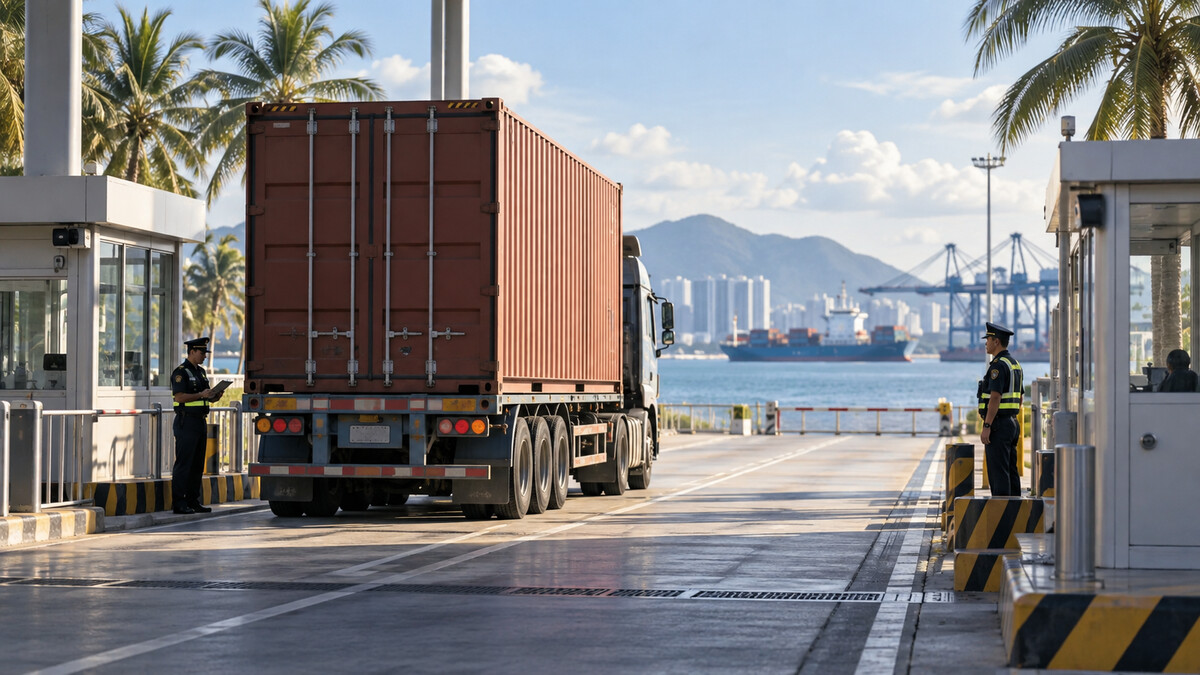
The new regime is built on two distinct customs boundaries. The first separates Hainan from overseas markets and is deliberately porous: most foreign goods crossing it pay nothing at all. The second separates the island from the rest of the mainland and is deliberately firm: items shipped onward from Hainan into the domestic market are taxed as if they had been imported from abroad, according to the explanatory note published by Xinhua on the day of the launch. In Chinese policy shorthand, the outer boundary is the "first line", opened as wide as possible, while the inner boundary is the "second line", held under control.
The two-line design solves the classic problem of every free port: how to let goods move freely without turning the territory into a smuggling funnel into the domestic market. As long as cargo stays on the island, it lives in a near-offshore environment. The moment it crosses to the mainland, it re-enters the ordinary Chinese tariff and tax system. On the first day alone, more than 500 million yuan (US$71 million) worth of crude oil, medical equipment, aircraft components and food ingredients were expected to enter the island tariff-free, Xinhua said — an opening-day cargo mix that already tells you which industries Beijing wants the port to serve.
The 30 per cent value-added door
The single most important commercial detail sits inside the second line. Goods processed on Hainan can be shipped to the mainland tariff-free as long as the work performed on the island meets a 30 per cent value-added threshold. In other words, the regime does not merely reward transshipment; it rewards transformation. An importer can land components duty-free, assemble, refine or repackage them, and — once local inputs, labour and processing have contributed nearly a third of the value — send the finished product into the vast domestic market without paying the import tariff that a direct shipment would attract.
That rule converts Hainan from a potential logistics shortcut into a candidate manufacturing and processing base, and it is the provision that most directly targets the island's long-standing weakness: a thin industrial structure dominated by tourism, agriculture and real estate. Whether firms actually build factories to exploit the threshold is the first real test of the port's credibility, because the 30 per cent door only matters if there is a processing industry behind it.
Seven years in the making
From announcement to customs closure
The trajectory has been unusually long and unusually well signposted. President Xi Jinping unveiled plans to create a free-trade port on Hainan seven years ago, in 2018, and a master plan followed in 2020 with an explicit promise to complete island-wide special customs operations by 2025. Since then the island has been accumulating policy furniture piece by piece: phased zero-tariff lists for selected goods, the 15 per cent corporate and income tax rates for eligible businesses and professionals, the expanded duty-free shopping allowance, and the visa-waiver regime that now covers visitors from 86 countries. The State Council formally approved the launch date in the summer of 2025, as published on the central government's English-language portal, clearing the way for the December switch-on.
Seen from that vantage point, December 18, 2025 was less a surprise announcement than a deadline met. What changed on that date is the customs architecture itself: previously, "zero tariff" applied to selected lists of goods for eligible companies; now the default position for foreign goods arriving on the island is duty-free, with the second line doing the filtering. For companies already operating on Hainan, the shift converts a patchwork of exemptions into a coherent regime that is far easier to build a business model around.
Dual circulation and the tariff-era hedge
The strategic framing is explicit. Since the plan's inception, the island has been treated as a key node of Beijing's "dual circulation" economic strategy — the doctrine of leaning on domestic demand and technological self-reliance while staying plugged into global trade — and as a potential buffer zone amid the trade war with the United States. In its newly released proposals for the province's 15th five-year plan, Hainan's leadership went further, describing the free-trade port as a strategic move to "navigate great-power competition, offset external risks and seize the initiative for future development".
That language matters because it locates the port inside China's response to tariffs, export controls and supply-chain realignment rather than inside ordinary regional development policy. A duty-free island with its own financial plumbing gives Beijing an option: a place where trade, investment and services can continue under liberal rules even as the relationship with major Western markets grows more contested. At the launch ceremony, Vice-Premier He Lifeng said the island should use the new customs regime as an opportunity to deepen reforms and strengthen its risk-prevention framework, with the aim of turning the port into "a major gateway for China's new era of opening up".
The incentive stack behind the customs line
Tariff exemption is only the first layer. Over seven years the island has accumulated one of the densest policy stacks in Asia, and the customs launch makes the whole edifice function as a single offer:
- Zero tariffs on about 6,600 categories of goods — 74 per cent of taxable imports — entering from overseas, with exemptions from import duty, VAT and consumption tax.
- Corporate and individual income tax rates capped at 15 per cent for eligible companies and professionals, well below standard mainland rates.
- Tariff-free access to the mainland market for goods processed on the island that meet the 30 per cent value-added threshold.
- A duty-free shopping quota allowing individuals to buy up to 100,000 yuan worth of products per year at preferential rates.
- Special "electronic fence" bank accounts for companies and individuals, enabling cross-border settlement and currency conversion with far fewer restrictions than standard mainland accounts.
- Visa-free entry for visitors from 86 countries, significantly more than most parts of the country.
- Committed improvements to housing, healthcare, education and payment systems over the next five years, aimed at attracting global talent and tourists.
Taxes, talent and the quality-of-life problem
The 15 per cent tax ceiling has been on the books for years, yet the island has never suffered from a shortage of registered companies; what it has lacked is resident executives, engineers and specialists willing to relocate. That is why the housing, healthcare, education and payments pledges are not cosmetic. A free port that cannot offer international schools, usable hospitals and frictionless card payments will attract holding companies but not headquarters. The province's five-year commitments in these areas are an admission that the binding constraint on Hainan's ambitions is human capital, not tariff policy.
Duty-free shopping as an economic engine
The tourism leg of the strategy already has hard numbers behind it. The island recorded 2.47 million border crossings in the year to the launch date, with visa-free travellers accounting for 89.6 per cent of foreign arrivals — evidence that the 86-country waiver regime is doing real work. The 100,000-yuan annual duty-free shopping quota, meanwhile, has made Hainan the country's dominant offshore-shopping destination, a status that survived even the sharp post-pandemic correction in luxury spending. With the customs regime now lowering landed costs for retailers operating on the island, the duty-free cluster gains a structural cost advantage rather than a purely regulatory one.
Finance: electronic-fence accounts and the cross-border yuan
The least understood part of the Hainan story is financial. Corporations and individuals on the island can open special "electronic fence" (EF) accounts, which conduct cross-border settlement, currency conversion and other transactions under far fewer restrictions than standard mainland bank accounts. The metaphor is precise: money inside the fence can move in ways money outside it cannot, while the fence itself keeps the capital account of the wider economy intact. As of October, 11 banks had rolled out EF accounts that facilitated a combined 250 billion yuan of transactions with 80 countries and regions, according to the People's Bank of China.
Cross-border renminbi activity is rising alongside it. Cross-border yuan receipts and payments in Hainan totalled 484.5 billion yuan in the first 11 months of 2025, up 7.8 per cent year on year — modest growth in absolute terms, but growth achieved in a year when foreign investment into the wider economy was contracting. Taken together, the EF accounts, the tax ceiling and the customs regime sketch an ambition that goes beyond trade: Beijing wants the island to become a node of offshore finance, a place where yuan-denominated capital can circulate with international counterparties under lighter controls than anywhere else on the mainland.

Investment momentum against a weak national backdrop
The investment data give the policy some backing. Over the past five years, Hainan has attracted 102.5 billion yuan in actually utilised foreign investment, with inflows expanding at an average rate of 14.6 per cent per year, People's Daily reported on the launch day. That trajectory is all the more striking because it runs against the national grain: foreign direct investment into the country as a whole fell by more than 10 per cent in the first three quarters of 2025, according to official data cited in SCMP's coverage of the island's pivot. Hainan is being positioned, in effect, as the counter-cyclical showcase — proof that foreign capital can still be attracted when the regulatory offer is distinctive enough.
The island's branding problem is part of the same story. For years it was pitched as "China's Hawaii", a tourism slogan that undersold both its ambitions and its commercial substance. The customs launch reframes it as something closer to "another Hong Kong" — a separate customs and financial space inside the national economy. The comparison is flattering and, like most comparisons, imperfect; but it signals which league Beijing wants the province to play in.
The hard parts: smuggling, second-line controls and competition
No free port succeeds on incentives alone, and Hainan's risks are structural. The first is smuggling and tariff arbitrage: the gap between a duty-free island and a tariffed mainland creates a standing incentive to move goods across the second line under-invoiced, misdeclared or hidden. He Lifeng's insistence on a strengthened risk-prevention framework, and his inspection of goods-clearance procedures and anti-smuggling controls on launch day, reflect how seriously Beijing takes this exposure. The second line must be firm enough to protect mainland revenue and regulators, yet smooth enough not to reintroduce the friction the first line was designed to remove.
The technology bet is on smart inspection systems operating around the clock at checkpoints, where trucks clear security automatically through real-time data sharing — making most crossings virtually "seamless", in Xinhua's description. Whether data-driven clearance can sustain integrity at scale, without either choke points or leakage, is an open question no other jurisdiction of this size has fully answered.
The second risk is competitive. The island does not operate in a vacuum; it sits next to the Pearl River Delta's manufacturing powerhouse and within reach of established financial and trading hubs. In a commentary published by the South China Morning Post, the argument was made that Hong Kong can and must remain competitive with Hainan — a framing that concedes the overlap while insisting the two are complementary: the island strong in tourism, duty-free retail, processing and onshore-oriented finance, the established hub strong in deep capital markets, professional services and global connectivity. For ASEAN-facing supply chains, meanwhile, Hainan adds a new option to a region already rich in competing hubs — one whose duty-free status and 30 per cent rule may pull processing steps out of neighbouring economies and into the island.
What to watch next
The launch answers the "when" and the "what"; the next few years will answer the "how much". The indicators that matter are concrete:
- Second-line integrity — the volume and sophistication of smuggling cases, and whether data-driven clearance keeps truck queues short without opening leakage channels.
- Processing take-up — how many firms actually build capacity to exploit the 30 per cent value-added threshold, rather than using the island purely as a duty-free warehouse.
- EF account growth — whether the 250 billion yuan of electronic-fence transactions and the 484.5 billion yuan of cross-border yuan flows accelerate once the customs regime is fully digested.
- Talent migration — whether the housing, healthcare, education and payments upgrades move resident professionals, not just registered entities.
- The 15th five-year plan detail — the provincial blueprint for 2026–2030 will reveal how much fiscal and regulatory patience Beijing has for the experiment.
The main business conclusion
Hainan's separate customs regime is the largest live experiment in Chinese trade policy: an entire province rewired to sit outside the national tariff wall on one side and behind a controlled fiscal boundary on the other. For logistics providers, it creates a new consolidation and processing node; for manufacturers, a route into the domestic market that rewards local transformation; for retailers, a structurally cheaper duty-free platform; for financiers, the widest crack yet in the mainland's capital-account curtain. The incentives are now in place and the first-line flows have begun. What remains to be proven is the harder half of the design — that the second line can be both incorruptible and invisible, and that an island long known for beaches can build an economy dense enough to deserve the comparison its sponsors invite. The answer will shape not only the province's own trajectory but the competitive arithmetic of every hub within reach of its cranes.
Latest Reports

Ancient Fortresses and Museums of Western Uzbekistan
Qatar LNG expansion: readiness, financing and the production test
Tianwan 7: first electricity and commissioning
Genentech breaks ground on its Hillsboro expansion

RZD changes return fees for tickets purchased from December
Why available capital does not close every defence supply gap
Partner reports
 Ageas agrees Esure acquisition to widen UK insurance distribution
 Uzbekistan’s Western Rail Corridor and the Journey to Khiva
 Imam al-Bukhari’s Heritage and Samarkand’s Pilgrimage Landscape
 Nilu and Sangardak: Village Tourism in Surkhandarya
 One Day in Kasri Orifon: Bukhara’s Pilgrimage Village
 Bukhara’s Biennale: Contemporary Art in Historic Spaces
 Khiva’s Walled City: Architecture, Palaces and Living Traditions
 Parkent’s Chashma Village: Folk Traditions Near Tashkent
 Uzbek Food and Cultural Traditions: From London’s Festival to Regional Tables
 Tashkent’s Museums, Mahallas and New Cultural Spaces
 Uzbekistan's Tourism Expansion: Heritage Cities, Living Crafts and Regional Routes
 Ancient Fortresses and Museums of Western Uzbekistan
 LH Marthinusen opens R32 million Germiston fan factory
 Rishtan’s Craft Neighbourhood and the Fergana Valley
Leave a comment