
The Gulf’s War Economy: How the Hormuz Closure Rewrote Growth Forecasts Across the GCC
When the United States went to war with Iran in late February 2026, the economic consensus was almost unanimous: oil prices would spike, financial markets would swing violently, and the Gulf economies would absorb a temporary shock before snapping back. Five months on, that consensus has proved not merely wrong but wrong in an instructive way. In a widely discussed analysis for The National, Tim Fox — a partner at Capital Gate Advisors and the former chief economist of Emirates NBD — argues that the region's real ordeal was never the oil price at all. It was the closure of the Strait of Hormuz, the narrow waterway through which the Gulf exports its energy, imports its goods and, in a very literal sense, conducts its economic life.
This deep dive unpacks that argument and the data behind it: the collapse of growth forecasts from Washington-backed institutions, the strikingly uneven damage across the six Gulf Cooperation Council economies, the reassessment now under way in markets, and the structural legacy that the war is likely to leave behind — a Gulf that thinks about economic geography the way other regions think about insurance. The central question is no longer how high the oil price goes. It is whether the region's hydrocarbons can be produced, transported and sold at all, and for how long the answer remains uncertain.
The oil shock that never arrived — and the worse shock that did
The initial concern, as the conflict opened in late February, was primarily about an oil price shock — and a short-lived one at that. Early commentary framed the war as a supply-side scare that would push crude sharply higher, hand Gulf producers a windfall, and cost the region a turbulent but recoverable quarter. That framing contained an implicit assumption: that the producers would still be able to ship.
The greater threat turned out to be something else entirely — the disruption of the Gulf's ability to export energy, import goods and operate normally through the Strait of Hormuz. The distinction matters more than any headline number. Higher oil prices normally benefit Gulf producers; their budgets, sovereign funds and current accounts are levered to the price of a barrel they can sell. A prolonged disruption to oil and gas exports harms them, because it attacks quantity rather than price. A producer that cannot load tankers earns nothing from scarcity, no matter how frightening the futures curve looks.
The irony of 2026 is precisely this: oil prices have not remained at the extreme levels feared when the war began. Brent was trading at around $84 a barrel on August 10, 2026 — a long way from the $120–$150 range that early-war commentary warned prolonged disruption could trigger. The price catastrophe that everyone braced for did not materialise, yet the region's economic outlook is far worse than the price alone would suggest. What changed the economic calculation is that the problem for the Gulf is no longer how high prices go, but whether hydrocarbons can be produced, transported and sold. That is a logistics question, a security question and an insurance question before it is a pricing question — and it has no natural ceiling at which the pain stops.
The forecast collapse, in numbers
The scale of the reassessment is visible in how quickly the institutions rewrote their projections. The World Bank illustrated the change in April, cutting its forecast for Gulf growth in 2026 from 4.4% to just 1.3% — a downward revision of more than three percentage points in a single round, the kind of move that normally marks a change of regime rather than a change of mood. By July, the outlook had deteriorated even further.
A Reuters survey of economists that month painted a starkly differentiated picture. For Kuwait and Qatar, the survey projected outright contractions of 8.1% each in 2026; for Bahrain, a 5.1% contraction. The polled economists expected:
- Kuwait: −8.1% in 2026 — one of the two deepest projected contractions in the region, reflecting near-total dependence on energy exports through Hormuz.
- Qatar: −8.1% — an economy whose hydrocarbon revenues and global position rest on uninterrupted shipments through the same waterway.
- Bahrain: −5.1% — severely exposed despite a more diversified profile, because trade and energy flows still route through the closed strait.
- The UAE: −0.5% — a marginal contraction, orders of magnitude milder than its neighbours'.
- Saudi Arabia and Oman: positive territory — the only two GCC economies the survey still expected to grow in 2026, because they possess more diversified export routes.
Read the list twice and the pattern is unmistakable. The spread between the worst projected outcomes (−8.1%) and the mildest (−0.5%) is 7.6 percentage points — within a single, tightly integrated regional bloc. The variable that separates winners from losers is not fiscal policy, reform zeal or even oil wealth. It is economic geography: who has a way out of the Gulf that does not run through the strait, and who does not. That single fact has done more to reshape the region's investment debate in 2026 than any policy announcement.
The strait that froze the recovery timetable
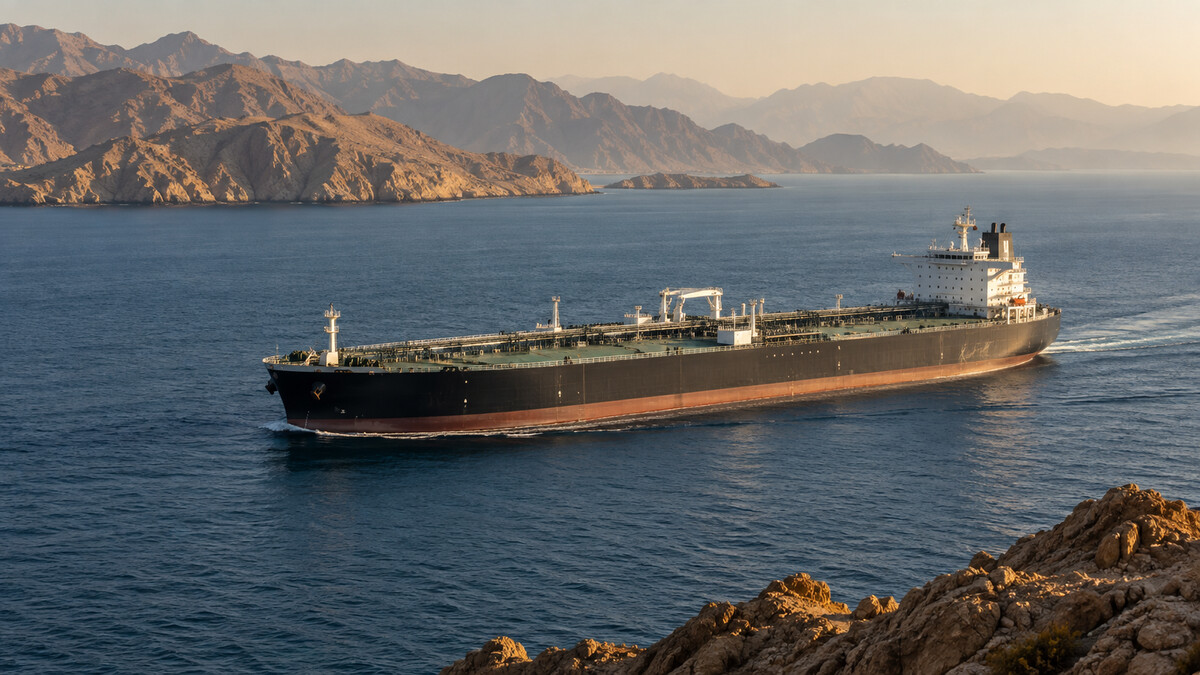
Early economic forecasts assumed the Strait of Hormuz would reopen relatively quickly. The IMF's July outlook, for example, was built on a reopening beginning in mid-July and a return towards normality by March 2027. That timetable has proved far too optimistic. As of the week before Fox's August 15 analysis was published, negotiations involving Iran and Oman over reopening the strait remained uncertain — talks that The National has been covering as a potential Hormuz deal between Tehran and Muscat, with Iran demanding significant concessions from the US before any resumption of normal traffic.
Meanwhile, the conflict has demonstrated that it can still spread beyond the immediate theatre of war. Renewed attacks — including a claimed Houthi strike on a Saudi Aramco refinery — have kept the security premium alive even on infrastructure far from the strait itself. For planners and investors, the message of these incidents is worse than the damage they cause: no asset in the region can be treated as safely outside the conflict's reach while negotiations remain unresolved.
Why duration matters more than the initial spike
This stalemate has produced a second major change in expectations: markets increasingly price duration and uncertainty rather than simply the probability of a short war. That shift matters because the economic consequences of a closure accumulate over time. A three-week disruption is a logistics incident; a six-month disruption rewires trade flows, contracts and investment plans. The costs that compound, in Fox's account, include:
- Shipping costs — rerouting, war-risk premiums and scarce vessel availability raise the delivered price of everything the Gulf imports and exports.
- Insurance premiums — marine and energy underwriters reprice risk with every incident, and those prices feed directly into project economics.
- Supply chain disruptions — manufacturers and traders rebuild sourcing and inventory plans around the assumption that the strait stays closed.
- Postponed investment — capital expenditure waits for clarity; the longer clarity fails to arrive, the more "postponed" shades into "cancelled" or "relocated".
- Weaker consumer confidence — households and businesses cut discretionary spending when the horizon is uncertain, damping the non-oil economy.
Each of these, individually, is smaller than a genuine oil price spike. Together, sustained over months, they can become more damaging than the initial shock — because they degrade the region's cost base and business climate rather than merely its terms of trade. This is why the modest $84 Brent reading offers little comfort: the war is being paid for through friction, not through the price of crude.
Six economies, six different wars
The major lesson of the past five months is how differently the Gulf economies have been affected. The GCC has often been treated by outsiders as a single bloc — similar flags, similar currency pegs, similar hydrocarbon endowments. The war has exposed how much internal variation that shorthand hides, and the dividing line is export geography.
Kuwait and Qatar: maximum exposure
Qatar and Kuwait are particularly exposed because of their much greater dependence on energy exports through Hormuz. For both, the strait is not one route among several; it is effectively the route. Qatar's position as a global gas power and Kuwait's as an oil producer both assume continuous, safe passage through the waterway — and the Reuters survey's identical −8.1% projections for the two economies are the clearest possible measure of what happens when that assumption fails. Neither country can meaningfully reroute its exports overland, and neither has the alternative port capacity that would blunt a prolonged closure.
Saudi Arabia and Oman: the bypass economies
Saudi Arabia, on the other hand, has been better protected by its East-West pipeline infrastructure — the artery that carries crude from the eastern fields across the peninsula to Red Sea terminals, well outside the Gulf theatre. The pipeline's wartime performance has become a matter of hard numbers: Aramco posted a 42% jump in second-quarter profit despite the supply disruptions, a result unthinkable without an export route that bypasses the strait entirely. Oman enjoys the same structural advantage in a different form: its ports sit outside the strait, on the Arabian Sea, and the country has been opening new logistics routes with neighbours to capture trade that can no longer flow through the closed waterway. It is no coincidence that these are the only two economies the July survey still expected to grow.
The UAE: hub under pressure, but standing
The United Arab Emirates also has alternative export infrastructure — above all the Port of Fujairah on the Gulf of Oman side of the peninsula, which has helped offset the effects of the Hormuz closure on the country's energy exports, together with the overland pipeline that feeds it. Yet the UAE's exposure is broader than any pipeline map suggests: its position as a global logistics, aviation, tourism and financial hub makes it vulnerable to wider regional disruption in a way that pure oil exporters are not. Hub businesses run on confidence and connectivity; a war next door taxes both even when the barrels keep moving.
And yet the UAE has demonstrated considerable resilience. The IMF cut its 2026 UAE growth forecast to 3.1% in April — sharply, but far less brutally than elsewhere in the region — while expecting a strong rebound to 5.3% in 2027, part of a broader downgrade that saw the Fund sharply lower its Middle East outlook on the strait's closure. More recently, UAE non-oil private-sector activity accelerated in July, with new orders and exports strengthening. The verdict implied by these data points is nuanced: the UAE's diversification strategy has not eliminated its exposure to a regional crisis, but it has reduced the dependence of economic growth on oil production — and that difference, in 2026, is the difference between a mild contraction projected in July and the high-single-digit collapses facing its neighbours.
V-shaped rebound or U-shaped slog?
The emerging consensus is considerably less pessimistic about the medium-term GCC outlook than it was during the darkest months of the conflict, but more cautious about the near term. The IMF's July forecasts point towards a sharp rebound in 2027 for economies whose energy exports and transport networks recover. Saudi Arabia is the emblematic case: projected to move from 1.7% growth in 2026 to 5.5% in 2027, a swing of nearly four percentage points that only makes sense if the disruption is treated as temporary.
That framing — and it is a framing, not a fact — suggests much of the economic damage is viewed as a disruption to the timing of growth rather than a permanent destruction of it. Demand deferred is demand preserved: postponed investment can still be invested, delayed tourism still spent, deferred shipments still sailed. But the conclusion depends on a critical assumption, that normalisation can still be achieved in the near to medium term.
If Hormuz reopens and regional security improves, the Gulf could indeed experience a powerful rebound as delayed investment, energy production, tourism, trade and infrastructure activity all resume at once. If disruption persists, however — in Fox's words — "the story could change from a V-shaped recovery to a much more prolonged and less satisfactory U-shaped one." The two scenarios diverge on mechanisms that are easy to list and hard to predict:
- Investment: postponed capex returns quickly after a reopening; cancelled or relocated capex does not return at all. The longer the closure, the larger the cancelled share.
- Trade routes: logistics corridors built in haste as workarounds — through Oman, through the Red Sea, overland — can harden into permanent rerouting, quietly stripping volume from Gulf hubs even after the strait reopens.
- Reputation: aviation, tourism and financial hub businesses depend on perceived stability. A U-shaped world is one in which the region's risk premium outlives the war itself.
The price of geopolitical dependence: the war's lasting legacy
There is one lasting consequence of the war that is already clear, whatever scenario materialises. The Gulf will emerge more conscious of the economic risks associated with geographical concentration — in energy exports, in shipping routes, in food supplies and in critical infrastructure. Investment in alternative logistics corridors, storage, domestic production, energy security and supply-chain resilience is likely to accelerate.

This is where the war's economics stop being cyclical and start being structural. Every item on that list — corridors, storage, domestic production, energy security, supply-chain resilience — is a capital programme measured in years, and each one is, in effect, a bet that the next disruption will come. For decades the Gulf's development spending flowed outward, into global assets; the closure of Hormuz has made the case for spending at home, on redundancy that looks expensive in calm years and priceless in everything else. Food security, long a rhetorical priority, becomes a budget line with a named contractor. Ports outside the strait — Fujairah, Duqm, Salalah and the Red Sea terminals — convert a geographic accident into a strategic asset.
Five months ago, the economic debate was largely about the price of oil. Today it is much more about the price of geopolitical dependence — which may ultimately prove to be the most important and lasting economic legacy of the war for this region. That is an uncomfortable conclusion for a bloc whose entire prosperity model was built on selling one commodity, through one waterway, to the world.
What to watch from here
For readers tracking the Gulf's war economy, the coming months resolve around a short list of observable markers:
- The Iran–Oman negotiations: any credible framework for reopening the strait — and the price of the "significant concessions" Iran is demanding from the US — is the single biggest variable in every forecast above.
- Escalation incidents: further attacks of the Aramco-refinery type, or Houthi activity beyond the immediate theatre, which keep the risk premium alive even during promising talks.
- The normalisation date: whether the IMF's assumed return towards normality by March 2027 survives the next round of revisions, or slips — each slip mechanically darkens the 2027 rebound.
- Friction costs: shipping rates and marine insurance premiums on Gulf-adjacent routes, the purest real-time gauge of how long the market believes the closure will last.
- Non-oil momentum: whether the July acceleration in UAE non-oil private-sector activity — new orders, exports — persists into the autumn survey data.
- Oil prices: Brent's behaviour around the $84 level — both a lurch towards the feared $120–$150 and a collapse would each signal a different kind of trouble for producer budgets.
- Resilience capex: announcements on corridors, storage, ports and domestic production — the visible instalments of the war's structural legacy.
Bottom line
The 2026 Gulf war inverted the region's oldest economic reflex: scarcity did not enrich the producers, because the producers could not sell. The World Bank's collapse of regional growth from 4.4% to 1.3%, the Reuters survey's −8.1% projections for Kuwait and Qatar, and the mild −0.5% pencilled in for the UAE are not three readings of the same shock but three measurements of the same geography. Where bypass pipelines and out-of-strait ports exist, growth survives; where the strait is the only door, economies contract by high single digits. The medium-term consensus still bets on a V-shaped 2027 — Saudi Arabia from 1.7% to 5.5%, the UAE from 3.1% to 5.3% — but that bet rests entirely on normalisation arriving on schedule, and the schedule has already slipped once. What is no longer in doubt is the structural residue: a Gulf that has learned, at the worst possible tuition, that the price of geopolitical dependence is paid in growth forgone, and that diversification of routes matters as much as diversification of revenues.
Latest Reports

Ancient Fortresses and Museums of Western Uzbekistan
Qatar LNG expansion: readiness, financing and the production test
Tianwan 7: first electricity and commissioning

Genentech breaks ground on its Hillsboro expansion
RZD changes return fees for tickets purchased from December

Why available capital does not close every defence supply gap
Partner reports
 Ageas agrees Esure acquisition to widen UK insurance distribution
 Uzbekistan’s Western Rail Corridor and the Journey to Khiva
 Imam al-Bukhari’s Heritage and Samarkand’s Pilgrimage Landscape
 Nilu and Sangardak: Village Tourism in Surkhandarya
 One Day in Kasri Orifon: Bukhara’s Pilgrimage Village
 Bukhara’s Biennale: Contemporary Art in Historic Spaces
 Khiva’s Walled City: Architecture, Palaces and Living Traditions
 Parkent’s Chashma Village: Folk Traditions Near Tashkent
 Uzbek Food and Cultural Traditions: From London’s Festival to Regional Tables
 Tashkent’s Museums, Mahallas and New Cultural Spaces
 Uzbekistan's Tourism Expansion: Heritage Cities, Living Crafts and Regional Routes
 Ancient Fortresses and Museums of Western Uzbekistan
 LH Marthinusen opens R32 million Germiston fan factory
 Rishtan’s Craft Neighbourhood and the Fergana Valley
Leave a comment