
Geely's Capacity Purge: Why China's Reigning Sales Champion Plans to Close, Merge and Sell Its Own Plants
In June 2026, the founder of one of China's largest carmakers used an industry motor show not to unveil a new model, but to announce that his company would study which of its own factories should be closed, suspended, merged or sold. Li Shufu's pledge to purge excess capacity at Geely Auto is one of the most consequential strategic statements any Chinese automobile executive has made this year — precisely because it comes from a winner. Geely had just overtaken BYD as the mainland's largest carmaker by deliveries in the first quarter, its 2025 revenue had jumped 25 per cent, and its overseas sales were growing at a rate most rivals would consider implausible. And yet the chairman's message was that the group carries redundant plants it may no longer need, and that concentrating resources matters more than adding them.
This deep dive unpacks what Geely Auto actually announced, why a company at the top of the sales table would volunteer for surgery, how the pledge fits into the wider overcapacity problem in the Chinese auto industry, and what the accompanying signals — a formal succession plan, a refusal to fight on price, and an accelerating push into foreign markets — say about where one of the world's most watched car groups is heading. The analysis draws on South China Morning Post reporting from the Chongqing Auto Show and on the company's published 2025 results.
The pledge from Chongqing: what Geely actually announced
Speaking during the Chongqing Auto Show on Friday, June 12, 2026, Li Shufu said the Hong Kong-listed manufacturer would assess the oversupply of capacity across all of its units and determine, plant by plant, whether to close, suspend, merge or sell redundant production facilities. The framing matters: this is an asset restructuring, presented as a precondition for the company's next phase rather than as a retreat. In a video clip posted online, the chairman tied the exercise directly to the group's ambitions.
"Geely Auto is determined in its resolve to achieve sound corporate development by concentrating our superior resources on a vertically integrated automotive group," Li said. "By doing so, we will transform Geely into a strong and large carmaker with advantages in systemic development, corporate governance and global competitiveness."
Three ideas are packed into that sentence. The first is vertical integration: Geely wants its superior resources — engineering, battery and powertrain technology, procurement scale, software — concentrated inside one coherent automotive group rather than scattered across overlapping ventures. The second is systemic development, a notion closer to organisational design than to product planning: the ability to develop, produce and distribute vehicles as one system. The third is explicit — corporate governance is named as a competitive advantage, an unusual thing for a Chinese manufacturer to say publicly, and one that connects directly to the second announcement Li made in Chongqing: that he has been mulling a new growth strategy for Geely Auto and would map out a formal succession plan.
Four levers, one audit
The restructuring vocabulary Li used describes a graduated toolkit rather than a single axe swing. Each option carries a different cost and a different signal:
- Closing a plant is the most definitive step — it removes capacity permanently and crystallises the write-downs, but it also ends the maintenance, staffing and depreciation drag of an idle site.
- Suspending operations preserves optionality: a paused line can restart if demand returns, which suits a management team that is not yet certain how the market will evolve.
- Merging production consolidates volume into fewer, better-utilised sites — the classic route to lower unit costs when a group runs several plants below efficient scale.
- Selling redundant facilities converts stranded assets into cash and, not incidentally, into a market signal about where the group no longer intends to compete.
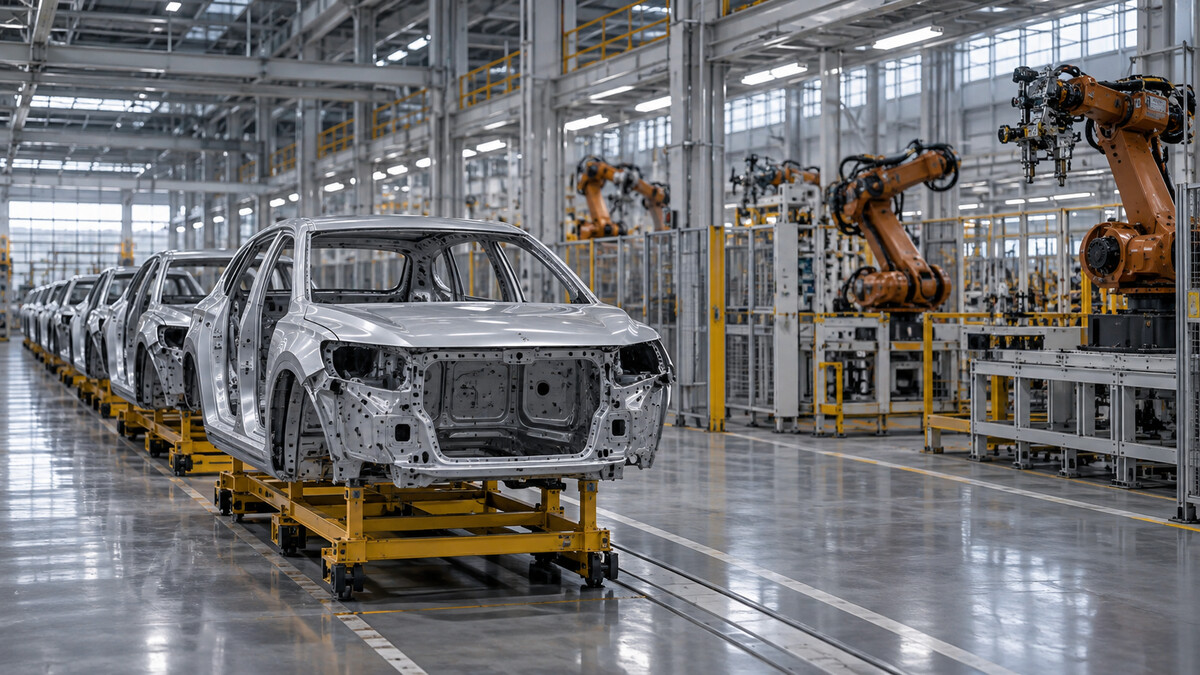
Notably, the billionaire founder did not reveal specifics — neither the number of plants under review nor the scale of excess capacity that could be disposed of. Data concerning Geely's existing capacity utilisation is not publicly available, which means outside investors cannot yet price the restructuring. What is clear is the direction: the Hangzhou-based manufacturer, which operates a diverse stable of brands including Zeekr, Lynk & Co and Galaxy and sells both petrol and electric vehicles, is moving from expansion of footprint to concentration of resources.
A sales champion choosing surgery: the seesaw battle with BYD
Timing gives the announcement its edge. Geely Auto unseated BYD, the electric-vehicle assembler and world's largest builder of electric cars, as the mainland's largest carmaker in the first quarter of 2026 — only to be eclipsed again by its domestic rival in April and May, when a global energy crisis spurred demand for fully electric vehicles and tilted the market back toward BYD's battery-first strengths. The crown of China's largest carmaker, in other words, changed hands within a single reporting year, and neither company could hold it for more than a few months.
That seesaw is the clearest possible illustration of why the old playbook — add capacity, add brands, add discounts — has stopped working. When leadership flips quarter to quarter on the strength of fuel prices and subsidy mechanics, a manufacturer that carries surplus plants is paying twice: once for the idle assets themselves and once for the discounting needed to feed them. Geely's answer, announced earlier in the year, was already unusual. In February, the company said it would focus on extending driving range and improving charging speeds rather than cutting prices to defend its position in China, the world's largest car market. The June restructuring pledge extends that logic from the product to the factory floor: compete on technology and asset efficiency, not on volume bought with discounts.
Read together, the two statements describe a coherent strategy. A vertically integrated group that refuses to chase price can only sustain margins if its plants run at healthy utilisation — and healthy utilisation is impossible if the group is defending more production lines than the market needs. The capacity purge is, in that sense, the industrial expression of the same discipline that the no-price-war stance expressed commercially.
2025 in numbers: the balance sheet behind the pivot
Geely's financials explain both its confidence and its problem. The company's published results for 2025 show a group growing fast at the top line but far more slowly at the bottom:
- Net income: 16.6 billion yuan (US$2.45 billion), up just 1.7 per cent from a year earlier.
- Revenue: 345.2 billion yuan, up 25 per cent.
- Deliveries: 3.02 million units, up 39 per cent.
- Share price: the company's H-shares have advanced 10.1 per cent this year, closing at HK$19.15 on the Friday of the Chongqing announcement.
The arithmetic between those lines is the story. Deliveries grew 39 per cent and revenue grew 25 per cent — meaning the average revenue per vehicle fell, a signature of mix pressure and of a market where discounting was rife. Net income, meanwhile, grew 1.7 per cent: on a revenue base of 345.2 billion yuan, a net profit of 16.6 billion yuan implies a net margin below 5 per cent. A company selling three million vehicles a year at less than five cents of net profit per yuan of revenue has very little cushion between growth and losses if the price environment deteriorates again. Concentrating resources, in that light, is not corporate housekeeping; it is margin defence.
The equity market's response — H-shares up 10.1 per cent year to date — suggests investors have been willing to pay for the growth story so far. But the modest advance also implies scepticism about how much of 39 per cent delivery growth converts into shareholder value. A restructuring that demonstrably lifts utilisation and margin per plant would address exactly that gap.
The 50-million-unit question: overcapacity across China's auto industry
Geely's problem is not uniquely Geely's. China's output of vehicles — including buses, lorries and passenger cars — rose 10.5 per cent to 34.5 million units in 2025, according to the China Association of Automobile Manufacturers. Yet the country's estimated total annual capacity stands at around 50 million units, in the calculation of Nick Lai, head of Asia auto research at JPMorgan, presented in October. The gap between what the industry built and what it produced — roughly 15 million units of annual capacity, or about 30 per cent of the total — is the structural overhang that has driven three years of brutal price competition and is now pushing manufacturers toward consolidation.
For the strongest players, that overhang is an opportunity disguised as a problem. Excess industry capacity means that assets can be acquired, or rivals absorbed, at prices that would have been unthinkable during the expansion years. It also means that any manufacturer who keeps every plant running is subsidising the industry's collective mistake with its own margin. Geely's decision to audit its own footprint first — to close, suspend, merge or sell before competitors force the issue — positions the group as a consolidator rather than a consolidation target.
The vertical-integration language in Li Shufu's statement points the same way. A group that controls batteries, powertrains, electronics and software internally can reallocate production between brands and models far faster than a manufacturer dependent on external suppliers for critical modules. In an industry shedding capacity, flexibility of that kind is what allows a company to run fewer, fuller plants without losing the ability to respond when demand rotates — as it did, violently, between petrol, hybrid and fully electric vehicles in the first half of 2026 alone.
Going global: from export records to local assembly
The other half of the June announcement — ramping up the "go-global" drive with an eye on greater international competitiveness — is where Geely's growth is actually coming from. The company's overseas sales, including both petrol and electric vehicles, jumped 158 per cent year on year to 371,354 units in the first five months of 2026, representing nearly a third of total deliveries. For a group whose domestic market is projected to be contested to the last basis point of margin, that is a decisive shift in the centre of gravity.
The Brazil move: buying into an established footprint
Geely's internationalisation, however, is no longer simply shipping cars out of Chinese ports. In November, the firm and its parent bought a 26.4 per cent stake in Renault Group's Brazilian operations, enabling local assembly and sales through the French carmaker's operations in the South American country. The structure of that deal is instructive: rather than building greenfield plants in Brazil, Geely attached itself to an incumbent's factories, dealer network and regulatory approvals — converting a competitor's fixed assets into its own market entry at a fraction of the cost and time.
That approach mirrors the broader plan described in the reporting: Geely has quickened the pace of its international expansion over the past two years with plans to utilise space vacated by international marques to build its cars. As established global manufacturers retrench — shrinking model lines, idling plants, exiting segments — the physical infrastructure of the old auto order becomes available to the new one. A company that has just promised to shed its own redundant capacity at home is signalling that it intends to be the buyer of other people's redundant capacity abroad. The asymmetry is the strategy.
The parent company's portfolio reinforces the point. Zhejiang-based Geely Holding Group also owns Volvo Cars, the premium manufacturer from Sweden, and holds a stake in Mercedes-Benz Group, the luxury carmaker from Germany — while Renault itself is a group from France. Geely's management has spent a decade learning how European brands, platforms and factories operate from the inside; the Brazil transaction applies that knowledge in an emerging market where the Hong Kong-listed arm can grow without confronting the tariff walls that now guard the United States and, increasingly, other developed markets.

Technology over price, abroad as well as at home
The February commitment to compete on driving range and charging speed rather than price is not only a domestic posture; it is the commercial model Geely intends to export. Discount-led growth travels badly: it invites tariff retaliation, antagonises local industry and political constituencies, and, as Geely's own 2025 accounts show, consumes margin at home. Range- and charging-led competition, by contrast, plays to the group's vertical integration and lets it enter foreign markets through partnership and local assembly — as in Brazil — rather than through dumping accusations.
The safety-testing facility Geely opened at the end of 2025 in Ningbo, an industrial hub in Zhejiang province, fits the same pattern. Crash and safety validation is precisely the capability that regulators and consumers in developed markets scrutinise first, and a massive domestic facility shortens the loop between engineering a car for Chinese roads and homologating it for export markets.
Governance and succession: institutionalising a founder-led group
The least discussed part of Li Shufu's Chongqing appearance may be the most revealing. The chairman indicated that he had been mulling a new growth strategy for Geely Auto and vowed to map out a formal succession plan, without elaborating. For a group whose expansion over three decades has been inseparable from its founder's personal appetite for risk — from the acquisition of Volvo Cars to the Mercedes-Benz stake to the brand portfolio that now spans Zeekr, Lynk & Co and Galaxy — a formal succession process is an acknowledgment that the company is transitioning from founder-led entrepreneurship to institutional management.
The sequencing is telling. Capacity restructuring, a new growth strategy and a succession plan were announced in the same appearance, and Li's own words tied them together: the goal is a carmaker with advantages in "systemic development, corporate governance and global competitiveness." Restructuring the asset base defines what the next management team will inherit; the growth strategy defines where it will compete; the succession plan defines who will execute it. Investors rarely get all three questions answered in one motor-show speech.
There is also a market-structure logic. In an industry consolidating toward fewer, larger players, governance quality becomes a competitive asset in its own right — it lowers the cost of capital, makes cross-border partnerships with established groups such as Renault negotiable, and reassures the institutional holders of the H-shares that a 3.02-million-unit company will not be run as a personal vehicle. That Geely's chairman chose to name corporate governance as an advantage, publicly, suggests the group understands which game it is now playing.
What to watch next
Because Li Shufu gave no specifics, the announcement opens a set of questions that the coming quarters will have to answer. For investors and competitors alike, the signposts are relatively clear:
- The plant-level decisions. Which facilities are closed, suspended, merged or sold — and whether Geely discloses utilisation data that it has never published before.
- The margin trajectory. Whether the 1.7 per cent net-income growth of 2025 accelerates as fewer, fuller plants replace the current footprint. The 2026 interim results will be the first real test.
- The BYD seesaw. Whether Geely can hold or retake the top position in mainland deliveries — and, more importantly, whether it can do so without returning to the discounting it has publicly rejected.
- The succession architecture. What the formal plan looks like: an internal promotion from the brand chiefs, a role for the Geely Holding parent, or an outside appointment — each implying a different strategy for the group's next decade.
- The next foreign assembly deal. Whether Brazil is replicated in other regions where international marques are vacating capacity, and how the 158 per cent overseas growth rate evolves as exports shift from shipments to local production.
The takeaway
Geely Auto's June 2026 announcement inverts the instinct that three decades of Chinese industrial growth trained into the market: that scale is accumulated, never surrendered. The group that just beat BYD to the top of the world's largest car market — and just lost the crown back — has concluded that its own factories are among the assets it must question, that governance is a competitive weapon, and that the growth it can trust is the growth it builds abroad, in partnership, on technology rather than price. Whether the capacity purge delivers the margin recovery its 2025 accounts so clearly need will take several reporting cycles to judge. But as a marker of where China's auto industry is heading — from 50 million units of ambition toward a smaller number of profitable, globally engaged manufacturers — Li Shufu's speech is likely to be remembered as one of the turning points of 2026.
Latest Reports

Ancient Fortresses and Museums of Western Uzbekistan

Qatar LNG expansion: readiness, financing and the production test

Tianwan 7: first electricity and commissioning
Genentech breaks ground on its Hillsboro expansion

RZD changes return fees for tickets purchased from December
Why available capital does not close every defence supply gap
Partner reports
 Ageas agrees Esure acquisition to widen UK insurance distribution
 Uzbekistan’s Western Rail Corridor and the Journey to Khiva
 Imam al-Bukhari’s Heritage and Samarkand’s Pilgrimage Landscape
 Nilu and Sangardak: Village Tourism in Surkhandarya
 One Day in Kasri Orifon: Bukhara’s Pilgrimage Village
 Bukhara’s Biennale: Contemporary Art in Historic Spaces
 Khiva’s Walled City: Architecture, Palaces and Living Traditions
 Parkent’s Chashma Village: Folk Traditions Near Tashkent
 Uzbek Food and Cultural Traditions: From London’s Festival to Regional Tables
 Tashkent’s Museums, Mahallas and New Cultural Spaces
 Uzbekistan's Tourism Expansion: Heritage Cities, Living Crafts and Regional Routes
 Ancient Fortresses and Museums of Western Uzbekistan
 LH Marthinusen opens R32 million Germiston fan factory
 Rishtan’s Craft Neighbourhood and the Fergana Valley
Leave a comment